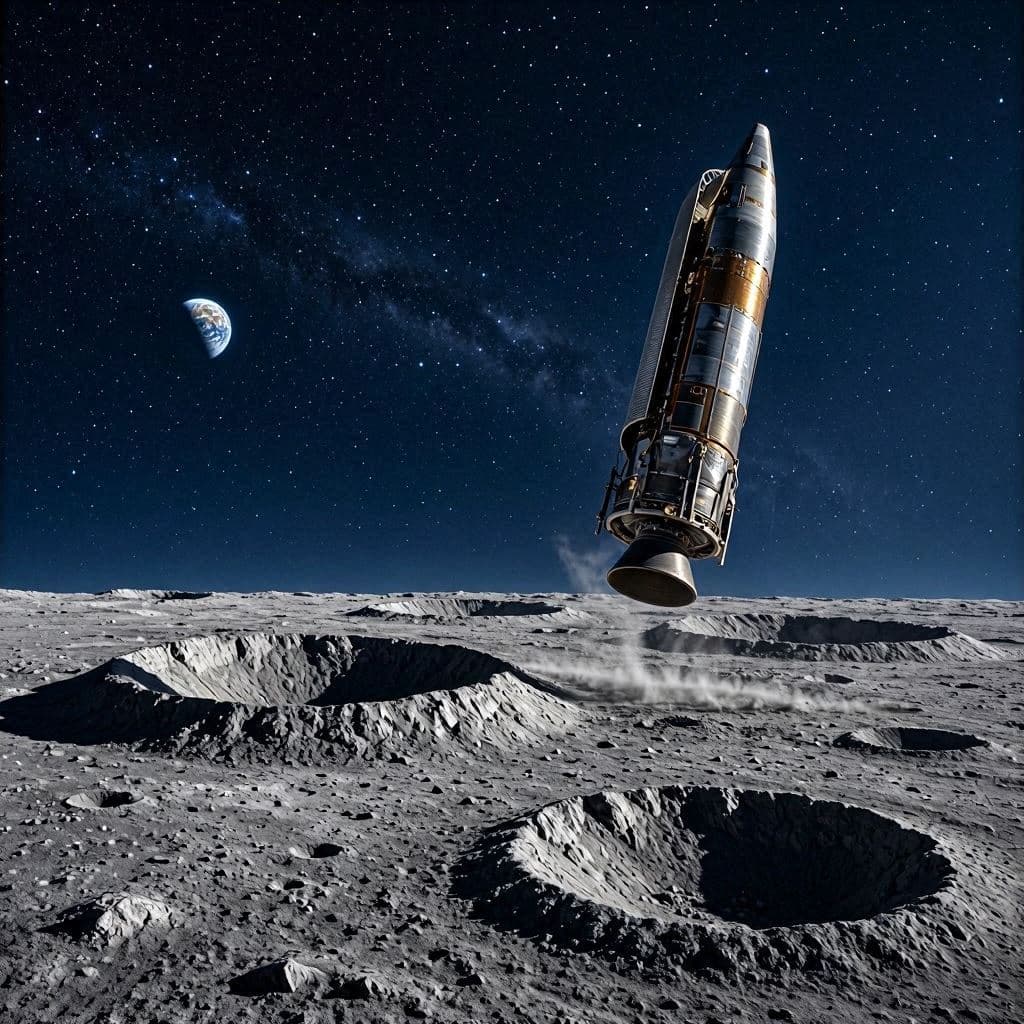
In the silent theater of space, where orbits are dictated by gravity and time, human artifacts often outlive their original purpose. A discarded upper stage of a SpaceX Falcon 9 rocket, launched in early 2025, is now on an unintended collision course with the Moon. Scheduled to impact on August 5, 2026, this event is not a planned scientific experiment but a consequence of orbital mechanics, offering a rare, albeit accidental, glimpse into the dynamics of space debris and lunar geology.
The rocket stage, weighing several tons, has been drifting through space for over a year since its mission to deliver payloads to lunar orbit. Without propulsion or guidance systems active, it has become a passive object subject to the gravitational pulls of the Earth, Moon, and Sun. Astronomers have tracked its trajectory with precision, predicting that it will strike the lunar surface at a speed of approximately 5,400 miles per hour. The impact is expected to occur near the equator, creating a new crater and ejecting a plume of dust and regolith.
While the collision poses no threat to Earth or any operational spacecraft, it highlights the growing issue of space junk. As commercial spaceflight expands, the number of defunct stages and satellites in orbit increases, raising concerns about long-term sustainability. This incident serves as a reminder of the need for responsible end-of-life planning for space hardware, including de-orbiting strategies that minimize the risk of uncontrolled reentries or impacts.
For scientists, the impact presents an unexpected opportunity. Although unplanned, the crash will generate seismic waves that could be detected by instruments such as NASA’s LRO (Lunar Reconnaissance Orbiter) or future landers. Analyzing the resulting crater and ejecta pattern can provide valuable data on the Moon’s surface composition and subsurface structure. It acts as a natural probe, revealing layers of material that have remained untouched for billions of years.
The public reaction has been mixed, with some expressing concern over the "littering" of space, while others view it as a fascinating astronomical event. Educational institutions and astronomy clubs are using the occasion to discuss orbital mechanics and the history of space exploration. It offers a tangible example of how objects move in space, making abstract concepts more accessible to students and enthusiasts alike.
SpaceX has acknowledged the situation, noting that the stage was left in a disposal orbit intended to avoid conflict with operational missions. However, the complex interplay of gravitational forces eventually led to this lunar encounter. The company continues to work on improving its de-orbiting procedures for future missions, aiming to reduce the footprint of its operations in cislunar space.
As the rocket stage approaches its final destination, the scientific community watches with interest. The impact on August 5 will be a brief but significant event, adding a new chapter to the Moon’s geological history. It underscores the importance of monitoring space debris and learning from every interaction between human technology and the celestial bodies we explore.
AI Image Disclaimer: The visual elements accompanying this report are AI-generated interpretations designed to illustrate the orbital and impact context of the story.
Sources: NPR The Guardian Project Pluto
Published by Banx Network. This article is part of the Banx decentralized media programme, powered by the BXE token on the XRP Ledger.