The universe is full of hidden giants, forces so massive they warp the very fabric of space yet remain invisible to the naked eye. In a recent discovery, astronomers have identified a dormant black hole lurking within an unusual system of three interacting galaxies. This finding sheds light on the complex dynamics of galactic mergers and the silent partners that influence their evolution. It is a reminder that even in the brightest clusters, darkness plays a crucial role.
Body: The discovery centers on a triple galaxy system where gravitational interactions have created a chaotic yet fascinating environment. Using advanced observational techniques, scientists detected the presence of a black hole that had remained hidden due to its lack of active accretion. Unlike quasars, which shine brightly as they consume matter, this black hole was quiet, revealing itself only through its gravitational influence on surrounding stars and gas.
The detection was made possible by analyzing the motion of stars near the center of one of the galaxies. Their erratic orbits suggested the presence of a massive, unseen object. By combining data from multiple telescopes, including X-ray and optical instruments, researchers were able to confirm the black hole’s existence and estimate its mass. This multi-wavelength approach is essential for uncovering such elusive cosmic entities.
Triple galaxy systems are rare and provide unique laboratories for studying gravitational physics. The interaction between the three galaxies creates tidal forces that can strip stars and gas from their hosts, feeding the central black holes. In this case, the hidden black hole appears to be influencing the flow of material, potentially affecting the formation of new stars in the region.
This discovery challenges existing models of black hole growth. Traditionally, it was thought that black holes grow primarily through active accretion during mergers. However, the presence of a dormant black hole in such a dynamic system suggests that other mechanisms, such as direct collapse or minor mergers, may play a significant role. It adds nuance to our understanding of how these cosmic monsters evolve over time.
The findings also have implications for the search for gravitational waves. As galaxies merge, their central black holes may eventually collide, producing ripples in spacetime. Identifying dormant black holes in multi-galaxy systems helps astronomers predict where such events might occur, guiding future observations with detectors like LISA. It is a step toward mapping the hidden history of the universe.
For the scientific community, this discovery is a triumph of patience and precision. It highlights the importance of looking beyond the obvious, using subtle clues to reveal the unseen. The hidden black hole serves as a symbol of the mysteries that still await discovery in the depths of space.
Closing: As astronomers continue to probe the secrets of triple galaxy systems, each new finding adds a piece to the puzzle of cosmic evolution. The detection of this hidden black hole reminds us that the universe is far more complex than it appears. In the silence of space, there is much to be heard.
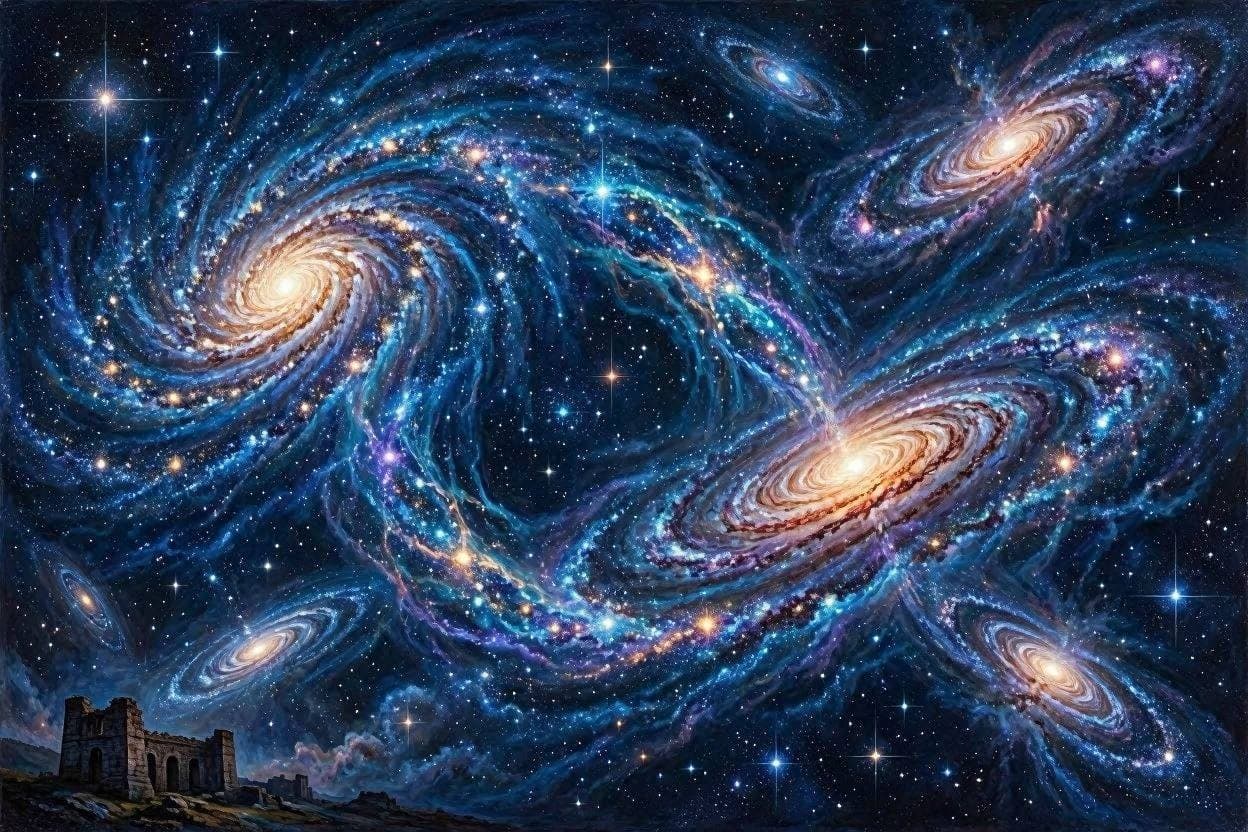
AI Image Disclaimer: Visuals in this article are AI-generated representations of galaxy interactions and black hole concepts, intended to illustrate the scientific context without depicting specific real-time data.
Sources: Phys.org Space.com European Southern Observatory (ESO) NASA Chandra X-ray Center
Published by Banx Network. This article is part of the Banx decentralized media programme, powered by the BXE token on the XRP Ledger.