The universe is expanding, a fact established nearly a century ago, but the force driving this acceleration remains one of cosmology’s greatest mysteries. Known as dark energy, this invisible influence is thought to make up roughly 68% of the universe’s total energy content. Now, a comprehensive study of 3,000 supernovas suggests that dark energy may not be constant, as previously assumed, but could be evolving over time. This finding has the potential to reshape our understanding of cosmic destiny.
Supernovas, particularly Type Ia, serve as "standard candles" in astronomy because their intrinsic brightness is well understood. By measuring how dim they appear from Earth, scientists can calculate their distance and, combined with redshift data, determine how fast the universe was expanding at different points in history. The Dark Energy Spectroscopic Instrument (DESI) collaboration analyzed data from thousands of these explosions, mapping the expansion rate across billions of years.
The results indicate a slight deviation from the standard Lambda-CDM model, which posits that dark energy is a cosmological constant—a fixed property of space itself. Instead, the data hints that the strength of dark energy may have changed over cosmic time. If confirmed, this would mean that the acceleration of the universe is not uniform, potentially leading to different future scenarios than the widely accepted "Big Freeze."
This possibility introduces a new layer of complexity to cosmological models. If dark energy evolves, it could imply the existence of new fields or particles that interact with gravity in unexpected ways. Theoretical physicists are already exploring modifications to general relativity and quintessence models, which propose a dynamic form of dark energy. The study provides empirical fuel for these theoretical fires, encouraging deeper investigation.
However, scientists urge caution. While the statistical significance of the findings is notable, systematic errors or unknown biases in the data could still explain the apparent evolution. Further observations and independent verification are necessary to rule out alternative explanations. The scientific process is one of rigorous scrutiny, and this result is a starting point for more detailed analysis rather than a final conclusion.
The implications for the ultimate fate of the universe are profound. If dark energy weakens over time, the expansion could slow down, possibly leading to a recollapse or a steady state. If it strengthens, the universe could face a "Big Rip," where galaxies, stars, and even atoms are torn apart. Understanding the nature of dark energy is key to predicting which of these scenarios, if any, will come to pass.
For the public, this research underscores the dynamic nature of scientific knowledge. What we consider fundamental truths today may be refined tomorrow as new data emerges. It is a reminder that the universe is still full of surprises, waiting to be uncovered by persistent inquiry and advanced technology. The story of the cosmos is still being written.
As DESI and other next-generation surveys continue to collect data, the picture of dark energy will become clearer. Whether it is constant or evolving, the quest to understand it drives some of the most innovative work in modern physics. It is a journey into the unknown, guided by the light of distant stars.
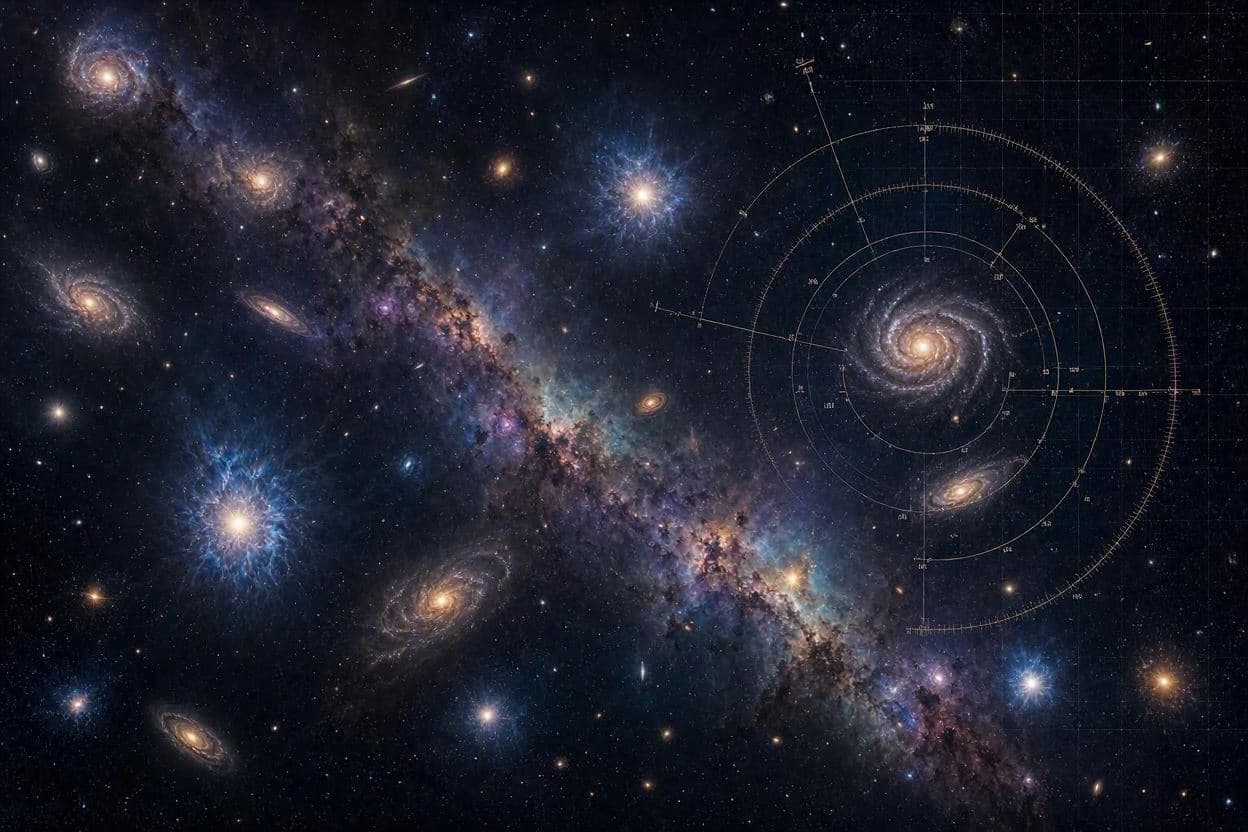
AI Image Disclaimer: The illustrations for this article are AI-generated to represent the concepts of cosmic expansion and supernova observations, using abstract and symbolic imagery rather than real astronomical data plots.
Sources: DESI Collaboration, Nature, ScienceDaily, BBC News
Published by Banx Network. This article is part of the Banx decentralized media programme, powered by the BXE token on the XRP Ledger.