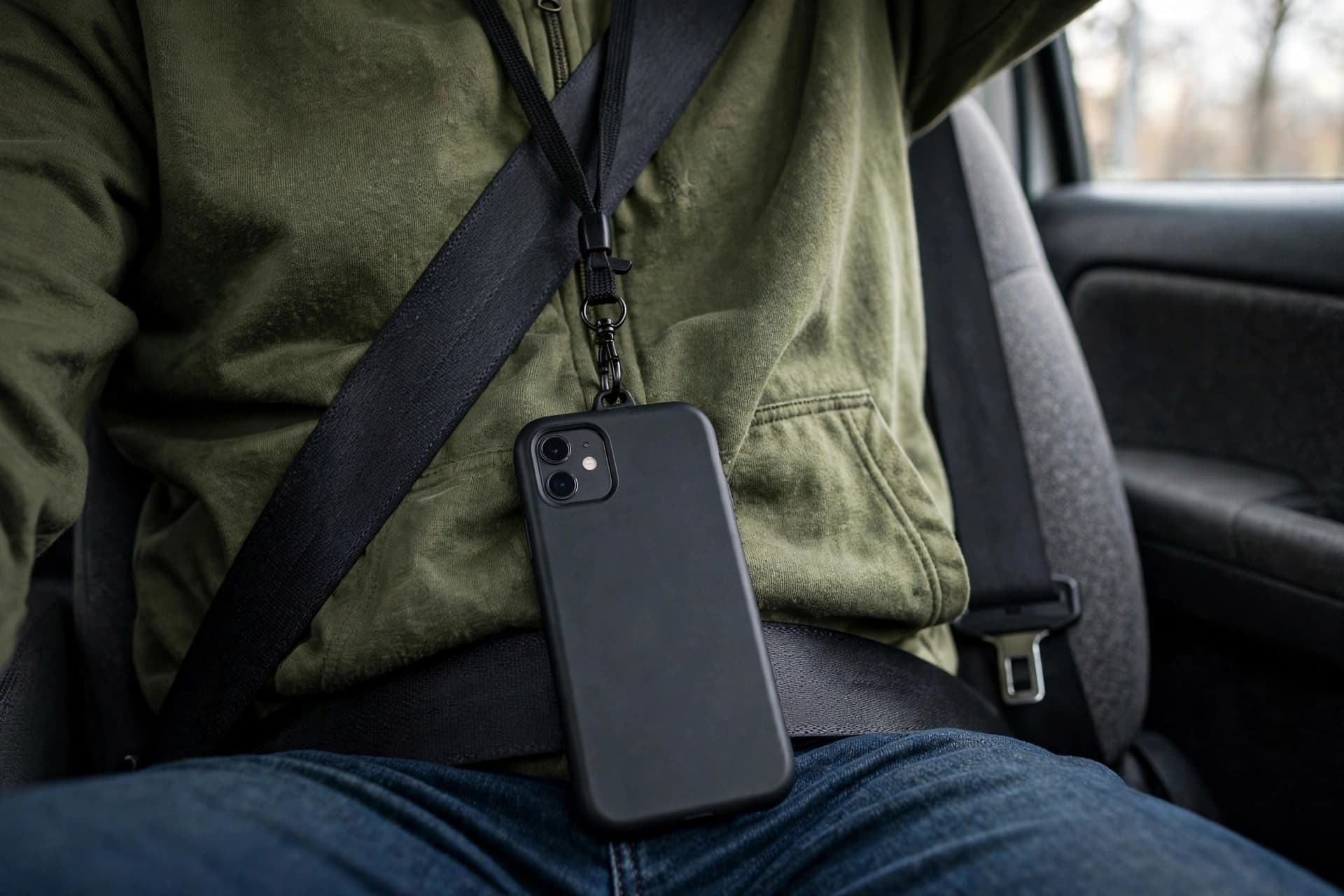
There is a particular frustration that comes with discovering a rule you never knew existed—one that seems to contradict common sense, or at least the version of it you carried in your head. For a driver in Queensland, that frustration arrived this September in the form of a $1,295 fine and four demerit points, all because a phone was hanging from a lanyard around her neck. She had not been using it. She had not even been holding it. But under the state’s road rules, having a phone anywhere on your person while driving is an offence.
The woman, from the Sunshine Coast, told Yahoo News she had no idea that wearing a phone on a lanyard—a common practice for people who want to keep their hands free—could result in such a penalty. The fine was issued after an AI camera detected the phone “on her body” . Her experience is not isolated. Queensland has some of the highest traffic fines in the country, and they continue to rise. As of July 1, penalties increased by 3.5 percent under the state’s annual indexation policy. A mobile phone offence now carries a $1,295 fine and four demerit points. Failing to wear a seatbelt correctly carries the same penalty .
The broader context is one of concern about driver behavior that persists despite increasingly severe financial consequences. Acting Inspector Paul Kelly of the Queensland Police Service recently described a case in which a 23-year-old man was caught speeding twice within ten minutes—first at 155 km/h in a 100 km/h zone, then at 90 km/h in a 60 km/h zone. His total fines for the day reached $3,108, and he accumulated twelve demerit points, resulting in a six-month licence suspension . Kelly called the behavior “disappointing” and “a complete disregard for the law” .
The Royal Automobile Club of Queensland has questioned whether higher fines are actually changing behavior. Michael Kane, the club’s public policy head, noted that road deaths have continued to rise despite substantial increases in penalties, suggesting that “simply raising fine amounts does not work” . The club has supported a comprehensive review of the penalty system, arguing that consistency and incentives for compliant road users may be more effective than ever-larger fines.
For the woman with the lanyard, the lesson was an expensive one. She told Yahoo News she was too afraid of the cost to appeal. Her story has prompted warnings from authorities that distracted driving—in any form—will not be tolerated. Whether the fines are the right tool for the job remains a question without a clear answer. But for now, the message from Queensland’s roads is unambiguous: the rules are the rules, and ignorance of them carries a price.
AI Image Disclaimer: The imagery accompanying this article was generated by artificial intelligence and is intended for illustrative purposes only, not as a documentary record of the events described.
Sources: Yahoo News Australia, Torquecafe.com, RACQ
Published by Banx Network. This article is part of the Banx decentralized media programme, powered by the BXE token on the XRP Ledger.