
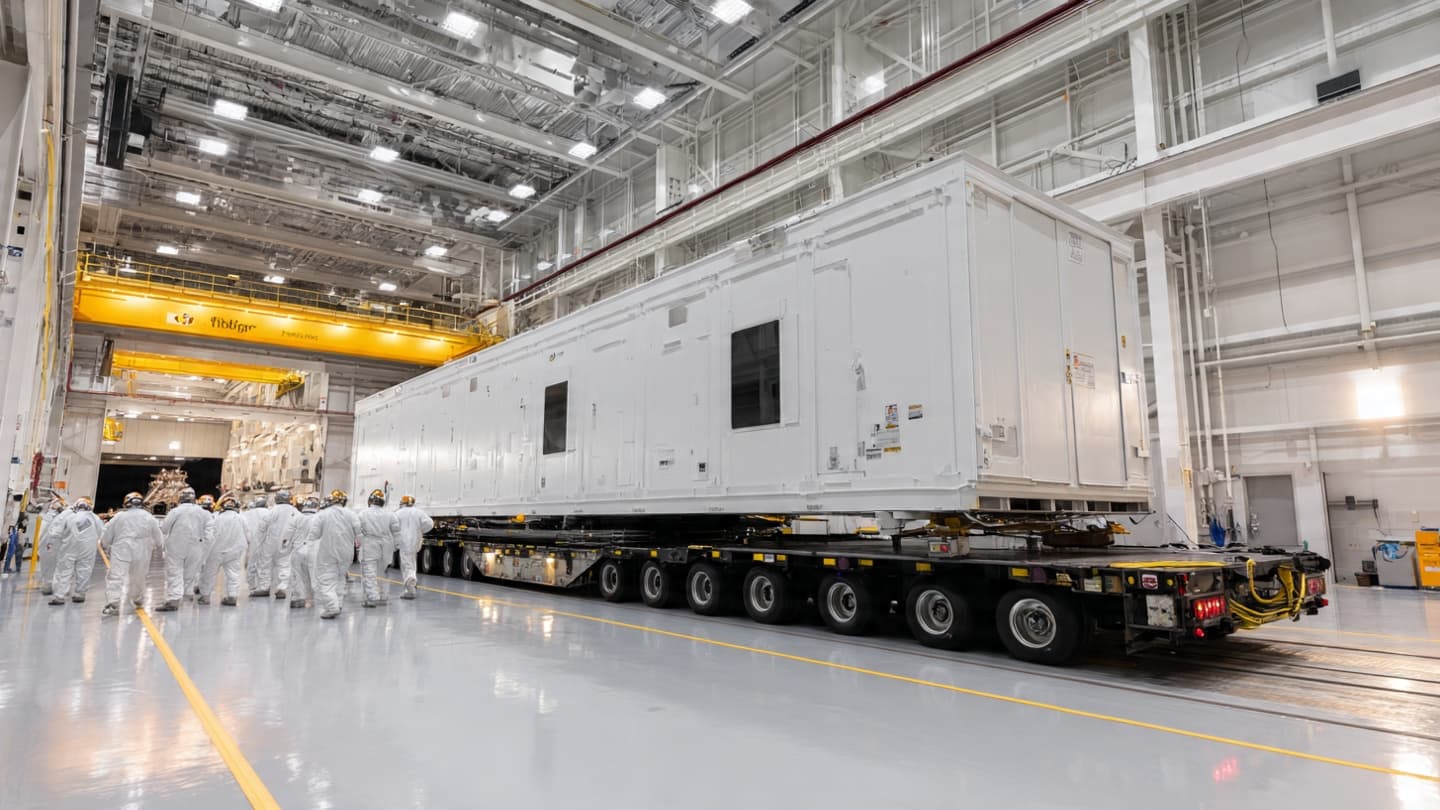
There are moments in space exploration when years of quiet engineering begin to gather momentum, much like a river finally reaching the sea. Such a moment has arrived for NASA's Nancy Grace Roman Space Telescope, which has now reached Florida as preparations continue for one of the agency's most anticipated astronomy missions.
The observatory recently arrived at NASA's Kennedy Space Center in Florida, where final testing and launch preparations will take place. The telescope, named in honor of astronomer Nancy Grace Roman, is designed to investigate some of the universe's most profound questions, including the nature of dark energy and the search for distant exoplanets.
Engineers transported the spacecraft from the Goddard Space Flight Center in Maryland after years of development and integration work. At Kennedy Space Center, teams will conduct final inspections, fueling procedures, and system checks before launch.
NASA currently plans to launch the Roman Space Telescope aboard a SpaceX Falcon Heavy rocket. The mission is expected to lift off no later than May 2027, although preparations taking place this year mark a significant milestone in the telescope's journey toward space.
Once operational, Roman will survey vast regions of the cosmos with a field of view approximately 100 times larger than that of the Hubble Space Telescope. Scientists hope these observations will reveal millions of galaxies and thousands of new exoplanets.
The mission is also expected to complement observations made by the James Webb Space Telescope. While Webb specializes in detailed observations of selected objects, Roman will conduct broad surveys, allowing astronomers to identify promising targets for further study.
Researchers believe Roman's measurements may help explain why the expansion of the universe is accelerating, a phenomenon commonly attributed to dark energy. Understanding this mysterious force remains one of modern astronomy's most important challenges.
As the observatory undergoes final preparations in Florida, scientists and engineers are moving closer to a mission that could reshape humanity's understanding of the cosmos for decades to come.
AI Image Disclaimer: Visuals associated with this article are AI-generated illustrations created to support the story.
Sources: NASA, Space.com, NASA Goddard Space Flight Center, SpaceNews
Published by Banx Network. This article is part of the Banx decentralized media programme, powered by the BXE token on the XRP Ledger.



