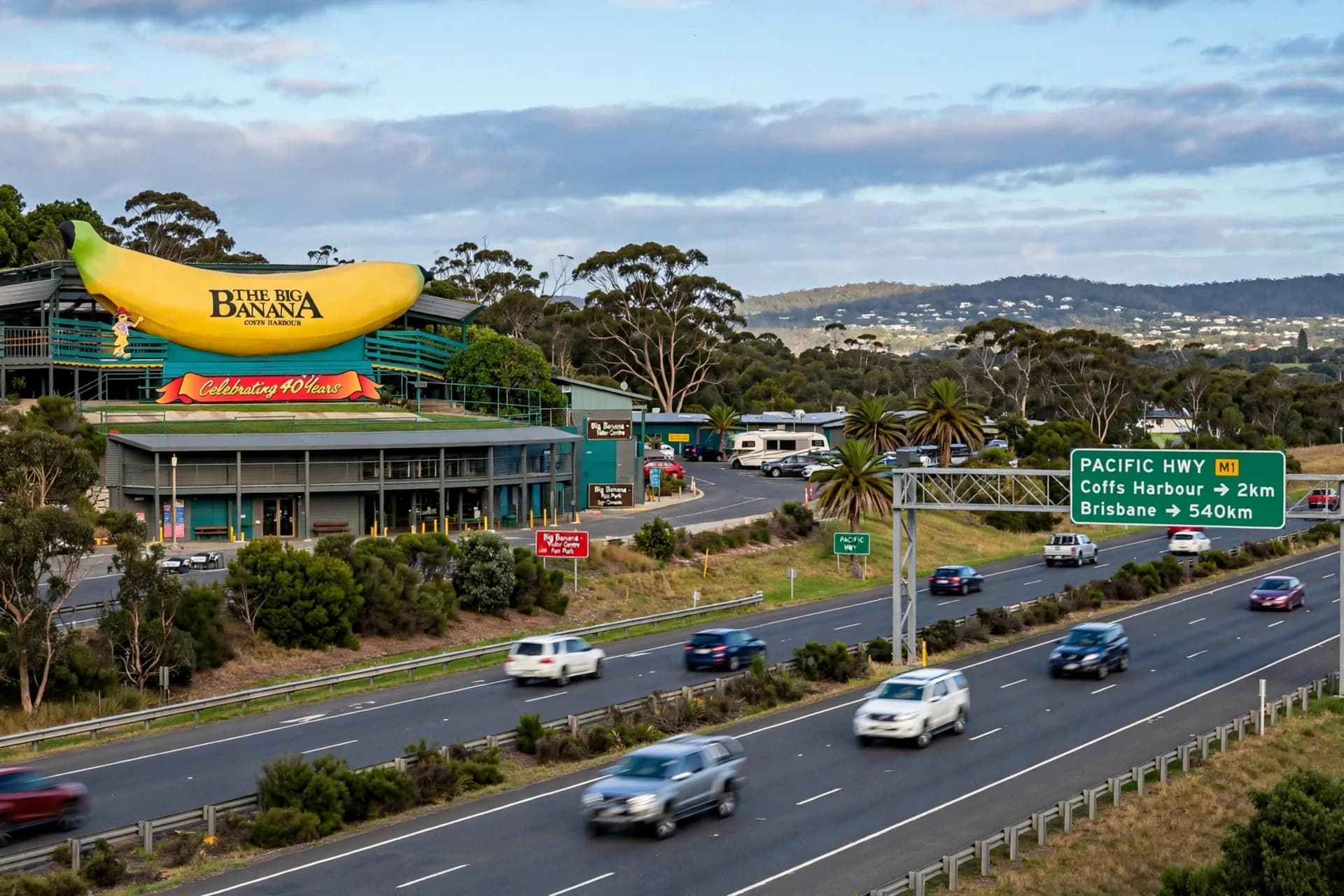
For more than half a century, the Big Banana has been more than a roadside attraction. It has been a landmark, a waypoint, a reason to pull over. Travelers on the Pacific Highway knew that when the giant yellow fruit appeared on the horizon, they were somewhere—Coffs Harbour, halfway between Sydney and Brisbane, a place where the car could rest and the legs could stretch. Soon, that relationship will change. The highway is moving, and the Big Banana will no longer stand beside it.
The final section of the M1 Pacific Motorway upgrade, which will connect the existing highway north of Coffs Harbour, is nearing completion, and when it opens, the Big Banana will be bypassed. For motorists, this means a faster, smoother journey—a continuous dual-carriageway link between Sydney and Brisbane that avoids the traffic lights and speed zones of the coastal town. For the landmark itself, it means a shift in identity: from a must-stop on the highway to a destination that must be sought out rather than stumbled upon.
The Big Banana has stood since 1964, when John Landi planted the first banana plantation on the site and built the oversized fruit as a way to attract passing trade. Over the decades, it grew into a complex that includes a water park, ice-skating rink, toboggan ride, and candy factory. It became, in the words of many travelers, an Australian institution—a place where children posed for photos and parents bought bananas and souvenirs.
Bypasses have a way of reshaping towns. When a highway moves, the traffic that once flowed through a community’s main street is redirected to its edges. Some businesses that depended on passing trade wither. Others adapt, finding new ways to draw visitors who are willing to turn off the main road. The question for the Big Banana is whether its identity is strong enough to survive the change. A landmark that is no longer on the way to anywhere becomes a place you must choose to visit.
The answer may lie in what the Big Banana has always been. It is not simply a service station or a rest stop. It is a piece of Australiana, a piece of childhood memory, a piece of the road trip itself. Families who stopped there on holidays decades ago now bring their own children. That kind of connection is not easily bypassed. It is the reason people will still turn off the motorway, even when the motorway no longer demands it.
The M1 upgrade represents something larger, too—the ongoing transformation of the Pacific Highway from a winding, two-lane coastal road into a modern, high-speed corridor. The old highway took travelers through the heart of every town, past every shopfront and every school zone. The new highway takes them around those towns, faster and safer, but also further from the life that once lined the route. The Big Banana’s fate is a small chapter in that larger story.
When the final section of the M1 opens and the traffic begins to flow around Coffs Harbour rather than through it, the Big Banana will still be there. It will still be yellow. It will still be big. But it will no longer be what it once was: the first thing travelers saw when they arrived, and the last thing they saw when they left. The road has moved on. The question is whether the landmark can move with it.
AI Image Disclaimer: This article includes illustrations generated by artificial intelligence tools for editorial purposes only.
Sources: Transport for NSW, Australian Broadcasting Corporation, The Sydney Morning Herald
Published by Banx Network. This article is part of the Banx decentralized media programme, powered by the BXE token on the XRP Ledger.