
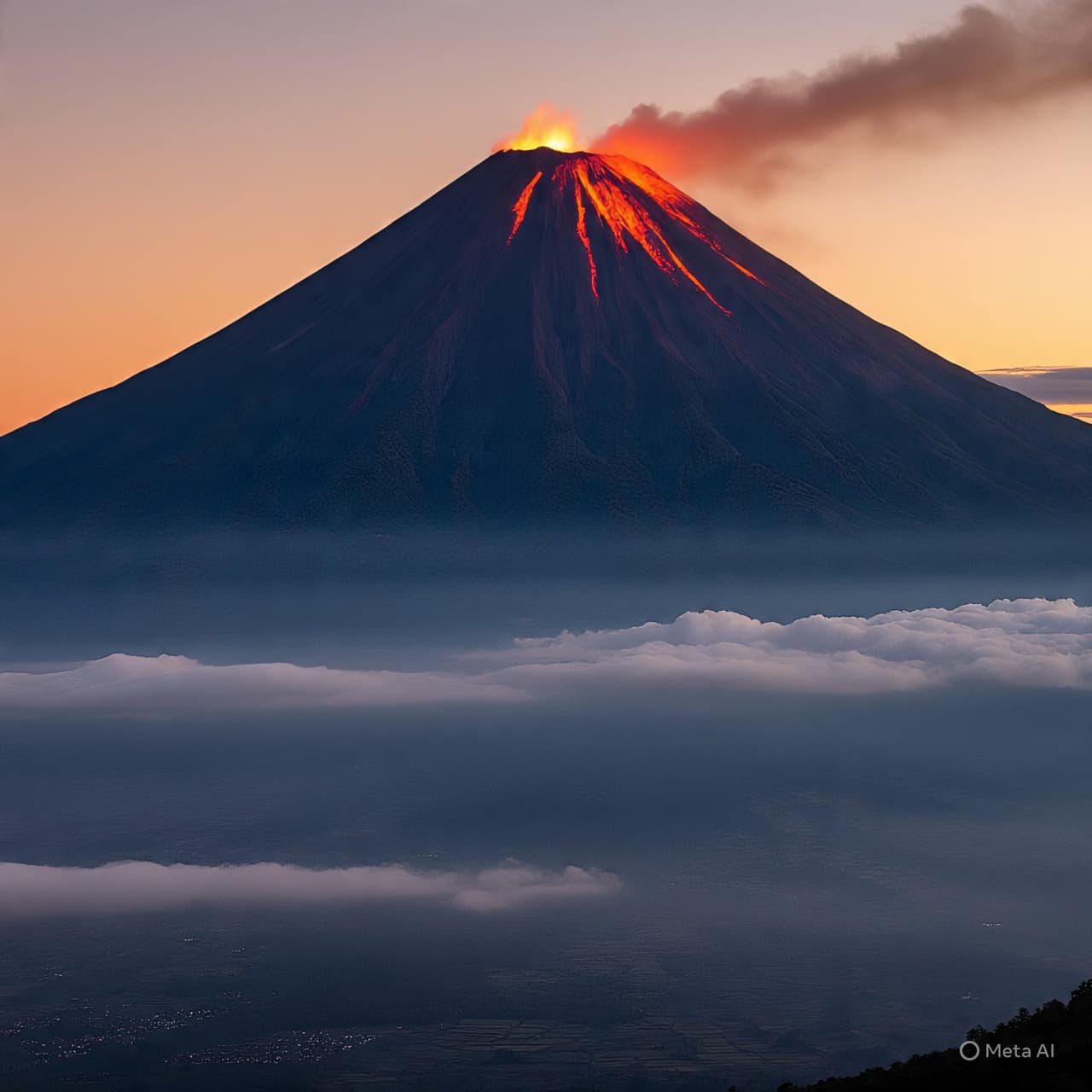
At dawn, when shadows still cling to the mountains and the world tilts gently toward light, there are places where the earth keeps a steady rhythm that is both ancient and alive. Mount Mayon — that symmetrical sentinel of volcanic fire — has been speaking in molten currents now for fifty-five days, a quiet chronicle of heat and rock that unfolds with each sunrise and every lingering glow at dusk. Its effusive eruption, continuing through March 1, invites us to pause and reflect on the patience of landscapes and the forces that shape both land and life.
In the most recent bulletin from the Philippine Institute of Volcanology and Seismology (PHIVOLCS), the volcano’s summit continues to effuse lava, producing incandescent flows that descend the gullies like slow rivers of light. At the same time, occasional minor strombolian bursts — little fireworks of nature — remind observers that the energy beneath Mayon’s slopes is persistent and restless.
For scientists watching from monitoring posts, the rhythm of seismic activity, rockfalls, and emissions is a language that needs careful listening. Lava flows have been observed in Basud, Bonga, and Mi-isi gullies, winding through channels carved by past seasons. Plumes rise gently from the crater, while the crater’s glow is visible to the naked eye after twilight.
Day by day, volcanic earthquakes murmur beneath the surface, rockfalls mark the subtle shifts on the upper slopes, and pyroclastic currents — locally known as uson — occur quietly yet continuously. These phenomena, measured meticulously by PHIVOLCS instruments, shape a portrait of a mountain speaking in its own long, slow cadence.
The alert status over Mayon remains at Level 3, signaling that while the eruption is effusive rather than explosive, caution and vigilance are still the watchwords for communities and travelers alike. Entry into the six-kilometer Permanent Danger Zone is not advised, and aircraft are cautioned against flying close to the vent due to the hazards of drifting plumes and falling debris.
For residents of Albay and nearby towns, the presence of Mayon’s glow on the horizon these past weeks has been both a reminder of nature’s power and a testament to local resilience. Volcanic activity, by its very nature, sits at the intersection of beauty and risk — the stark contrast of burning rock against a backdrop of rice paddies, fishing boats, and everyday life.
While Mayon continues its effusive episode, scientists and civil defense teams maintain a watchful presence, mapping the mountain’s movements, advising communities, and awaiting each report that adds to the narrative of this living, breathing volcano. In the gentle balance of observation and experience, the eruption becomes more than a series of data points — it becomes a reflection of human patience in the face of earth’s deep rhythms.
AI Image Disclaimer “Graphics are AI-generated and intended for representation, not reality.”
Sources GMA News Online; Manila Bulletin; Inquirer.net; Philstar.com; Smithsonian Global Volcanism Program.
Published by Banx Network. This article is part of the Banx decentralized media programme, powered by the BXE token on the XRP Ledger.


