
Key Highlights
- Cost Disparity:Cheap drones can cost as little as $20,000, while interceptors may exceed millions.
- Strategic Shift:Military planners are rethinking air defense strategies in light of drone technology.
- Economic Impact:The cost exchange ratio highlights the financial burden of defending against low-cost threats.
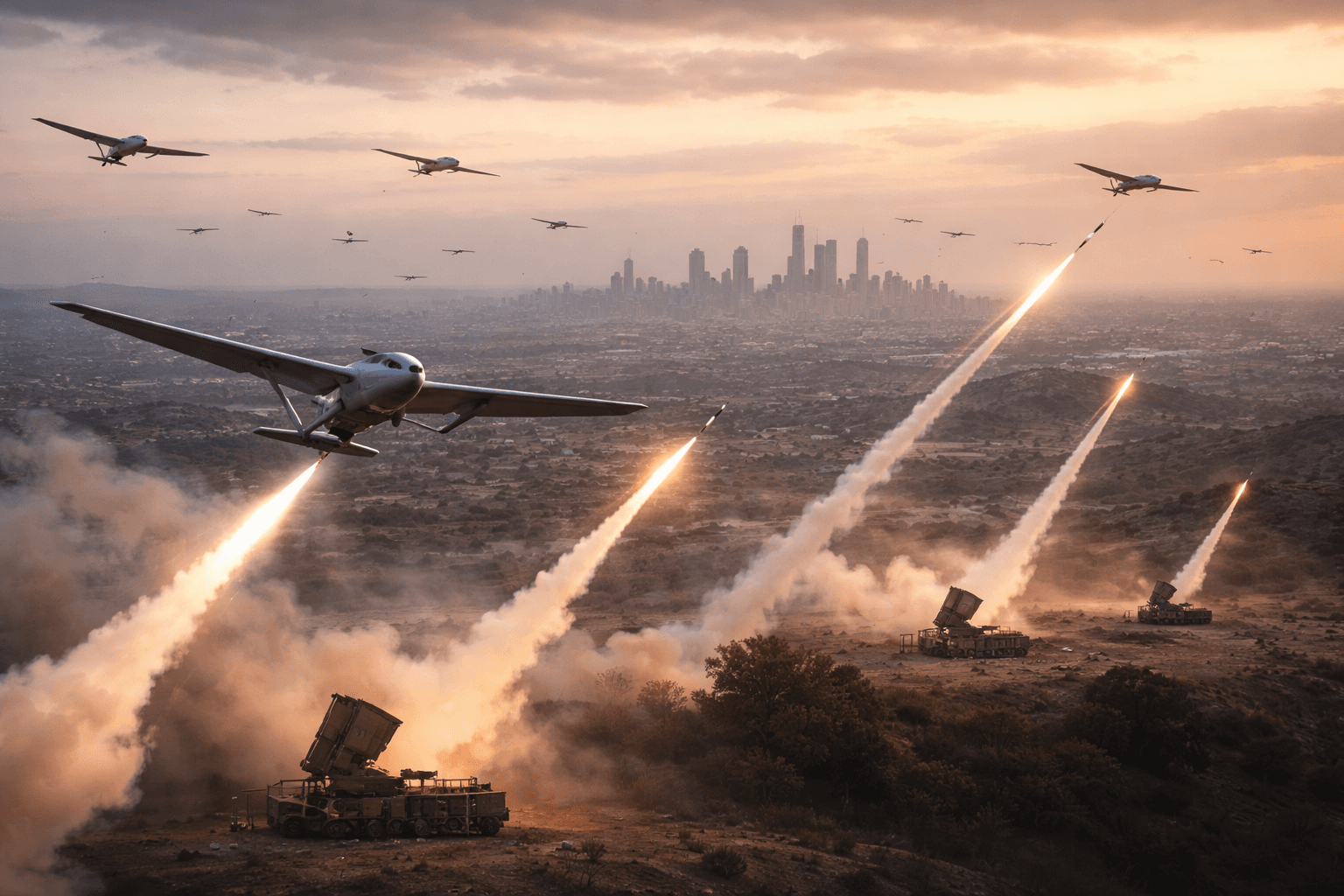
In the quiet arithmetic of modern warfare, numbers sometimes whisper louder than explosions. Somewhere between a buzzing propeller and the launch of a multimillion-dollar missile lies a question that military planners increasingly cannot ignore: what happens when the economics of war begin to tilt? Across the Middle East, that quiet equation has taken shape in the form of small, noisy aircraft drifting across the sky. They are not the sleek machines of science fiction nor the towering missiles of Cold War imagery. Instead, they resemble simple flying wings, propelled by modest engines and guided by relatively basic navigation systems. Yet their presence has forced some of the world’s most sophisticated air-defense networks to respond with weapons worth hundreds of thousands—or even millions—of dollars.
The contrast is striking. Iran’s widely used Shahed-style drones are estimated to cost somewhere between roughly $20,000 and $50,000 per unit, depending on configuration and production scale. These drones are designed as one-way attack systems—loitering munitions that fly toward a target and detonate on impact. Their simplicity is part of their strength: they can be manufactured quickly, launched in large numbers, and deployed across long distances.
Against them stand some of the most advanced air-defense systems in the world. Interceptor missiles from systems such as Patriot, THAAD, or naval Standard Missiles can cost from several hundred thousand dollars to several million per shot. In certain cases, military doctrine calls for launching more than one interceptor at a single incoming threat to ensure it is destroyed. The result is a striking imbalance. Analysts often describe it as a “cost exchange ratio.” For every inexpensive drone launched, defending forces may spend ten, twenty, or even sixty times more attempting to intercept it.
This imbalance becomes even more visible during large-scale attacks. When hundreds of drones are launched simultaneously, defenses must react quickly, deciding which targets to intercept and which systems to use. Even when interception rates are extremely high—sometimes above ninety percent—the financial cost of the defense effort can escalate rapidly. Defending nations still consider those costly interceptors worthwhile if they prevent damage to cities, energy infrastructure, or military bases. In that sense, the calculation is not only about the price of weapons but also the value of what they protect. A missile that costs millions may still be considered economical if it prevents a catastrophic strike on critical infrastructure.
Even so, the emergence of low-cost drones has forced a broader rethink within military planning. Many defense analysts now believe that the future of air defense will rely on layered systems: electronic warfare to disrupt navigation signals, smaller interceptor drones, rapid-fire cannons, and even experimental laser weapons designed to shoot down targets at a fraction of the cost. In this evolving landscape, the drone itself becomes less important than the idea behind it. The concept is simple but powerful: overwhelm expensive defenses with inexpensive tools.
As conflicts continue to evolve, this quiet equation may shape the next generation of military strategy. The skies of modern warfare are no longer dominated solely by the most advanced machines, but by the balance between cost, quantity, and ingenuity. And in that balance, a small drone with a modest price tag can suddenly carry a much larger strategic weight.
Published by Banx Network. This article is part of the Banx decentralized media programme, powered by the BXE token on the XRP Ledger.



