1. The Internet Is About to Enter a New Era
The internet has transformed almost every aspect of modern life.
We use it to communicate, transfer money, run businesses, store information, control infrastructure and connect billions of devices. Behind this digital world lies a vast network of fibre-optic cables, wireless connections, routers, servers and data centres.
Despite its complexity, the internet primarily relies on classical information.
Computers represent information using bits, which take the value of either zero or one. These bits can be processed, copied, transmitted and stored using established electronic and optical technologies.
The quantum internet proposes a different approach.
Instead of relying exclusively on classical bits, quantum networks would use quantum systems, such as individual photons, to transmit or share quantum information. They could also distribute quantum entanglement between distant devices.
This would not simply make today's internet faster. A quantum network would support fundamentally different capabilities, including certain forms of quantum-secure communication and connections between quantum computers.
The distinction is important.
A quantum internet would not necessarily replace the conventional internet. The more realistic vision is a network that combines classical and quantum technologies, allowing each to perform the tasks for which it is best suited.
Ordinary internet connections would continue carrying websites, video streams, emails and everyday digital traffic. Quantum links could provide specialised services alongside them.
The result could be a new layer of communications infrastructure built around the laws of quantum physics.
2. What Exactly Is the Quantum Internet?
The quantum internet is a proposed network that would connect quantum devices and distribute quantum information between them.
To understand how it works, consider the difference between a conventional computer and a quantum computer.
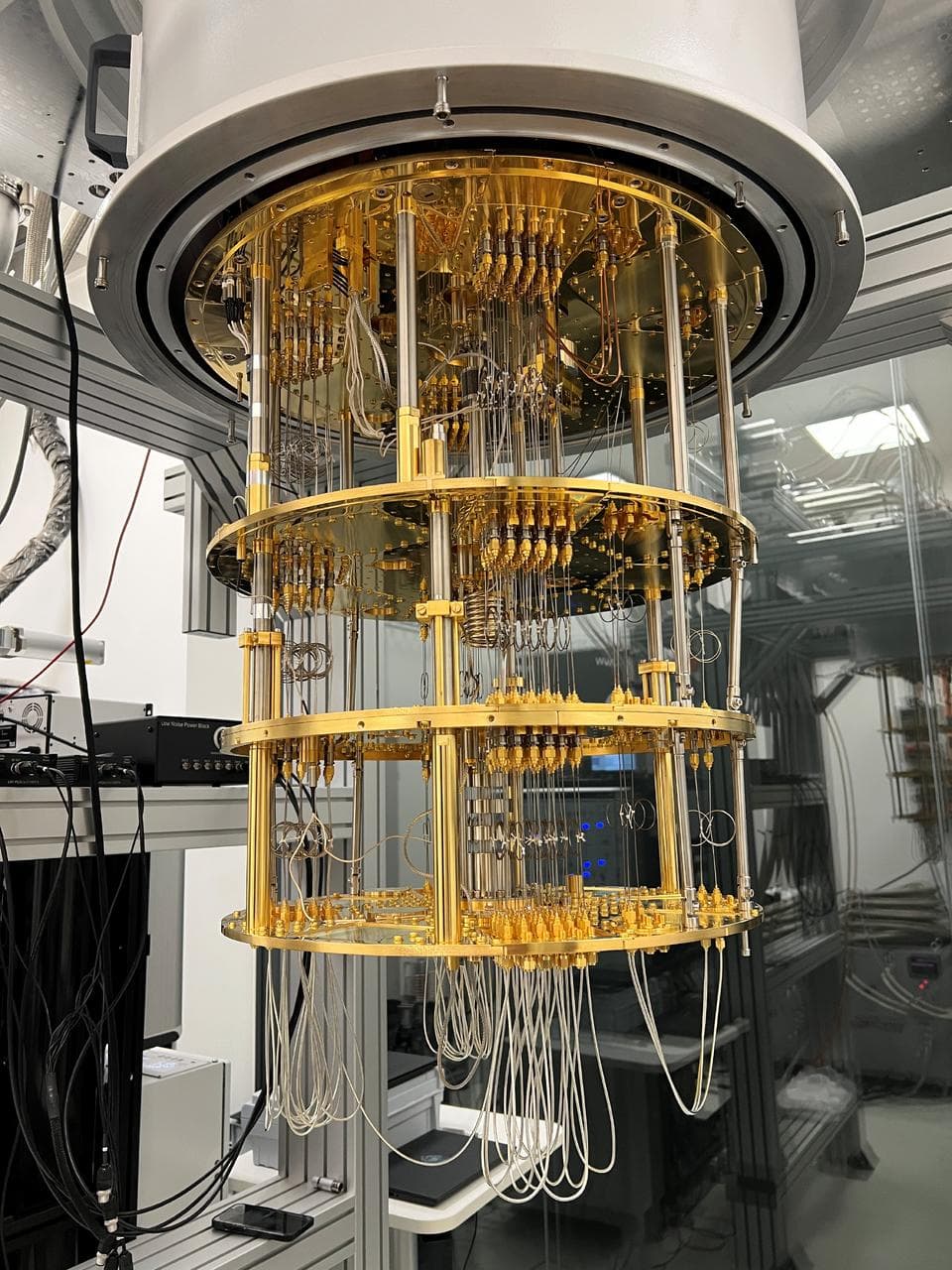
A classical computer processes bits. A quantum computer uses quantum bits, known as qubits, which can be implemented using physical systems such as trapped ions, superconducting circuits or other carefully controlled quantum systems.
Qubits can exhibit properties such as superposition and entanglement. These properties enable quantum information-processing tasks that differ from conventional computing.
A quantum network would allow compatible quantum devices to communicate through quantum channels, usually involving photons or other physical carriers of quantum information.
Possible applications include:
Quantum communication: transmitting quantum states or establishing shared quantum resources between distant devices. Quantum key distribution: using quantum communication protocols to help two parties establish cryptographic keys. Distributed quantum computing: connecting quantum processors so they can share entanglement or support specialised collaborative computations. Quantum sensor networks: connecting advanced sensors for certain high-precision measurement applications. Scientific research: enabling experiments involving quantum systems that are difficult to coordinate using classical communications alone.
Not every application requires a complete global quantum internet.
Some capabilities can be demonstrated using small, local networks. Others require quantum memories, reliable repeaters and the ability to preserve delicate quantum states over much longer distances.
Researchers are therefore building the foundations gradually, starting with specialised links and small network demonstrations.
The ultimate objective is to connect quantum devices in ways that conventional communications alone cannot reproduce.
3. The Science Behind It: Understanding Qubits
The most important difference between classical and quantum information lies in how information is represented.
A classical bit has a definite value of zero or one.
A qubit can be prepared in a quantum superposition of two basis states. When measured in a particular basis, the result is probabilistic, with the probabilities determined by its quantum state.
This does not mean that a qubit is simply a conventional bit containing both values in the ordinary sense. Quantum superposition describes a physical state with properties that cannot be fully represented by a classical probability distribution over definite values.
Quantum systems can also exhibit interference, allowing certain outcomes to reinforce one another while others cancel out.
Quantum computers exploit these effects to perform particular computations in ways that may offer advantages over classical methods.
A quantum internet would focus on transmitting, distributing or coordinating these quantum states between separate devices.
But quantum information introduces difficult engineering problems.
Quantum states are delicate. Interactions with the surrounding environment can cause decoherence, degrading the properties needed for quantum communication and computation.
The network must therefore manage noise, losses and imperfections while preserving the information needed for its intended task.
This is one reason why building a quantum internet is not simply a matter of installing more powerful routers.
The network must preserve and manipulate physical quantum states, often at extremely low error rates.
4. Quantum Entanglement: The Property That Could Change Networking
One of the most intriguing features of quantum physics is entanglement.
Two or more quantum systems are entangled when their joint state cannot be fully described as independent states of each system.
When suitable measurements are performed on entangled systems, their outcomes can exhibit correlations that cannot be explained by ordinary classical models based on local hidden variables.
Quantum networks could distribute entanglement between distant nodes, allowing devices to share a quantum resource for specialised tasks.
This could support quantum teleportation, a process in which an unknown quantum state is transferred from one system to another using shared entanglement and classical communication.
Despite its name, quantum teleportation does not transport a person or object. Nor does it send usable information faster than light. It transfers a quantum state through a protocol that also requires a classical communication channel.
Entanglement is nevertheless valuable because it enables operations that would otherwise be difficult or impossible to perform across separate quantum devices.
A future quantum network might establish entanglement between laboratories, quantum processors or specialised sensors.
Those connections could allow researchers to carry out distributed experiments or link quantum systems that would otherwise operate independently.
The challenge is that entanglement is difficult to preserve over long distances.
Photons can be lost in optical fibre, while noise and imperfections can reduce the quality of the quantum states.
Creating entanglement is only part of the problem. Researchers must also distribute it, maintain it and use it reliably.
5. Quantum Key Distribution: A New Approach to Secure Communications
One of the most developed applications of quantum communication is quantum key distribution, commonly known as QKD.
QKD allows two parties to establish shared cryptographic key material using quantum signals and a classical communication channel.
The security of suitable QKD protocols relies on quantum-mechanical principles. For example, measurements of non-orthogonal quantum states can disturb those states, allowing certain forms of eavesdropping to be detected through statistical checks.
In a simplified scenario, two parties exchange quantum signals and then use an authenticated classical channel to compare selected information about their measurements.
They assess the error rate and other relevant statistics before deciding whether the resulting data can support a secure key.
If the protocol's security requirements are met, the parties can use the generated key with an appropriate encryption system.
This is a significant idea because it introduces a physical method of generating and distributing cryptographic keys.
However, QKD does not encrypt every message automatically, and it does not remove the need for sound cybersecurity.
The resulting keys must still be managed correctly. The communicating parties must authenticate one another, and their computers, networks and applications must remain secure.
The UK Department for Science, Innovation and Technology published an independent research report on QKD in June 2026, examining its potential applications and cybersecurity limitations. The report describes QKD as a technology with commercial opportunities while recognising the technical and deployment challenges involved. [1]
QKD is therefore an important part of the quantum communications landscape, but it should not be confused with a complete solution to internet security.
6. Could the Quantum Internet Be Impossible to Hack?
The idea of an internet that cannot be hacked is compelling.
Quantum communication is often promoted as a way to make eavesdropping detectable or to provide security based on the laws of physics.
But the claim that the quantum internet would be impossible to hack is too broad.
A properly implemented QKD protocol can provide strong security guarantees under specified assumptions. Those guarantees do not automatically extend to every part of the system carrying the information.
An attacker may target the devices themselves, exploit software vulnerabilities, compromise user credentials, manipulate endpoints or interfere with the network.
Hardware imperfections can also create weaknesses that are absent from idealised theoretical models.
The US National Security Agency warns that the practical security of QKD systems depends on their implementation and engineering, and highlights concerns such as authentication, specialised hardware, trusted relays and side-channel attacks. [2]
Consider a simple example.
Two banks might use a quantum link to establish cryptographic keys. Even if the key-distribution protocol is secure, an attacker who compromises one bank's computer could potentially access information after it has been decrypted.
Likewise, an attacker might disrupt the communication channel, preventing the parties from exchanging information.
Security is not the same as availability. A system can detect interference and still be vulnerable to denial-of-service attacks.
The quantum internet could strengthen particular forms of communication security, but it cannot eliminate every vulnerability in a complex digital system.
Its real significance lies in providing new security capabilities that can complement other defensive technologies.
7. The Quantum Internet Versus Quantum Computing
Quantum computing and the quantum internet are closely related, but they are not the same thing.
Quantum computing uses quantum systems to process information. Researchers hope to use sufficiently capable quantum computers to solve certain problems more efficiently than classical machines.
The quantum internet would connect quantum devices and distribute quantum information or entanglement between them.
The two technologies could eventually support each other.
For example, a network could connect quantum processors located in separate laboratories. Those processors might share entanglement or participate in specialised distributed quantum computations.
Such a system could provide access to quantum resources that are not available inside a single machine.
However, connecting quantum computers does not automatically create a larger, more powerful computer in a simple plug-and-play manner.
The devices must be compatible, their quantum states must be coordinated, and the network must support the required operations with sufficient reliability.
The performance of a distributed system would depend on communication losses, error rates, processing capabilities and the efficiency of the network architecture.
Researchers are still working on the fundamental technologies needed to make large-scale quantum networking practical.
For now, quantum computing and quantum communication are best viewed as related fields with different objectives.
One focuses on processing quantum information. The other focuses on moving or sharing it between systems.
Together, they could eventually form part of a broader quantum technology ecosystem.
8. The Distance Problem: Why Quantum Signals Are Difficult to Send
Today's internet can transmit information over thousands of kilometres using optical fibre, amplifiers, repeaters and other established technologies.
Quantum communication faces a different problem.
In conventional fibre-optic communications, optical signals weaken as they travel. Classical repeaters can detect or regenerate signals to compensate for losses.
Quantum information cannot be handled in exactly the same way.
An unknown quantum state cannot be copied perfectly, and measuring a quantum system can disturb the properties that a protocol is trying to preserve.
As a result, the straightforward strategy of copying and amplifying a signal does not work for arbitrary quantum states.
The loss of photons becomes a major obstacle over long distances.
The US National Institute of Standards and Technology notes that point-to-point QKD systems face significant distance limitations, while quantum repeaters are being investigated as a way to extend quantum communication. [3]
Researchers are exploring several possible solutions, including quantum memories, entanglement swapping and improved photon sources and detectors.
Quantum memories could store quantum information temporarily, allowing network nodes to coordinate the timing of operations.
Entanglement swapping can help establish entanglement between systems that have not directly interacted, provided the necessary intermediate entanglement and operations are available.
These approaches are promising, but practical quantum repeaters remain a major engineering challenge.
A global quantum internet will require more than a few successful laboratory demonstrations. It will need reliable ways to extend quantum links over long distances while managing losses and errors.
9. Quantum Repeaters: The Missing Link in a Global Network
Imagine trying to send a fragile signal across an entire continent.
The longer the distance, the greater the chance that the signal will be lost or corrupted.
Quantum repeaters are designed to help overcome this problem, but they cannot simply amplify quantum information in the way conventional repeaters amplify classical signals.
Instead, quantum repeaters aim to create and connect shorter quantum links.
A network node might establish entanglement with a neighbouring node. Additional operations could then extend the entanglement across a larger distance.
Quantum memories could help store the relevant states until the network is ready to perform the next operation.
The process is technically demanding because quantum states are vulnerable to loss, noise and imperfect operations.
Researchers must also coordinate multiple probabilistic processes. Generating entanglement successfully across one link does not guarantee that the next link will be ready at the same time.
A major review published in Reviews of Modern Physics in December 2023 examined quantum repeaters and their importance in the development of quantum networks. It identified the realisation of practical repeaters as one of the crucial challenges facing a full quantum internet. [4]
Progress in this area could determine how far quantum networking can scale.
Without effective long-distance technologies, quantum communication may remain concentrated in limited networks.
With reliable quantum repeaters, more complex network architectures could become possible.
10. A Real-World Milestone: Entangled Photons Travel 62 Kilometres
The quantum internet is not merely a theoretical proposal.
Researchers are already testing quantum communication in real-world environments.
In August 2026, NIST reported that its researchers and collaborators had transmitted entangled photons through 62 kilometres of commercial optical fibre between NIST's campus in Gaithersburg, Maryland, and the University of Maryland in College Park. [5]
The experiment was important because commercial fibre is not a perfectly controlled laboratory environment.
Real networks contain losses, noise and other practical complications that can interfere with quantum signals.
Demonstrating that entanglement can survive transmission through existing fibre infrastructure helps researchers understand how quantum networking might operate in realistic conditions.
It also provides valuable information for designing future networks that could connect quantum devices across metropolitan areas.
However, the result should be interpreted accurately.
A 62-kilometre demonstration does not mean that a global quantum internet is ready for deployment. It does not establish that every type of quantum information can be transmitted over arbitrary distances, nor does it eliminate the need for repeaters.
It demonstrates progress on one important part of the problem: distributing entanglement through commercial fibre.
The next steps involve improving reliability, managing losses, integrating quantum memories and demonstrating increasingly complex network operations.
These incremental advances are essential to turning quantum networking from an experimental capability into a practical technology.
11. Satellites Could Connect Quantum Networks Across Continents
Optical fibre is not the only possible way to distribute quantum information.
Satellite-based quantum communication could help connect distant locations that would be difficult to link efficiently using fibre alone.
In a satellite-based system, quantum signals can travel through free space between ground stations and spacecraft.
Such links could potentially connect networks across countries or continents without requiring a continuous terrestrial fibre route.
But space-based quantum communication presents its own challenges.
The satellite must maintain accurate pointing and alignment. Atmospheric conditions can affect optical transmission, and ground stations need suitable equipment to receive the signals.
Cloud cover, weather and visibility can constrain some optical links, while orbital movement limits the time available for individual connections.
Satellite systems also require careful coordination between spacecraft, ground infrastructure and the wider network.
In June 2026, Boeing reported a development milestone for its Q4S quantum networking mission, which is designed to test whether entanglement swapping can operate using compact hardware suitable for launch and use in orbit. The mission was being prepared for a planned 2027 launch. [6]
The report describes a development programme, not a completed operational satellite network.
Nevertheless, it illustrates how companies and research organisations are investigating space-based components for future quantum communication.
A hybrid architecture combining fibre networks with satellite links could eventually help connect regional quantum networks over much greater distances.
12. Europe Is Investing in a Quantum Internet
The development of quantum networking is attracting investment from governments, universities, research organisations and technology companies.
Europe is one of the regions working towards a coordinated quantum communications ecosystem.
On 1 October 2026, the Quantum Internet Alliance announced that it had received €47.5 million in new funding from the European Commission to advance a full-stack quantum internet prototype and prepare for real-world deployment. The funding is intended to support a further 42 months of research and development. [7]
A full-stack approach means developing more than the individual quantum devices.
Researchers must consider how hardware, network protocols, software, control systems and applications will operate together.
A network may have excellent quantum components but still fail to scale if its software cannot coordinate operations or its devices cannot communicate reliably.
Standardisation is also important.
Different research groups and manufacturers need compatible approaches to network control, data exchange and device integration if their systems are eventually expected to work together.
The European programme illustrates the shift from isolated experiments towards integrated quantum network development.
However, a prototype is not the same as a mature commercial internet.
The funding supports a research and development effort intended to move the technology closer to practical use. Its eventual success will depend on technical results, integration and real-world performance.
13. Banks and Financial Institutions Could Be Early Users
Financial institutions have strong incentives to protect sensitive information.
Banks, payment providers, investment firms and financial market infrastructure operators exchange data that must remain confidential and authentic.
A future quantum computer capable of breaking widely used public-key cryptographic systems could create serious risks for information that depends on those methods.
Quantum communication technologies may offer new ways to manage certain security requirements.
For example, QKD could help some organisations establish cryptographic keys over specialised links.
Potential applications might include communications between selected data centres, financial infrastructure facilities or other sites where the cost and operational complexity of dedicated quantum equipment can be justified.
But financial security requires much more than secret keys.
Institutions must protect customer devices, internal systems, identity management, software, payment applications and operational processes.
QKD also requires suitable infrastructure and does not replace every function of conventional cryptography.
For many organisations, migration to post-quantum cryptography may offer a more practical way to address future quantum-computing threats.
The appropriate strategy will depend on the organisation's risk profile, network architecture, regulatory obligations and technical requirements.
The quantum internet may eventually become part of financial security infrastructure, but adoption is likely to be selective rather than universal.
14. The Threat from Quantum Computers: Why Encryption Must Evolve
One of the major motivations behind quantum-resistant security is the possibility that sufficiently capable quantum computers could break some of the cryptographic systems used today.
Many widely deployed public-key systems rely on mathematical problems that are difficult for classical computers to solve efficiently.
A sufficiently powerful, fault-tolerant quantum computer running an appropriate algorithm could undermine some of these assumptions.
That would create risks for sensitive information, secure communications and digital infrastructure.
The concern is particularly important for data that must remain confidential for many years.
An attacker might collect encrypted information today and attempt to decrypt it in the future if the necessary quantum computing capability becomes available. This is often described as a “harvest now, decrypt later” risk.
However, not all encryption would be broken in the same way. Quantum computers do not automatically defeat every cryptographic system, and the practical threat depends on the algorithms used and the capabilities of future machines.
The response is not limited to quantum networking.
Post-quantum cryptography involves cryptographic algorithms designed to resist attacks from both classical and quantum computers.
In 2024, the US National Institute of Standards and Technology finalised its first three principal post-quantum cryptography standards, providing a foundation for organisations to begin migrating to quantum-resistant algorithms. [8]
These standards are particularly important because they can be implemented in conventional computing infrastructure without requiring every connection to use a quantum channel.
For many organisations, adopting post-quantum cryptography is likely to be a central part of preparing for future quantum threats.
Quantum networking and post-quantum cryptography are related, but they solve different problems.
15. Quantum Internet Versus Post-Quantum Cryptography
The two technologies are sometimes confused because both are associated with protecting communications against future quantum threats.
Their approaches are different.
Quantum internet and quantum communication use quantum states and related physical processes to support communication between specialised devices. QKD is one application that can help establish cryptographic keys.
Post-quantum cryptography uses mathematical algorithms designed to remain secure against attacks from both classical and quantum computers.
Post-quantum cryptography can generally be deployed through software and conventional hardware updates, although migration still requires planning, testing and compatibility work.
QKD typically requires specialised optical equipment and dedicated communication links.
That can make QKD valuable for selected high-security applications, but it can also make deployment more expensive and complex.
The UK government's 2026 QKD research report notes that the UK's National Cyber Security Centre recommends post-quantum cryptography as the preferred approach to post-quantum security for government and military applications, rather than QKD. [1]
This does not mean quantum communication has no value.
It means organisations must choose technologies based on their actual security needs, the threats they face and the practical limitations of each approach.
A realistic future may combine post-quantum cryptography, conventional cybersecurity, specialised quantum links and strong operational security.
There is unlikely to be a single technology that solves every security problem.
16. The Hidden Weaknesses of Quantum Security
Quantum communication can offer important security properties, but its practical implementation remains a serious engineering challenge.
One issue is the difference between theoretical security and real-world security.
A protocol may be mathematically secure under specific assumptions. A physical device implementing that protocol may still have imperfections that create exploitable weaknesses.
Side-channel attacks are one example.
Instead of attacking the underlying mathematics, an attacker may exploit unintended information leaked by a device, such as variations in its physical behaviour.
Other concerns include detector imperfections, implementation errors, compromised equipment and insecure handling of generated keys.
Authentication is another critical requirement.
The communicating parties need a reliable way to establish that they are exchanging information with the intended recipient. QKD does not remove the need for authentication.
Network architecture matters as well.
Some practical QKD networks use trusted relay nodes to extend communication across longer distances. If those nodes are compromised, the security of the overall arrangement may be affected.
Satellite systems introduce additional operational concerns, including weather, visibility and line-of-sight requirements.
These issues do not invalidate quantum communication. They show why security must be evaluated across the entire system rather than inferred from quantum physics alone.
The strongest approach is to combine rigorous protocol design with hardware testing, secure implementation, operational controls and independent assessment.
17. Could Quantum Networking Transform Scientific Research?
Cybersecurity is only one possible application.
Quantum networks could also help scientists conduct experiments that require quantum systems to interact across different locations.
For example, a network might distribute entanglement between laboratories, enabling researchers to study quantum phenomena across separate devices.
Distributed quantum computing could eventually allow compatible processors to share quantum resources, potentially supporting tasks that are difficult to perform using isolated machines.
Quantum sensor networks could also explore whether linked sensors can improve certain measurements or support new experimental methods.
Potential fields of interest include fundamental physics, precision measurement, materials research and specialised scientific instrumentation.
However, the practical benefits will depend on the specific experiment.
Not every scientific task becomes faster or more accurate simply because a quantum network is involved.
Researchers must demonstrate that networking provides a measurable advantage over classical coordination or other available techniques.
The technology also faces limits imposed by loss, noise, imperfect devices and the difficulty of maintaining quantum states.
Even so, scientific research is likely to remain an important driver of development because laboratories can use specialised networks to explore applications before the technology becomes widely available.
The quantum internet could eventually become a tool for connecting scientific instruments in ways that are not possible with ordinary networks alone.
18. The Economic Race to Build Quantum Infrastructure
The development of quantum networking could create opportunities across several industries.
Potential areas include photonics, quantum memory, specialised detectors, fibre-optic infrastructure, satellite communications, network software and cybersecurity services.
Companies developing these technologies may supply equipment to universities, research laboratories, government programmes and selected commercial customers.
There may also be opportunities in testing, integration, security assessment and the management of hybrid classical-quantum networks.
However, the size and timing of the future market remain uncertain.
A technically impressive system does not automatically become a profitable business.
Organisations will need to justify the cost of specialised equipment, installation, maintenance and training.
They will also need clear use cases that provide meaningful benefits compared with conventional technologies.
Quantum networking may initially serve specialised markets where security, scientific capability or access to quantum processing resources justifies the investment.
Broader adoption will depend on whether systems become more reliable, affordable and interoperable.
Investors should distinguish between companies that demonstrate working technology and those whose commercial prospects depend primarily on distant projections.
The quantum internet represents a potentially important infrastructure market, but its long-term economic impact will depend on practical deployment rather than scientific excitement alone.
19. When Could the Quantum Internet Become Available?
There is no single date when the quantum internet will suddenly arrive.
Different parts of the technology are progressing at different speeds.
Specialised quantum communication systems and small quantum networks already exist. Research teams are testing entanglement distribution, improving optical components and developing network architectures.
More capable regional networks will require better integration and reliability.
Global quantum networking will require further progress in quantum repeaters, quantum memories, error management, interoperability and long-distance transmission.
The timeline also depends on what is meant by a quantum internet.
A specialised network connecting a handful of research laboratories is very different from a worldwide system connecting quantum computers across continents.
The former is already being explored through real experiments and prototype networks. The latter remains a longer-term objective.
Over the coming years, progress is likely to be measured through milestones such as improved entanglement distribution, longer fibre links, more reliable network nodes and demonstrations involving multiple connected quantum devices.
Space-based experiments could also help researchers investigate long-distance connections.
However, no responsible forecast should treat a fully operational global quantum internet as guaranteed by a particular year.
The technology must overcome difficult scientific and engineering barriers before it can become a widely available service.
20. Three Possible Futures for the Quantum Internet Future One: A Specialised Security Network
Quantum communication becomes an established option for selected government, research and commercial applications.
QKD links protect particular high-value connections, while post-quantum cryptography secures conventional networks more broadly.
In this scenario, quantum technology becomes an important but specialised part of cybersecurity infrastructure.
Future Two: A Network of Connected Quantum Computers
Researchers develop reliable quantum repeaters and more capable network nodes.
Quantum processors in different locations begin sharing entanglement and supporting specialised distributed applications.
The quantum internet becomes an important research and computing platform, although ordinary internet services continue operating through conventional infrastructure.
Future Three: A Hybrid Global Quantum Network
Advances in fibre, satellites, quantum memories and network software enable increasingly large quantum networks.
Different regions become connected through hybrid infrastructure, supporting research, selected security applications and specialised quantum services.
In this scenario, quantum networking becomes a significant component of global communications, though it still operates alongside classical networks.
These are possible scenarios rather than guaranteed outcomes. Their likelihood depends on scientific progress, costs, commercial demand and the ability to build secure, interoperable systems.
21. What the Quantum Internet Means for Ordinary People
Most people will not need a quantum computer or a quantum communication device in their homes.
If quantum networking becomes commercially useful, its effects may initially be indirect.
Banks might use specialised links for certain communications. Research laboratories could connect quantum devices. Governments and critical infrastructure operators might investigate quantum communication for selected security needs.
Meanwhile, ordinary websites, smartphones and home networks would continue relying mainly on conventional internet infrastructure.
One of the most important changes for everyday users may actually come from post-quantum cryptography.
As organisations upgrade their systems to prepare for future quantum computers, the cryptographic technologies protecting digital services may change without users noticing much difference in how they operate.
People will still need strong passwords, multi-factor authentication, software updates and sensible security practices.
A quantum-secure communication link cannot protect a device that has already been compromised through phishing or malware.
The quantum internet should therefore be viewed as a potential addition to the digital infrastructure that supports modern life, not a replacement for every existing technology.
Its value will depend on the specific problems it can solve.
22. The Road Ahead: What Scientists Must Solve
The development of a practical quantum internet depends on progress across several interconnected areas.
Reliable quantum repeaters: Researchers need systems that can extend entanglement across longer distances without unacceptable losses or errors.
Quantum memories: Network nodes need effective ways to store quantum information long enough to coordinate operations.
Better photonic hardware: Efficient sources, detectors and interfaces are essential for reliable communication.
Network interoperability: Devices from different research groups and manufacturers must be able to work together.
Security validation: Systems require rigorous evaluation of both theoretical protocols and real-world implementation risks.
Lower costs: Equipment must become practical to deploy, maintain and operate outside highly specialised laboratories.
Useful applications: Organisations need clear reasons to invest in quantum networks rather than rely exclusively on conventional technologies.
None of these challenges has a simple solution.
The quantum internet will require coordinated progress in physics, materials science, engineering, computing and cybersecurity.
The most important milestones will be those that demonstrate reliable, repeatable operations under realistic conditions.
23. The Beginning of a New Internet?
The quantum internet remains one of the most ambitious technological projects emerging from modern physics.
It promises a new way to connect quantum devices, distribute entanglement and support specialised forms of secure communication and scientific research.
Progress is already visible. Researchers have demonstrated quantum communication over real fibre infrastructure, international programmes are investing in network prototypes, and companies are exploring satellite-based quantum networking.
But the distance between a successful experiment and a dependable global network remains substantial.
Quantum repeaters, quantum memories, hardware reliability, cost and security implementation are among the challenges that must be addressed.
The claim that the quantum internet will make hacking impossible should be treated with particular caution. Quantum technologies can provide valuable security capabilities, but they do not eliminate vulnerabilities in software, hardware, identity systems or human behaviour.
Post-quantum cryptography will also play a crucial role in protecting conventional digital infrastructure against future quantum-computing threats.
The most likely future is not a world where classical internet technology disappears overnight.
It is a world where conventional networks and specialised quantum networks operate alongside one another, each serving different purposes.
If researchers can overcome the remaining challenges, quantum networking could transform how certain kinds of information are shared and how future quantum computers cooperate.
The next internet revolution may not be about connecting more people and devices. It may be about connecting entirely new forms of computing—and using the laws of physics to create capabilities that conventional networks cannot provide.
The quantum internet is not yet an unhackable global network. But the science behind it could help reshape the future of communication, computation and cybersecurity.
References
[1] UK Department for Science, Innovation and Technology. (2026). Quantum Key Distribution Research Report. Published 10 June 2026. An independent assessment of QKD's commercial potential, technical limitations and cybersecurity implications. https://www.gov.uk/government/publications/quantum-key-distribution-research-report
[2] US National Security Agency (NSA). Quantum Key Distribution (QKD) and Quantum Cryptography. Explains the limitations of QKD, including implementation risks, authentication requirements, specialised hardware and trusted relays. https://www.nsa.gov/Cybersecurity/Quantum-Key-Distribution-QKD-and-Quantum-Cryptography/
[3] National Institute of Standards and Technology (NIST). Quantum Information Networks. Research overview covering quantum communication, QKD, network demonstrations and distance limitations. https://www.nist.gov/ctl/smart-connected-systems-division/quantum-information-networks
[4] Azuma, K., Economou, S. E., Elkouss, D., Jiang, L., Lo, H.-K. and Tzitrin, I. (2023). Quantum Repeaters: From Quantum Networks to the Quantum Internet. Reviews of Modern Physics, 95, 045006. https://doi.org/10.1103/RevModPhys.95.045006
[5] National Institute of Standards and Technology (NIST). (2026). 'Spooky' Particles Transit DC Suburbs, a Step Toward a Quantum Network. Published 5 August 2026. Reports the distribution of entangled photons through 62 kilometres of commercial optical fibre. https://www.nist.gov/news-events/news/2026/08/spooky-particles-transit-dc-suburbs-step-toward-quantum-network
[6] Boeing. (2026). Boeing Takes a Major Step Toward the Quantum Internet. Published 17 June 2026. Reports a hardware testing milestone for the Q4S quantum satellite mission, which is designed to test entanglement swapping in orbit. https://www.boeing.com/features/2026/06/boeing-takes-a-major-step-toward-the-quantum-internet
[7] Quantum Internet Alliance. (2026). QIA Enters Phase to Build Full-Stack Quantum Networks. Published 1 October 2026. Announces €47.5 million in European Commission funding to advance a quantum internet prototype. https://quantuminternetalliance.org/news/
[8] National Institute of Standards and Technology (NIST). (2024). NIST Releases First 3 Finalized Post-Quantum Encryption Standards. Published 13 August 2024. https://www.nist.gov/news-events/news/2024/08/nist-releases-first-3-finalized-post-quantum-encryption-standards
Published by Banx Network. This article is part of the Banx decentralized media programme, powered by the BXE token on the XRP Ledger.