
Key Highlights
- Belgrade's Smart City initiative utilizes AI to optimize traffic flow.
- The system analyzes data from thousands of sensors in real-time.
- Improved traffic management aims to enhance urban mobility and air quality.
Belgrade is a city that has always moved to its own, often chaotic, rhythm. Its streets are a complex web of history and modern ambition, where the echoes of ancient empires meet the exhaust of the morning commute. For decades, the flow of the city was a matter of human intuition and occasional frustration, a tide of metal and glass that rose and fell with the predictable unpredictability of a living organism.
Recently, however, a new kind of intelligence has begun to settle over the intersections, a silent observer that thinks in milliseconds and speaks in data. The "Smart City" initiative has introduced algorithms that watch the streets with an unblinking eye, looking for patterns in the chaos. This digital layer is designed to smooth out the jagged edges of the daily rush, transforming the urban landscape into a more manageable environment.
To see the city through the eyes of this system is to see a map of heat and motion, where every car is a data point and every traffic light is a variable to be solved. There is something strangely poetic about the idea of a machine trying to find the perfect harmony for a million different journeys. It is a search for the "green wave," a moment where the city opens up and allows its residents to move without the stutter of the brake light.
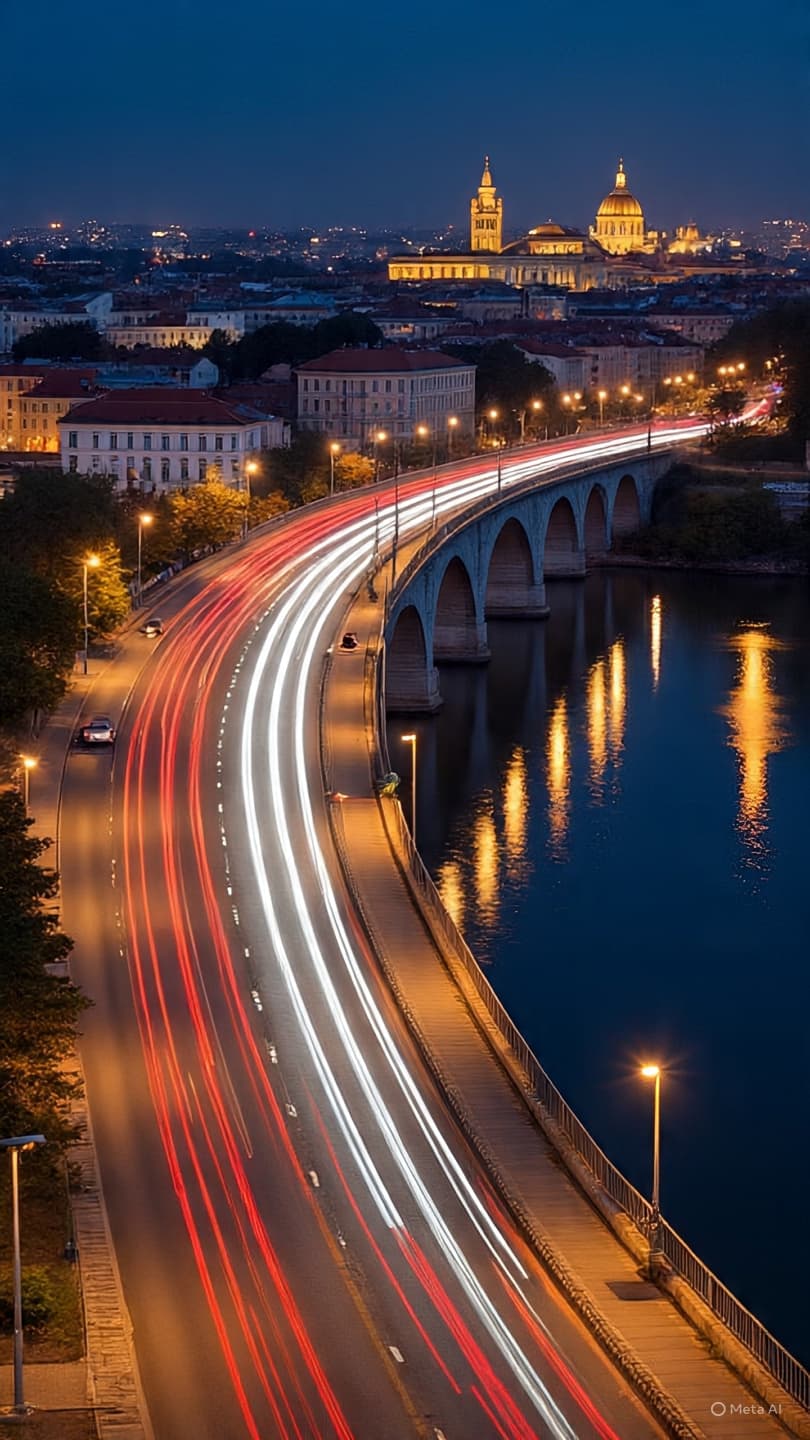
The transition to this AI-driven flow is subtle, often noticed only in the slightly shorter wait at a corner or the unexpected ease of a bridge crossing that used to be a bottleneck. This shift in the city’s breath represents a reduction in the collective sigh of the frustrated driver. By letting machines handle the timing, we are attempting to reclaim the time that the city used to steal from us.
There is a reflective irony in the fact that we are using the most advanced technology of the future to solve one of the oldest problems of urban life. Belgrade, with its layers of stone and history, is becoming a playground for algorithms, where the ancient and the digital must find a way to coexist. The technology does not change the destination, but it changes the quality of the journey.
The system is constantly learning, adapting to rain, festivals, and unexpected closures that define life in a capital. It is a dynamic architecture of light and timing, responding to the reality that a city is never truly finished but always in a state of flux. We are witnessing the birth of a more responsive urban environment, one that listens to the movements of its people.
As the lights change from red to green in a perfectly timed sequence, one can feel the invisible work of the processor. It is a reminder that we are increasingly living in a world of guided motions, where our path is being smoothed by calculations we will never see. This makes the city feel a little more like a partner and a little less like an obstacle.
The morning rush in Belgrade will always be a challenge, a testament to the city’s enduring energy. However, with the help of the Smart City tools, that energy is being channeled into something more productive and less exhausting. Residents now navigate the streets with a new kind of fluidity, part of a digital symphony playing quietly in the background of their lives.
Belgrade’s municipal authorities have expanded the city’s Smart City traffic management system, which utilizes artificial intelligence to optimize traffic light sequences and reduce congestion in real-time. The technology analyzes data from thousands of sensors to improve air quality and decrease travel times for residents across the metropolitan area.
Published by Banx Network. This article is part of the Banx decentralized media programme, powered by the BXE token on the XRP Ledger.



