There is a particular stillness that follows a crash on an ordinary street—the kind of stillness that arrives after the sirens have faded and the wreckage has been towed, leaving only a dark stain on the asphalt and the quiet disbelief of people who live nearby. On a Saturday afternoon in San Jose, that stillness settled over an intersection where a small airplane had come down not in a field or on a runway, but on a public road, in the middle of the day, with three people aboard.
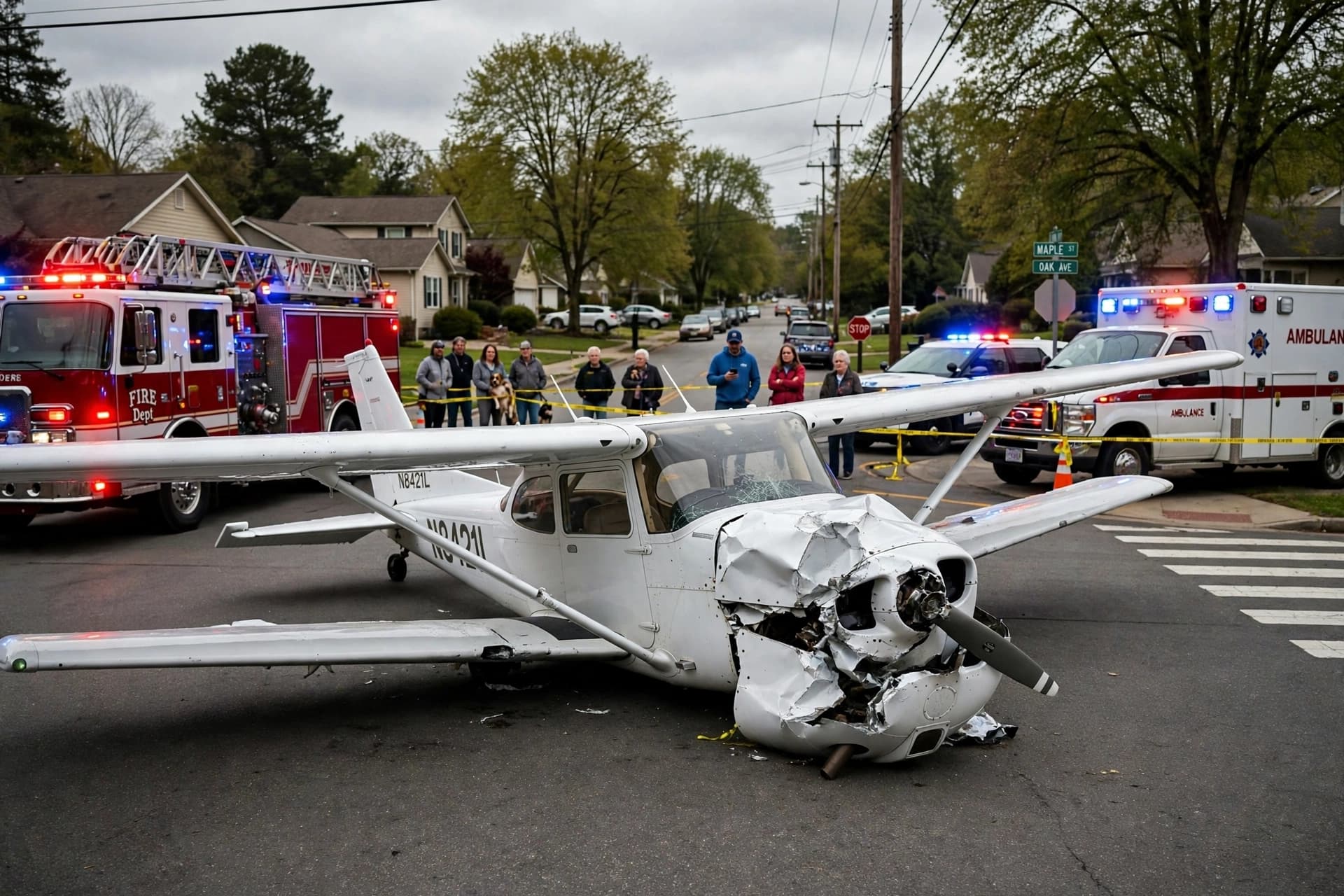
The pilot of a Cessna 177 reported "engine issues" shortly before the aircraft crashed near Capitol Expressway and Excalibur Drive around 3:10 p.m., according to the Federal Aviation Administration . The plane had departed Reid-Hillview Airport, roughly a mile and a half away, when the pilot declared an emergency, telling air traffic control, "We are having engine failure" . Two adults and a child were taken to a hospital with injuries described as non-life-threatening; the San Jose Fire Department said they were transported "out of an abundance of caution" . No vehicles were involved, and a minor fuel spill was absorbed .
What makes such an incident notable is not its scale but its location. A plane crash on a city street carries a different weight than one on a runway or in open country—it brings the abstraction of aviation failure into the spaces where people walk and drive and live. The intersection of Capitol Expressway and Excalibur Drive is not a remote airstrip. It is a place where the ordinary traffic of a Saturday afternoon was interrupted by something that belonged to the sky and arrived, unexpectedly, on the ground.
The aircraft was a 1968 Cessna 177A Cardinal registered to Flying Twenty Inc., a nonprofit flight club for San Jose State University students, alumni, and faculty, according to FAA records . The pilot's decision to declare an emergency and attempt a return to the airport reflects the training that governs such moments—the rapid calculation of options, the prioritization of lives over property, the acceptance that a landing on a road may be the best outcome available. The FAA is investigating the cause .
Drugs and alcohol did not appear to be factors, according to San Jose police . The investigation will proceed through the familiar channels of federal inquiry, examining the engine, the maintenance records, the pilot's actions. These are technical questions, and they will be answered in technical language. But the human questions—what it felt like to be in that plane as the engine faltered, what it felt like to watch it descend—will remain outside the scope of the report.
The three aboard survived with injuries that will heal. The street has been cleared. The investigation continues. And the ordinary rhythm of that intersection has resumed, perhaps with a slightly sharper awareness of how quickly the sky can intrude upon the ground.
AI Image Disclaimer: The images accompanying this article were generated by artificial intelligence and are intended for illustrative purposes only.
Sources: KTVU, The Mercury News, Breitbart (citing NBC Bay Area and ABC 7)
Published by Banx Network. This article is part of the Banx decentralized media programme, powered by the BXE token on the XRP Ledger.