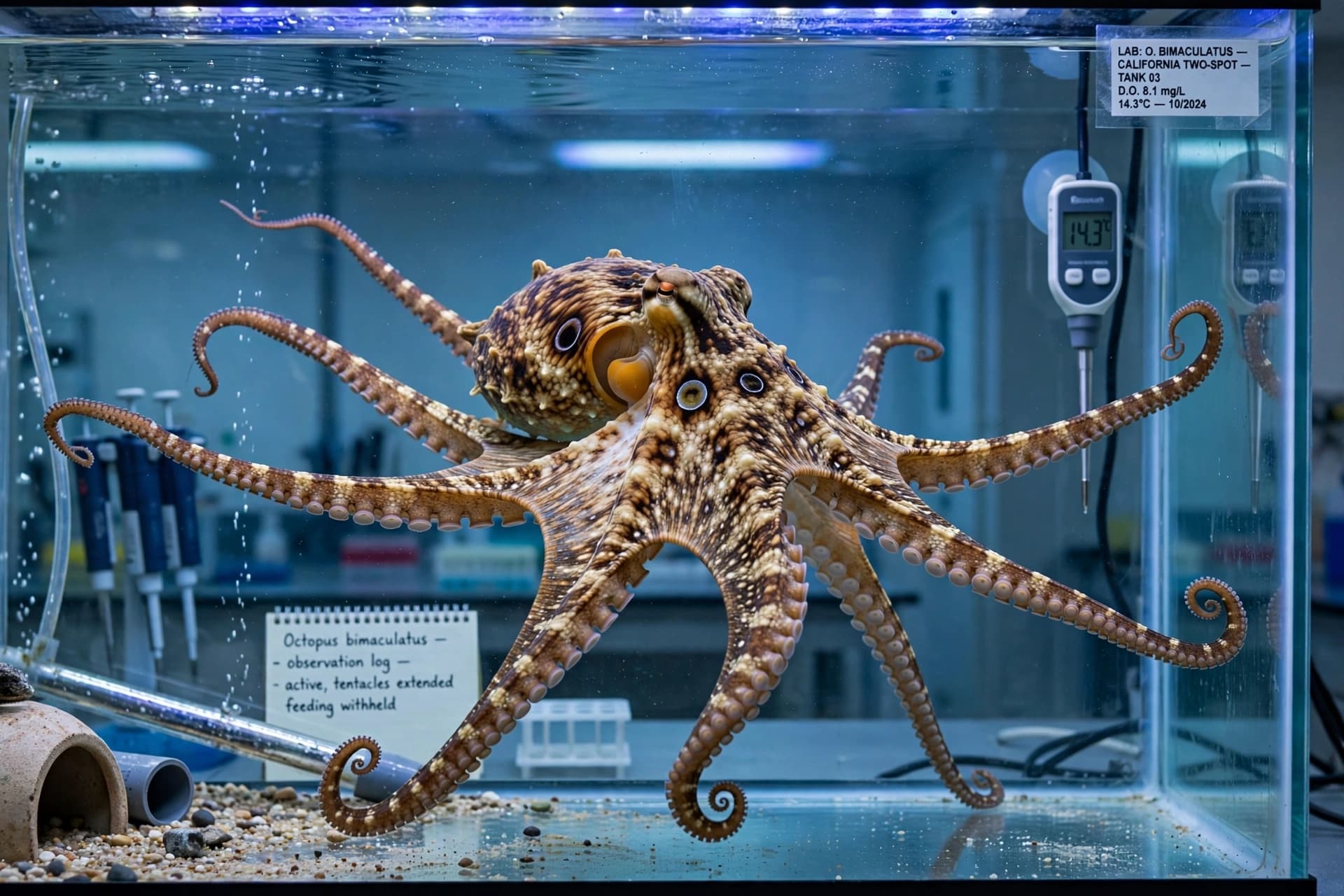
There are creatures in the sea that seem to belong to a different order of being, and the octopus is foremost among them. It can open jars, solve mazes, mimic other animals, and squeeze its boneless body through openings no wider than a coin. Its nervous system is not centralized like ours but distributed across eight arms, each capable of independent action. For decades, scientists have wondered how such complexity arose from a lineage so distant from our own. A new study suggests the answer may lie in a change so subtle and unexpected that researchers initially dismissed it as a laboratory error.
The discovery began five years ago when Richard Han, then a graduate student at Harvard Medical School, was examining ribosomal RNA in the California two-spot octopus . Ribosomes are the cell's protein factories, and their structure is among the most conserved in all of life. Yet Han noticed something strange: an unexpected break that split what is normally a single rRNA fragment into two. "We figured we were bad at extracting RNA," said Nicholas Bellono, a molecular biologist at Harvard and a co-author of the study published in Current Biology . But further tests confirmed the break was real.
To understand its function, the researchers engineered the same break into Escherichia coli bacteria. The altered cells produced proteins with about twice their usual accuracy, suggesting the mutation acts as a kind of quality-control mechanism . When the team compared octopus and squid tissue, they found the former had fewer and smaller protein clumps, which are toxic to neurons and implicated in human neurodegenerative diseases . The rRNA break, it seems, helps keep proteins properly folded, protecting the long-lived nerve cells that support the octopus's remarkable cognitive abilities.
The study examined when this genetic feature evolved. The rRNA break was present in all five shallow-water octopus species tested, but absent in a deep-sea dumbo octopus and in squid, which diverged from octopuses some 300 million years ago . The timing maps closely to the period when shallow-water octopuses were rapidly expanding their nervous systems to meet the demands of a more complex environment. "We can't make a direct relation between a slight change in the accuracy of protein synthesis and so-called advanced intelligence," Bellono said. But the timing, he noted, "maps perfectly" with the emergence of sophisticated behaviors .
Other researchers have responded with interest and caution. Eli Eisenberg, a geneticist at Tel Aviv University who was not involved in the work, called the associations "intriguing" but said more proof is needed to support the hypothesis that they contributed to neural complexity . To establish that link, he noted, scientists would need to alter the rRNA break and test for changes in learning or problem-solving—experiments that would be highly challenging. The study authors acknowledge the limitations but point to the broader implications of their finding.
The discovery also opens a door to potential medical applications. Protein clumps play a role in Alzheimer's and Parkinson's diseases, and the octopus's natural solution to this problem is elegant and precise. Amy Lee, a cell biologist at Harvard and senior author of the study, said she hopes it will be possible to design drugs that mimic the octopus's trick for accurate protein synthesis. If we "use nature as a guide to understand how that happens naturally," she said, "then we can probably find ways to put it into human cells" .
For now, the octopus remains what it has always been: a creature that challenges our assumptions about what intelligence looks like and where it comes from. The finding adds another layer to its mystery, revealing that even the most fundamental machinery of life can be reinvented in ways we did not anticipate. The ribosome, conserved across billions of years of evolution, was not immune to change after all.
AI Image Disclaimer: The imagery associated with this article is AI-generated and is intended for illustrative purposes only.
Published by Banx Network. This article is part of the Banx decentralized media programme, powered by the BXE token on the XRP Ledger.