
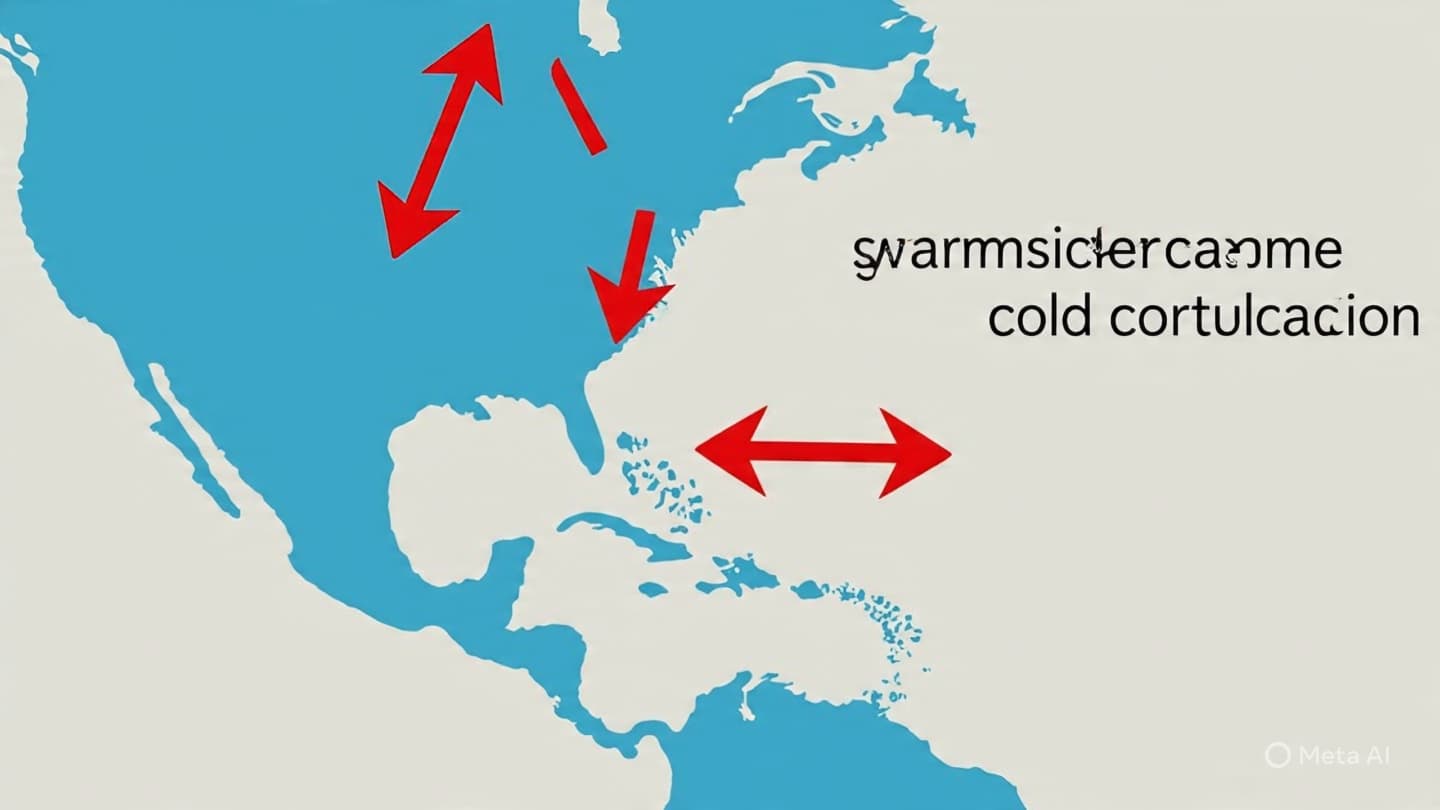
Like a quiet, unseen river threading through the depths of the ocean, the Atlantic Meridional Overturning Circulation moves with steady purpose, shaping climates and seasons without ever drawing attention to itself. It is a system so vast and subtle that its influence is often felt long before it is understood, a reminder that some of Earth’s most powerful forces operate far beneath the surface of daily life.
The Atlantic Meridional Overturning Circulation, often abbreviated as AMOC, is a large system of ocean currents that circulates warm, salty water from the tropics northward and returns colder water southward at deeper levels. This circulation plays a critical role in regulating temperatures, particularly across Europe and parts of North America.
At its core, the system depends on differences in water temperature and salinity. Warm surface water travels northward, gradually cooling and becoming denser until it sinks in the North Atlantic. This sinking motion helps drive the return flow of deep, cold water toward the equator, completing a global loop.
Scientists have long monitored this system because of its importance to global climate stability. A strong AMOC helps maintain relatively mild winters in Europe, while also influencing rainfall patterns across Africa, the Americas, and beyond. Its reach extends far beyond the Atlantic basin.
Recent studies, supported by observations from institutions such as the National Oceanic and Atmospheric Administration and the Intergovernmental Panel on Climate Change, suggest that the AMOC may be weakening. While natural variability has always existed, researchers are increasingly concerned that human-driven climate change could be accelerating this slowdown.
One of the primary drivers of concern is the influx of freshwater from melting ice in regions like Greenland. Freshwater is less dense than salty seawater, which can disrupt the sinking process that powers the circulation. Over time, this could weaken the entire system.
A slowdown in the AMOC would not mean an immediate or dramatic halt, but even gradual changes could have significant consequences. Potential impacts include cooler temperatures in parts of Europe, rising sea levels along the U.S. East Coast, and shifts in tropical rainfall patterns that could affect agriculture and water availability.
Despite these concerns, scientists emphasize that uncertainties remain. Ongoing research, including deep-sea measurements and climate modeling, continues to refine understanding of how quickly changes might occur and what their broader implications could be.
For now, the AMOC remains a vital yet delicate component of Earth’s climate system, reminding researchers and policymakers alike that even the slowest currents can carry profound consequences.
AI Image Disclaimer: Some images illustrating ocean currents in this article are AI-generated representations intended to visualize scientific concepts.
Sources: BBC News, The New York Times, Nature, NOAA, IPCC
Published by Banx Network. This article is part of the Banx decentralized media programme, powered by the BXE token on the XRP Ledger.



