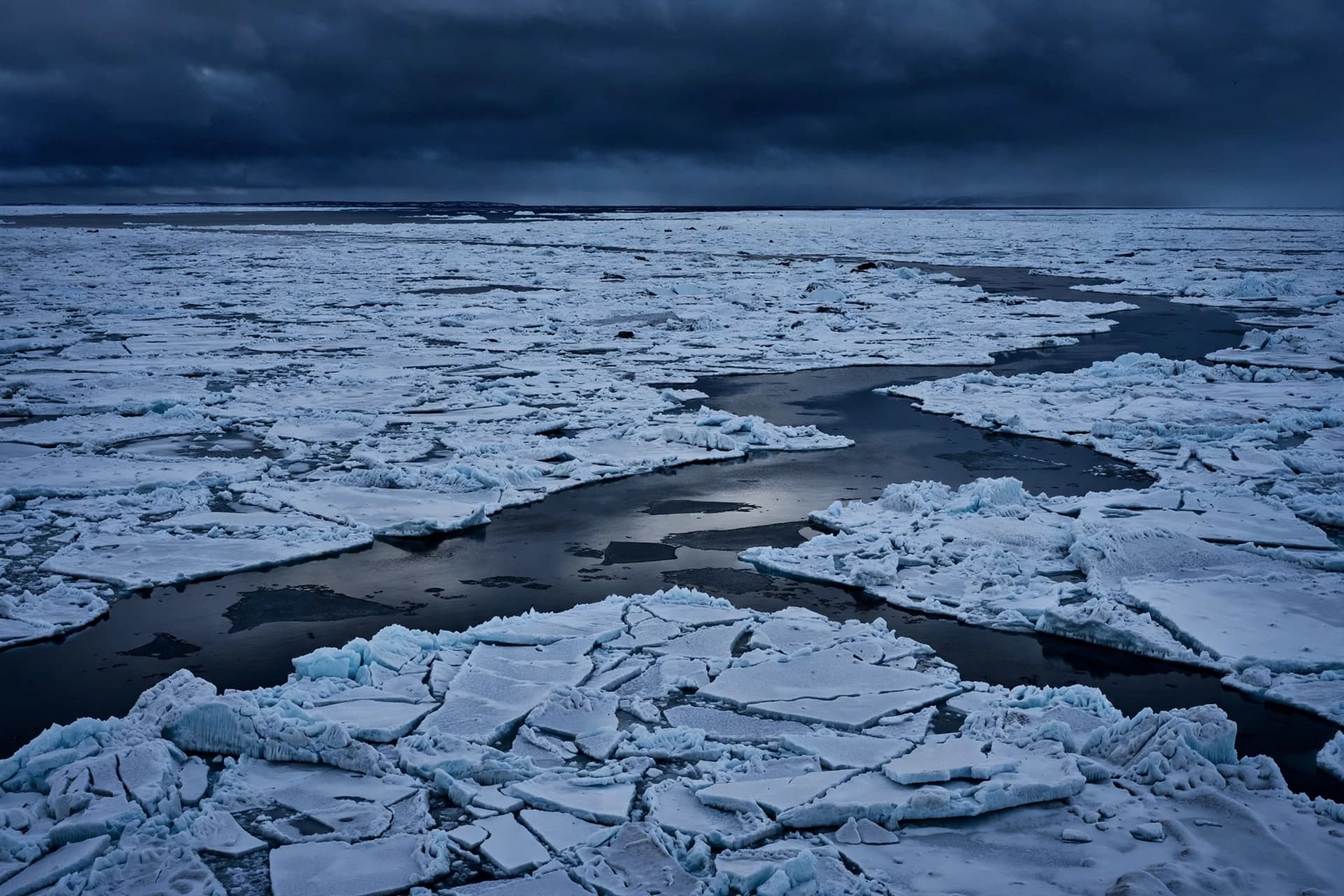
The ocean has often been described as Earth’s memory. It keeps what the winds forget and carries what the rivers surrender. Beneath its glittering surface lies a patient choreography of currents—cold waters sinking, warm waters rising—an ancient circulation that binds continents together in a quiet exchange of heat and salt. For centuries, this global conveyor has moved unseen, steady as breath. Yet in the far south, where ice meets ocean in a fragile embrace, that rhythm now seems to falter.
Scientists have long referred to this planetary circulation as the global ocean conveyor belt, formally known as thermohaline circulation. Driven by differences in temperature and salinity, it acts as a vast transport system, redistributing warmth from the tropics toward the poles and returning colder waters to the depths. It moderates climate, supports marine ecosystems, and stabilizes weather patterns in ways both subtle and profound.
Recent research published in journals such as Nature and Science, alongside findings shared by NASA and widely reported by BBC News and The Washington Post, suggests that accelerating melt from Antarctic ice sheets is disrupting this delicate engine. As glaciers and ice shelves release increasing volumes of freshwater into the Southern Ocean, the salinity of surface waters decreases. Fresher water is lighter, less inclined to sink. And when less water sinks, the great overturning circulation begins to slow.
The Southern Ocean plays a uniquely vital role in this system. It is one of the few places on Earth where surface waters become dense enough to plunge into the abyss, forming Antarctic Bottom Water—an essential component of deep-ocean flow. When freshwater from melting ice dilutes this region, it interferes with the formation of these deep currents. In effect, the ocean’s conveyor belt begins to lose momentum at one of its most critical junctions.
Climate models indicate that continued melt could significantly weaken this overturning circulation by mid-century. Some projections suggest a slowdown of more than 30 percent under high-emissions scenarios. The implications ripple outward. A weaker conveyor could reduce the ocean’s capacity to absorb heat and carbon dioxide, amplifying atmospheric warming. Marine ecosystems, finely tuned to nutrient flows carried by deep currents, may also face disruption.
There is historical precedent for such concern. Paleoclimate evidence shows that shifts in ocean circulation have coincided with abrupt climate changes in Earth’s distant past. While today’s conditions are not identical, the parallel offers a quiet reminder: when the deep ocean changes, the surface world follows.
Yet this is not a story of sudden collapse. Researchers emphasize that while weakening appears likely, a complete shutdown of the global conveyor belt remains unlikely in the near term. The system is vast, buffered by inertia and complexity. Still, even gradual change matters. Climate patterns influenced by ocean currents—monsoons, storm tracks, regional temperature gradients—could evolve in ways that challenge communities far from Antarctica’s icy margins.
What makes this moment distinct is the speed of change. Satellite observations reveal accelerating ice loss from West Antarctica in particular. Warmer ocean waters intrude beneath ice shelves, thinning them from below. As protective barriers weaken, glaciers flow more rapidly into the sea, adding to the freshwater pulse.
In this interplay between ice and ocean, the planet reveals its interdependence. A fracture along a distant Antarctic shelf may subtly reshape rainfall thousands of miles away. A change in salinity near the South Pole may influence fisheries and food security elsewhere. The conveyor belt is not merely a current; it is a thread stitching together climates and coastlines.
The research continues, with scientists refining models and expanding observational networks across the Southern Ocean. Their findings suggest vigilance rather than alarm—a careful watching of a system in transition. Policymakers and climate negotiators, informed by these studies, face decisions that may influence how rapidly Antarctic melt progresses in the decades ahead.
For now, the message from the scientific community is measured. Antarctic ice melt is contributing to a detectable slowdown in deep-ocean circulation, and continued warming could intensify this trend. The global conveyor belt still turns, but its cadence appears altered. And as it does, Earth’s climate narrative writes a new, quieter chapter—one shaped by ice, salt, and the unseen currents below.
AI Image Disclaimer Graphics are AI-generated and intended for representation, not reality.
Sources
Nature Science NASA BBC News The Washington Post
Published by Banx Network. This article is part of the Banx decentralized media programme, powered by the BXE token on the XRP Ledger.