There is a particular kind of anticipation that comes with looking up at the night sky, hoping for a dance of light that may or may not arrive. This weekend, skywatchers across the northern United States and Canada face that familiar uncertainty—not because the aurora will not come, but because the clouds may decide to hide it.
NOAA's Space Weather Prediction Center has forecast a period of G1, or minor, geomagnetic storm conditions between roughly 11 p.m. Saturday and 2 a.m. Sunday Eastern time, possibly extending to G2 or even G3 if solar wind conditions strengthen . That could push the aurora visible across parts of the northern United States, from the Dakotas through the Upper Midwest and into northern New England .
But as anyone who has chased the northern lights knows, two forecasts must cooperate. The sun must be active enough, and the sky must be clear enough. This weekend, one may come without the other.
The Upper Midwest appears to have the best combination of aurora potential and clearer skies. Parts of the Dakotas, Minnesota, Wisconsin, and Michigan's Upper Peninsula could offer some of Saturday night's best viewing conditions . Skies look generally favorable across northern Wisconsin and Michigan's Upper Peninsula, though clouds may vary near the lakes .
The outlook is more mixed in northern New York and New England, where some locations may find clear breaks while high or passing clouds could make a faint aurora harder to spot . In the Pacific Northwest and Northern Rockies, widespread clouds and possible showers could create problems for viewers, even if the aurora reaches those latitudes .
For those hoping to see the display, the familiar advice holds. Find a dark area away from city lights, with a clear view toward the northern horizon. Give your eyes at least fifteen minutes to adjust to the darkness. Use Night Mode or a longer exposure on your phone, and keep the camera steady against a tripod or solid surface . Even under G1 conditions, visibility this far south is never guaranteed, and what appears as a faint glow to the naked eye may show more color through a camera lens .
Scientists can track coronal mass ejections as they travel from the sun, but one crucial detail remains difficult to measure until they reach Earth: the direction of their magnetic field. If that field connects favorably with Earth's, the geomagnetic storm and aurora can become stronger. If it does not, an event that looked promising may underperform . Timing is another complication. A coronal mass ejection can arrive hours earlier or later than forecast, and multiple eruptions may interact before reaching Earth .
That is why the final viewing outlook may come down to real-time information Saturday night. The sun may start the show, but the weather above each backyard gets the final say. For those willing to wait and watch, the possibility remains—a chance that the clouds will part, and the sky will offer its quiet, shimmering answer.
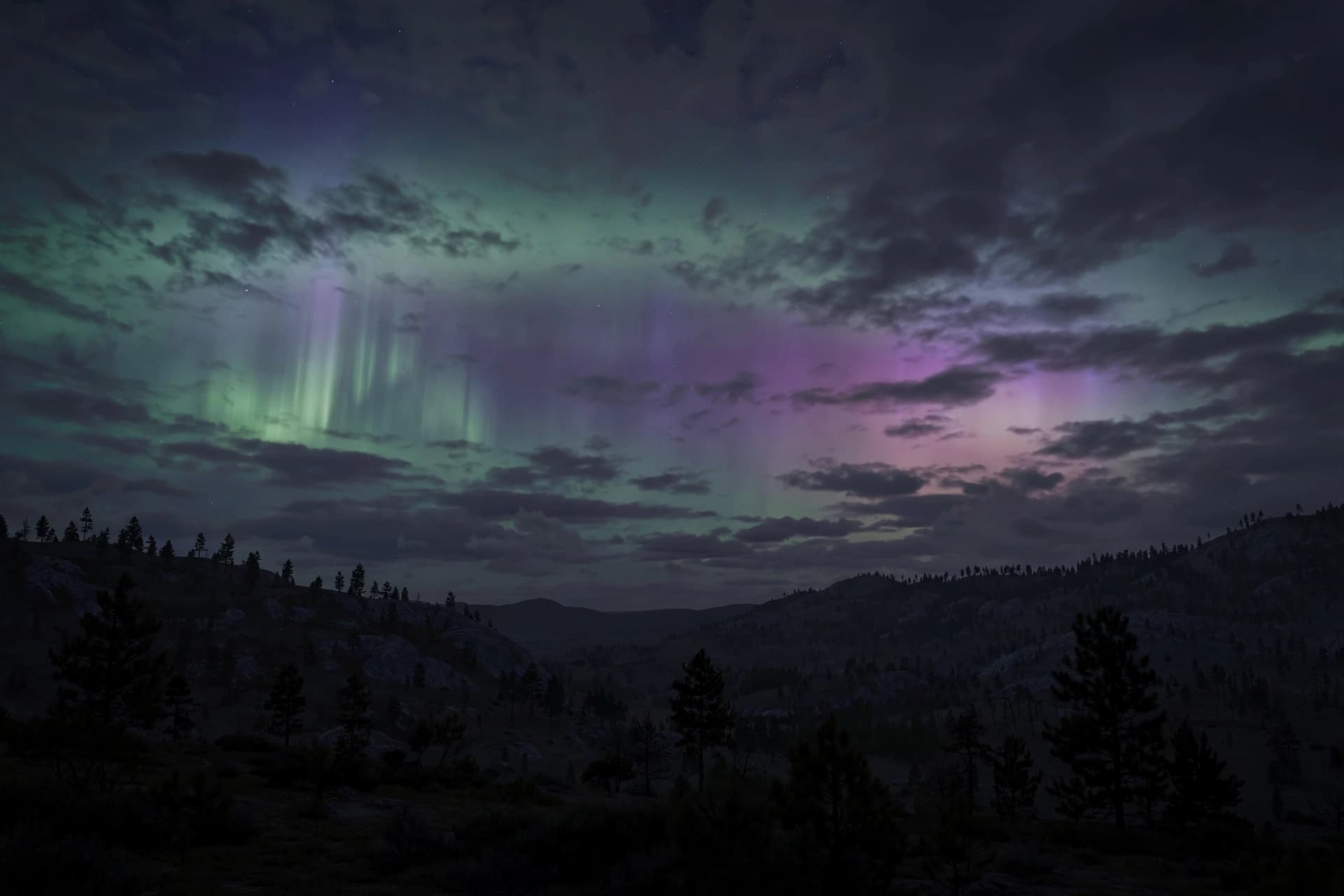
AI Image Disclaimer: Visual content accompanying this article is generated by artificial intelligence for illustrative purposes only.
Sources: NOAA Space Weather Prediction Center, WeatherBug, USA TODAY, Opera News
Published by Banx Network. This article is part of the Banx decentralized media programme, powered by the BXE token on the XRP Ledger.