The Nobel Peace Prize is announced only once a year, but the conversation around it can begin months earlier, gathering names, expectations, public campaigns, and quiet speculation. In 2026, President Donald Trump has been among the figures discussed publicly in connection with the prize. Yet as the October announcement approaches, recent reporting has highlighted a more complicated picture than the public campaign surrounding his interest might suggest.
Reuters reported on October 1 that experts it consulted considered Trump unlikely to receive the 2026 Nobel Peace Prize. The assessment came as the Norwegian Nobel Committee prepared to announce its decision on October 9. Importantly, the committee does not publicly confirm individual nominees, and its deliberations are confidential.
The official Nobel organization says 287 candidates were nominated for the 2026 prize, including 208 individuals and 79 organizations. It also stresses that the names of nominees are not publicly confirmed by the committee and that nomination records remain confidential for 50 years. Claims that particular political leaders or organizations have been nominated can therefore come from people who say they submitted nominations rather than from the committee itself.
Trump's name entered the public discussion through claims by national leaders that they had nominated him. Reuters reported in April that leaders from Cambodia, Israel and Pakistan had said they nominated Trump, while also noting that such claims could not be independently verified by the Nobel Committee because of its confidentiality rules.
The 2026 discussion also follows an unusual development involving last year's laureate, Venezuelan opposition leader Maria Corina Machado. Reuters reported that Machado later gave her Nobel medal to Trump, following his public lobbying for the prize and amid her efforts to obtain U.S. support for democratic change in Venezuela. That episode has become part of the context surrounding this year's discussion.
Haakon Gjerloew, acting director of the Peace Research Institute Oslo, told Reuters that the events surrounding last year's award could influence how the committee thinks about the 2026 selection. He suggested that the committee may consider whether a potential award could expose a laureate to political pressure. This is an expert's assessment, not a statement of the Nobel Committee's internal reasoning.
Reuters also reported that experts were discussing several possible recipients or organizations, including Pope Leo, the International Criminal Court, the International Court of Justice and UN rapporteur Francesca Albanese. Such names are part of public expert discussion rather than an official Nobel shortlist, which the committee does not disclose.
The committee is scheduled to announce the 2026 Nobel Peace Prize on Friday, October 9, in Oslo. Until then, the public record can establish the number of nominees, the rules governing confidentiality, Trump's publicly reported interest and the assessments offered by outside experts, but it cannot establish the committee's final choice in advance.
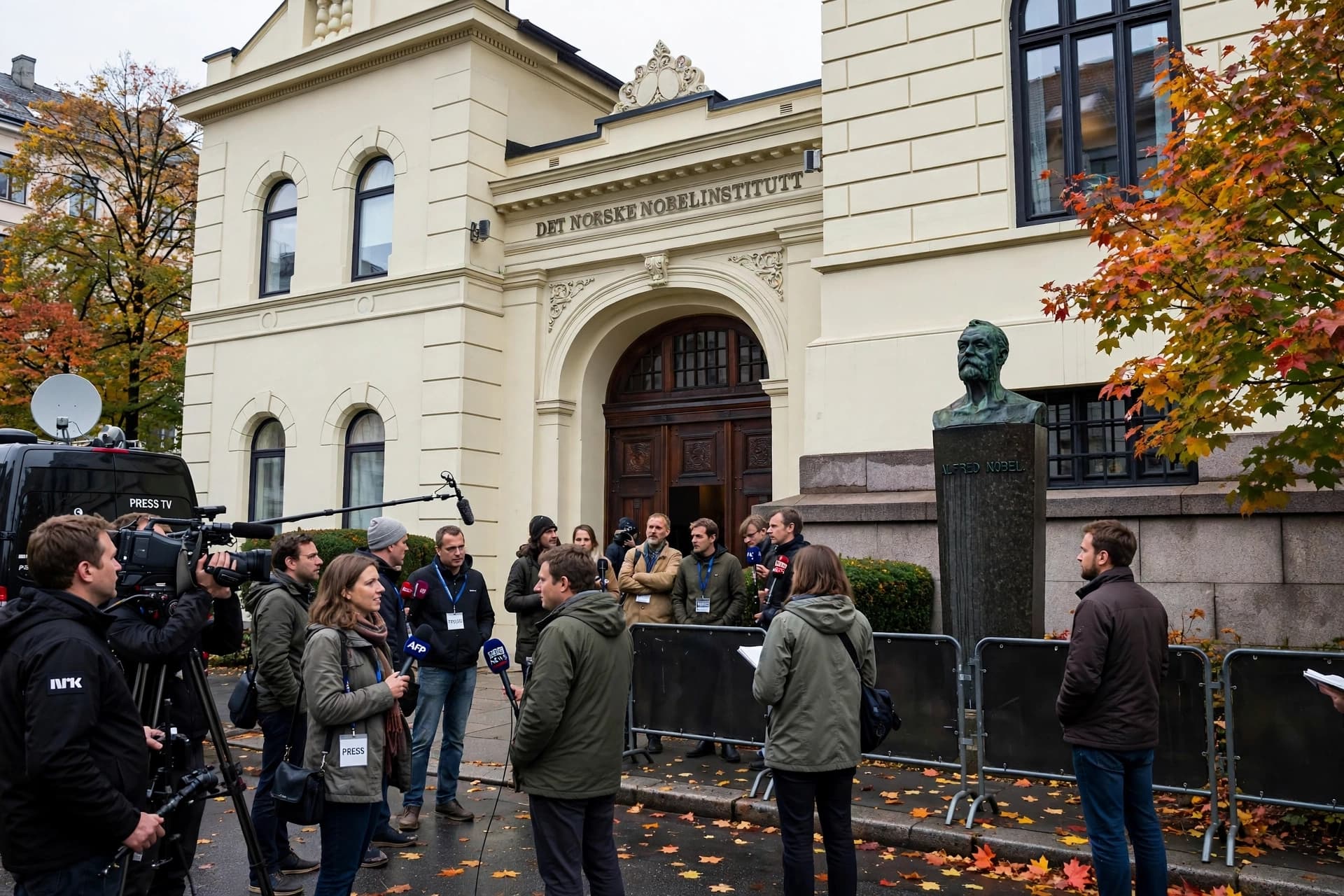
AI Image Disclaimer: This image is AI-generated for editorial illustration and does not represent an official Nobel Committee scene.
Sources: Reuters; Norwegian Nobel Institute; Peace Research Institute Oslo
Published by Banx Network. This article is part of the Banx decentralized media programme, powered by the BXE token on the XRP Ledger.