There was once a time when poets and sky‑gazers spoke of the Moon as an unchanging, serene companion — a luminous pearl beside our Earth, constant and unmoving in its path across the night. Yet in the quiet of space, far from human footsteps or starlight’s glare, there lies a slow dance of change. Like an old map fading at its edges, the Moon’s surface bears subtle marks of time and transformation, suggesting something deeper within is shifting and settling.
Modern planetary scientists have turned their instruments and analyses toward this celestial neighbor with renewed curiosity, uncovering evidence that the Moon’s interior continues a gradual process of cooling. As this once fi nal‑forge of fiery beginnings cools, the entire sphere contracts — akin to a grape slowly shriveling into a raisin. Unlike the supple skin of fruit, the brittle lunar crust responds to that contraction by creasing, folding, and breaking.
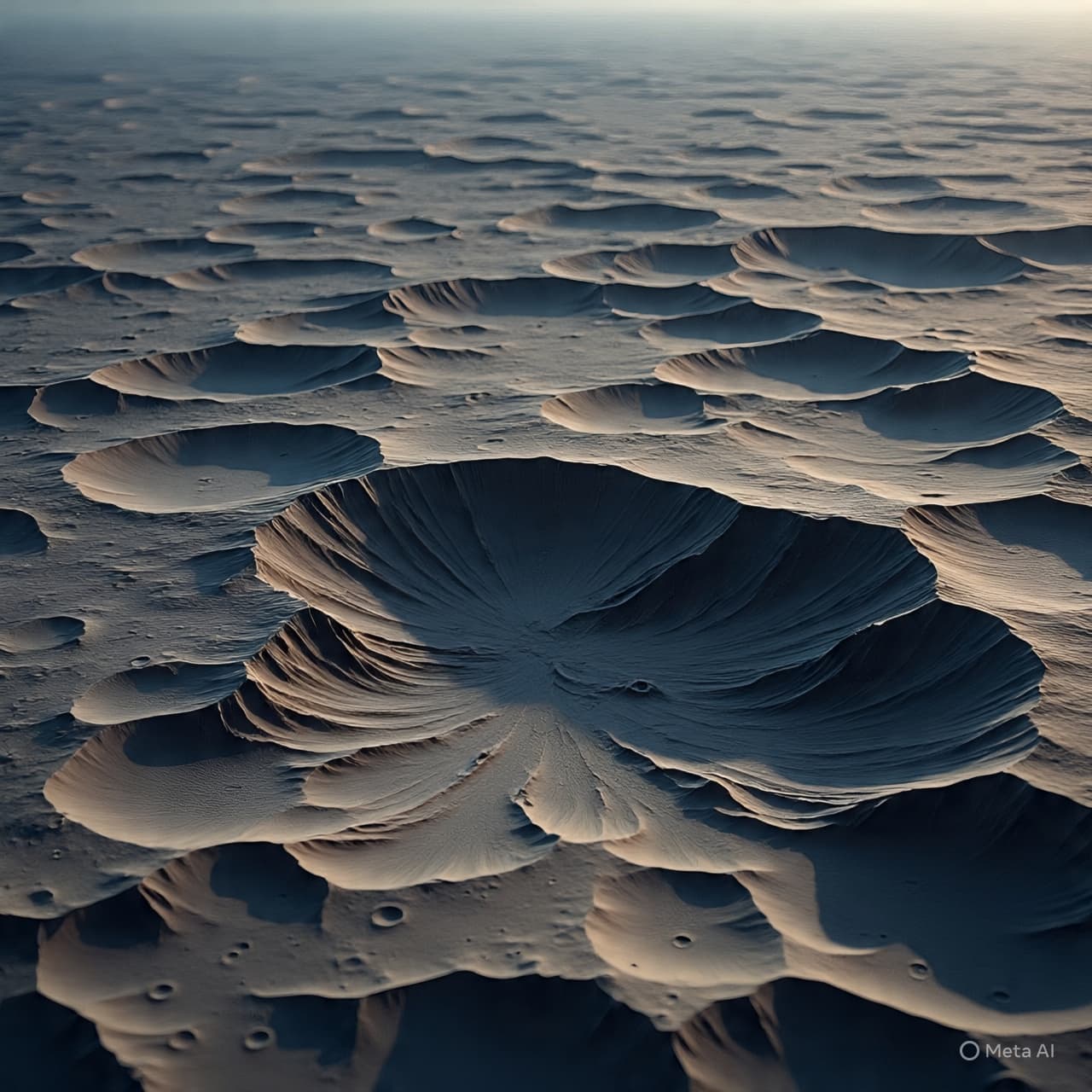
These creases appear as thrust faults and ridges — small but telling features that trace the Moon’s geological heartbeat. In recent research, scientists catalogued thousands of such subtle ridges across the lunar plains, each a sign of compressional forces at work. Far from relics of a long‑past era, these features are among the Moon’s youngest geological structures, hinting that the forces shaping the lunar surface are ongoing and dynamic.
Where the crust is stressed and bent, energy can be released in the form of moonquakes. These tremors have been detected at varying depths — some caused by the pull of Earth’s gravity, others by meteoroid impacts or thermal stresses. But the types linked to the Moon’s slow contraction occur nearer the surface, shaking the ground where the crust is most brittle.
Such shallow moonquakes are relatively rare and not catastrophic in human terms. Yet they can last for several minutes and, in places, reach magnitudes that would be noteworthy here on Earth. That explains the fresh tracks of rockfalls and landslides seen near some thrust faults — recent evidence that the lunar surface is not as silent as it once seemed.
For planners of future lunar exploration and habitation, these tremors carry practical implications. Some regions of scientific and logistical interest, notably near the lunar poles, show concentrations of young faults and potential quaking zones. Understanding where moonquakes are most likely can inform safe landing sites and guide the placement of habitats or instruments, blending curiosity with caution in the space age’s next chapter.
Yet through it all, the Moon still shines in the night sky — its gentle glow a reminder not of stasis, but of slow, continuing change. In its creases and faint quivers, we glimpse a world that, though seemingly serene, carries within it a quiet record of cooling, contraction, and cosmic history.
AI Image Disclaimer (rotated wording) Visuals are created with AI tools and are not real photographs.
Sources Check
ScienceDaily NASA NASA (Moonquake science) Smithsonian Institution Euronews
Published by Banx Network. This article is part of the Banx decentralized media programme, powered by the BXE token on the XRP Ledger.