The Moon has long been regarded as a quiet companion in Earth's night sky, preserving the scars of countless impacts across billions of years. Most of those collisions arrived unannounced from the depths of space, but one upcoming event is different. This time, scientists know where the impact is expected to occur, approximately when it will happen, and they are preparing telescopes around the world to witness it unfold.
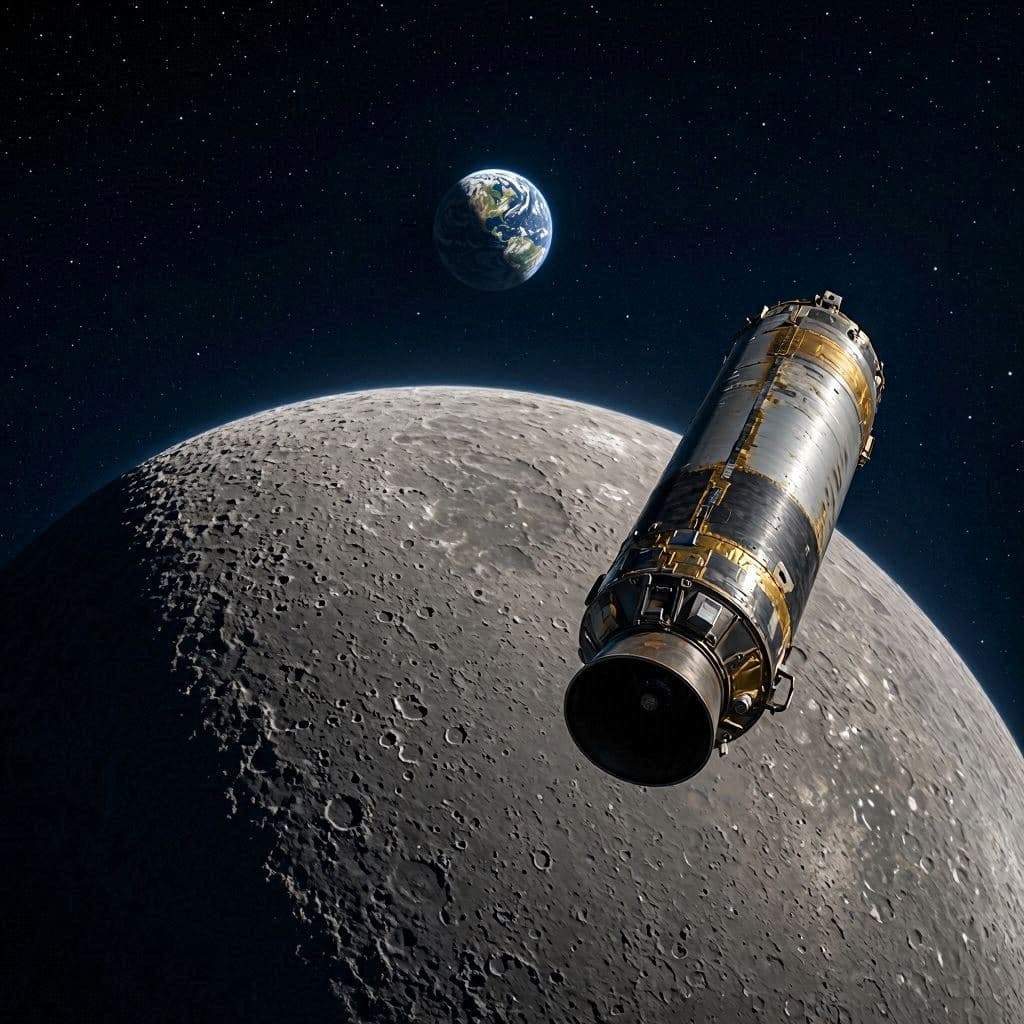
The object on course for the Moon is a spent Falcon 9 upper stage launched by SpaceX in January 2025. After delivering Firefly Aerospace's Blue Ghost-1 lunar lander and ispace's Hakuto-R Mission 2 spacecraft toward the Moon, the rocket stage was left in a highly elongated orbit. Gravitational interactions gradually altered its trajectory, placing it on a predicted collision course with the lunar surface.
Current calculations indicate that the rocket stage is expected to strike near Einstein Crater on August 5, 2026, traveling at roughly 2.4 kilometers per second, or about 5,400 miles per hour. The impact is anticipated to create a new crater and eject a cloud of lunar dust. Although such impacts occur naturally when meteoroids strike the Moon, an artificial object of known size and speed provides scientists with an unusual opportunity to compare predictions with real observations.
Astronomers hope the collision may produce a brief flash of light or a visible plume of debris. Whether either phenomenon can be seen from Earth remains uncertain. The impact will occur on a sunlit portion of the Moon near its visible edge, meaning sunlight could make the flash difficult to detect. Even so, professional observatories, amateur astronomers, and spacecraft already orbiting the Moon are expected to monitor the event from multiple perspectives.
Researchers emphasize that the event presents no threat to Earth or to ongoing lunar missions. Instead, it offers an opportunity to improve understanding of how impacts excavate lunar material, disperse dust, and form craters. Data collected during the event may help refine computer models used to interpret both natural asteroid impacts and future human activities on the lunar surface.
The incident also draws attention to the growing presence of human-made objects beyond Earth orbit. As more government agencies and private companies conduct missions to the Moon, experts have increasingly discussed how discarded hardware should be tracked and managed. While this collision was not intentional, it illustrates the importance of long-term planning for spacecraft operating throughout cislunar space.
Scientists are encouraging coordinated observations from both professionals and experienced amateur skywatchers. Even if the impact flash is too faint for many observers, combining measurements from different telescopes could help reconstruct the event and provide valuable information about the Moon's surface and the behavior of impact ejecta. Such collaborative campaigns have become an increasingly important part of modern planetary science.
Whether the collision becomes a visible spectacle or remains detectable only through scientific instruments, it represents a rare moment when researchers can anticipate a lunar impact before it occurs. The Moon has recorded the history of countless cosmic collisions, and this carefully observed event will add one more chapter—this time witnessed by humanity in real time.
AI Image Disclaimer: The accompanying images are AI-generated artistic interpretations based on published scientific information and are intended to illustrate the expected event rather than depict actual observations.
Sources (Verified):
NASA Space.com Scientific American Smithsonian Magazine arXiv
Published by Banx Network. This article is part of the Banx decentralized media programme, powered by the BXE token on the XRP Ledger.