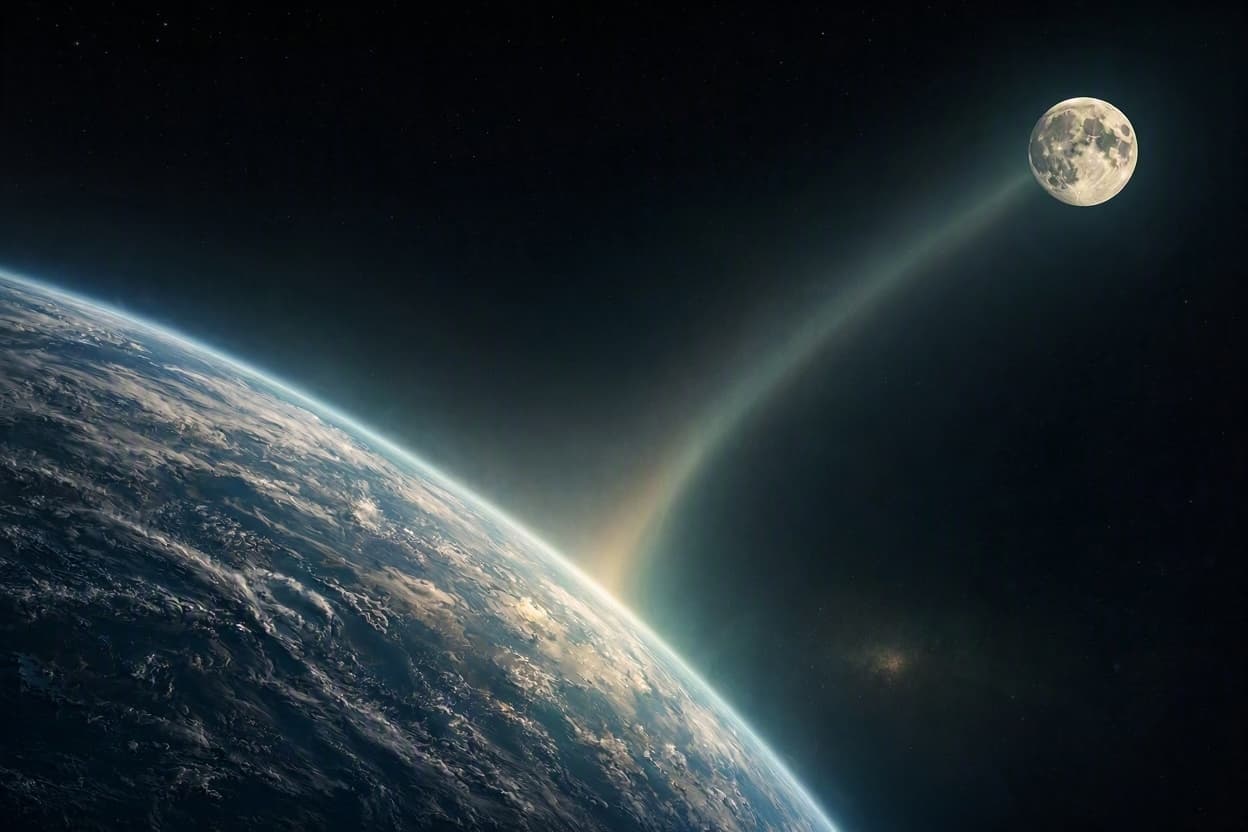
We often imagine space as a void that begins precisely where our blue sky fades into black, a sharp boundary between the familiar and the infinite. Yet, this perception is an illusion of perspective. In reality, Earth’s embrace extends far beyond the curve of the horizon, wrapping our planet in a tenuous, ghostly halo of hydrogen atoms known as the geocorona. This ethereal cloud stretches outward for 630,000 kilometers, a distance so vast that it completely envelops the Moon, reminding us that even in the deepest silence of the cosmos, we are never truly alone.
The discovery of the geocorona’s true extent was made possible by revisiting data from the Solar and Heliospheric Observatory (SOHO), a joint mission between NASA and the European Space Agency. For years, scientists knew that hydrogen escaped from Earth’s upper atmosphere, but they underestimated its reach. The new analysis reveals that this hydrogen envelope extends up to 50 times the diameter of our planet, creating a faint, ultraviolet-glowing sphere that dwarfs the Earth-Moon system in scale. It is a subtle presence, invisible to the naked eye, yet undeniable in its scientific reality.
For astronauts who have walked on the lunar surface, this means that their historic steps were taken not in a perfect vacuum, but within the outermost whispers of Earth’s atmosphere. The Apollo 16 mission, in fact, captured an image of this geocorona glowing in ultraviolet light, a poetic testament to the connection between our world and its satellite. While the density of these hydrogen atoms is incredibly low—just a few atoms per cubic centimeter—it is sufficient to be detected by sensitive instruments, bridging the gap between planetary science and astronomy.
The geocorona is formed when sunlight interacts with hydrogen atoms in the upper atmosphere, causing them to scatter ultraviolet light. This process, known as Lyman-alpha scattering, creates a faint glow that can be observed from space. Although it poses no physical resistance to spacecraft, its presence has implications for future astronomical observations. Telescopes placed on the Moon or in orbit must account for this background glow, which can interfere with sensitive measurements of distant stars and galaxies.
This finding also reshapes our understanding of atmospheric loss. The fact that hydrogen can travel so far before escaping into interplanetary space suggests that Earth’s gravitational hold is more extensive than previously thought. It provides insights into how planets interact with their space environments and how atmospheric particles behave under the influence of solar wind. These dynamics are crucial for modeling the evolution of planetary atmospheres over billions of years.
For the public, the idea that the Moon swims in Earth’s atmospheric ocean is a humbling reminder of our planet’s reach. It challenges the notion of Earth as an isolated island in space, instead presenting it as a dynamic system with influences that ripple far into the cosmos. This perspective fosters a deeper appreciation for the interconnectedness of celestial bodies and the delicate balance that sustains life.
As we plan future missions to the Moon and beyond, understanding the geocorona becomes increasingly important. It affects everything from orbital mechanics to the calibration of scientific instruments. By studying this faint halo, scientists can refine their models of space weather and atmospheric physics, ensuring safer and more accurate exploration. It is a small detail with significant practical applications.
In the end, the geocorona is a symbol of Earth’s enduring presence. Even at the distance of the Moon, our planet leaves its mark, a silent witness to human exploration. It reminds us that home is not just a place on the ground, but a sphere of influence that extends into the stars. Every journey to the Moon is, in a very real sense, a voyage through the outer edges of our own world.
AI Image Disclaimer: The visual elements in this article are AI-generated illustrations depicting Earth’s atmospheric layers and abstract representations of hydrogen clouds, designed to reflect the themes of space science without showing real proprietary satellite data or specific mission footage.
Sources: ESA Science & Technology, Space.com, EarthSky, Phys.org
Published by Banx Network. This article is part of the Banx decentralized media programme, powered by the BXE token on the XRP Ledger.