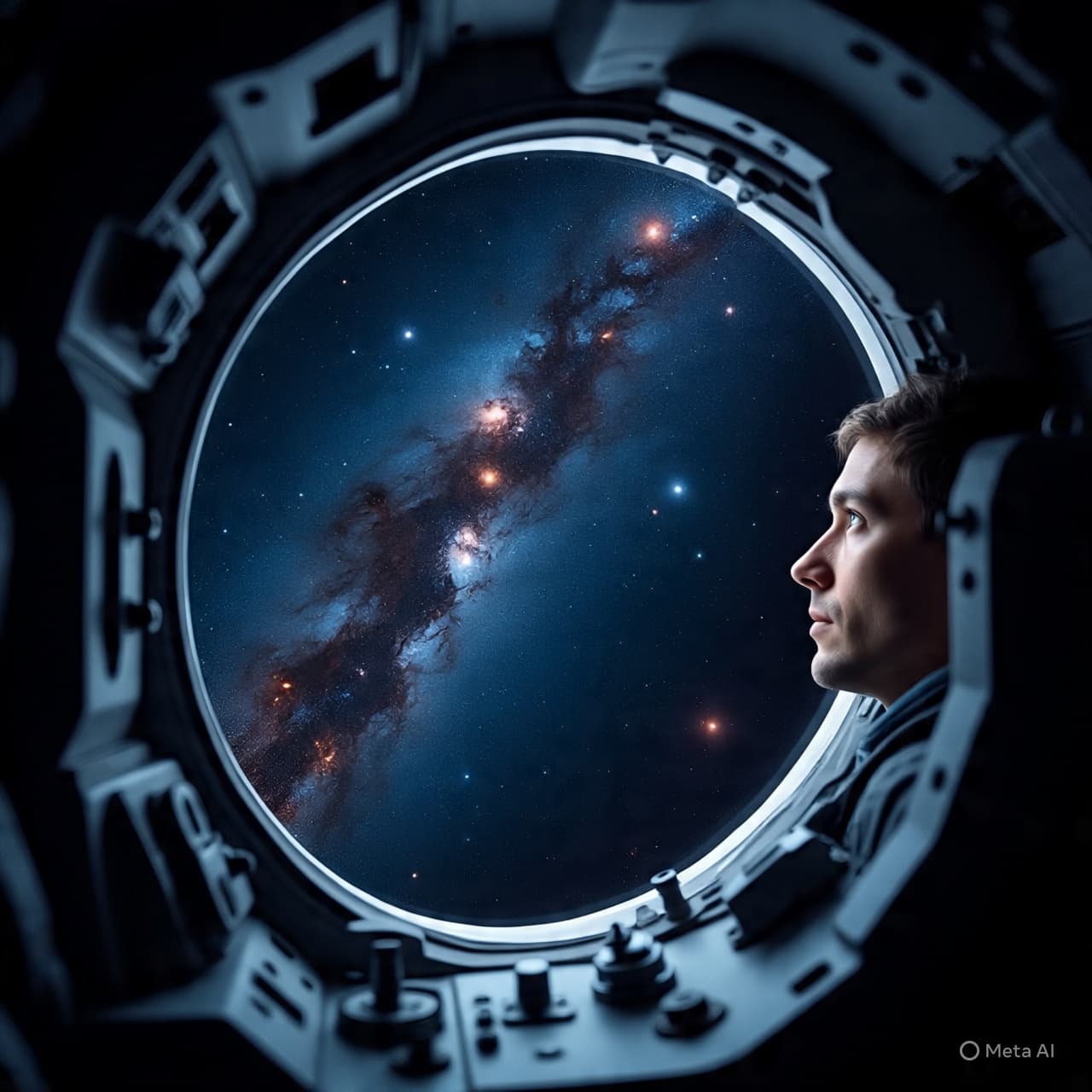
There is a moment, rarely spoken of outside the quiet circles of astronauts, when distance becomes something more than measurement. It is not counted in kilometers, but in feeling. For the Artemis II crew, that moment arrived not with a loud announcement, but with a quiet realization—Earth, the only home they have ever known, had slipped from view.
The Artemis II mission, part of NASA’s renewed push toward deep space exploration, carries humans farther than any crewed mission in decades. As the spacecraft traced its path beyond familiar orbit, the planet that once filled their windows gradually shrank, then softened, and eventually disappeared altogether. It was not dramatic. It was subtle, almost gentle—and perhaps that is what made it so profound.
Crew members later described the experience as deeply unsettling. One astronaut reflected that “human minds shouldn’t have to go through this,” not as a criticism of exploration, but as an honest acknowledgment of how deeply humans are rooted to Earth. The absence of that visual anchor, the steady presence of the blue planet, seemed to alter something fundamental in perception.
Psychologists have long studied the “overview effect,” a cognitive shift experienced by astronauts when viewing Earth from space. Yet this moment—the inverse, when Earth vanishes—remains less understood. Instead of awe, it introduces a quiet disorientation, a sense of detachment from everything familiar: geography, culture, even time itself.
In practical terms, the crew remained safe, guided by precise instruments and mission protocols. But emotionally, the experience revealed the limits of preparation. Training can simulate weightlessness, emergency scenarios, and technical failures, but it cannot fully recreate the feeling of watching your world disappear into darkness.
NASA officials have noted that these insights are critical as humanity prepares for longer missions, including journeys to Mars. Understanding the psychological landscape of deep space is as essential as mastering propulsion or navigation. The human mind, after all, travels alongside the spacecraft.
The Artemis II crew’s reflections also highlight a broader question: what does it mean to leave Earth, not just physically but emotionally? As exploration pushes further outward, the distance between humans and their home may become one of the greatest challenges—not of engineering, but of identity.
Still, the mission continues, guided by purpose and curiosity. The disappearance of Earth is not an end, but a threshold—a reminder that exploration often asks more from us than we expect, revealing both our resilience and our fragility.
In the quiet after that moment, the crew carried on, their journey unfolding against a backdrop of stars. And somewhere behind them, unseen but ever present, Earth remained—no longer visible, but not forgotten.
AI Image Disclaimer Visuals are created with AI tools and are not real photographs.
Source Check NASA BBC CNN The Guardian Space.com
Published by Banx Network. This article is part of the Banx decentralized media programme, powered by the BXE token on the XRP Ledger.