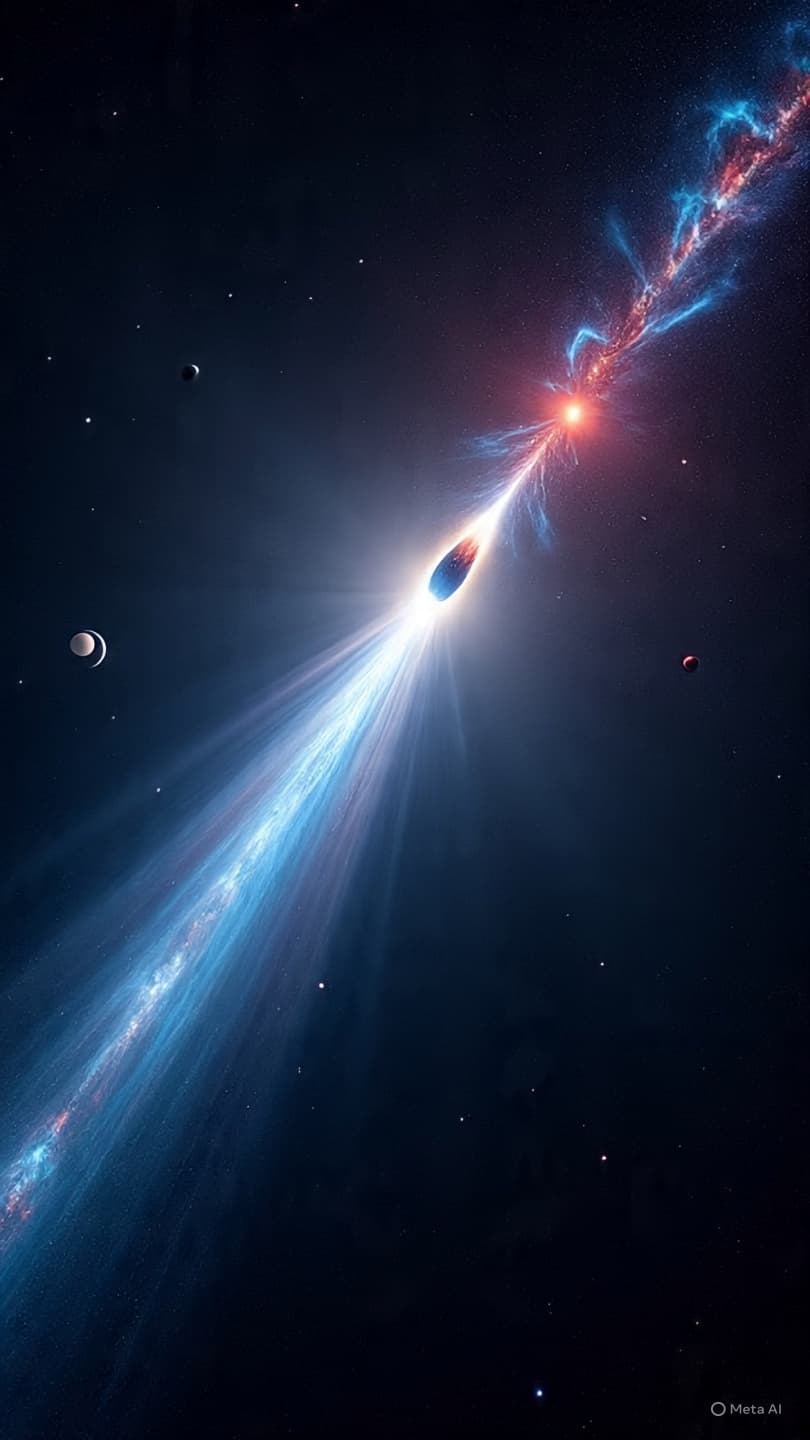
There is a certain stillness we associate with space, as if distance itself enforces calm. Objects drift, orbit, and endure, held in place by forces that feel steady and predictable. Yet every so often, that quiet gives way—not to chaos, but to a moment of change, unfolding slowly enough to be observed, yet rare enough to feel almost intimate.
It was during one such moment that captured something unexpected: a comet in the act of breaking apart. Not as a single dramatic event, but as a gradual separation, where fragments began to drift from the main body, each following its own path through space.
The comet itself, a relatively small and fragile object, had likely been shaped over long periods by subtle forces—solar radiation, gravitational interactions, and the slow weakening of its internal structure. Comets are, by their nature, loosely bound collections of ice, dust, and rock. They are often described as “dirty snowballs,” though the phrase hardly captures the delicacy of their composition.
In this case, the fragmentation appears to have occurred as the comet moved closer to the Sun, where increased heat can cause volatile materials to sublimate—transforming directly from solid to gas. This process creates jets that can act like gentle thrusters, altering the comet’s rotation and placing stress on its structure. Over time, these stresses can lead to cracks, and eventually, to separation.
What makes this observation particularly meaningful is its timing. The breakup was not inferred after the fact, but witnessed as it unfolded. Through a series of images, scientists were able to track the progression—from a single body to multiple fragments—each step offering insight into how such events occur.
There is a certain clarity in seeing a process rather than reconstructing it. It allows researchers to refine their models, to compare expectation with observation, and to better understand the conditions under which comets remain intact or begin to disintegrate. In this sense, the event becomes more than an isolated occurrence; it becomes a reference point for future study.
The fragments themselves continue to move outward, forming a kind of temporary constellation. Each piece carries with it part of the comet’s original composition, offering opportunities to study its internal makeup in ways that might not have been possible otherwise. What was once hidden within a single body is now, in a sense, exposed.
There is also a broader perspective to consider. Comets are often seen as remnants of the early solar system, preserving materials from its formation. When one breaks apart, it is not only a structural change, but a redistribution of those materials—an ongoing process in a system that is still evolving.
At the same time, the event does not suggest instability on a larger scale. Comet fragmentation is a known phenomenon, observed in different forms over time. What is unusual here is the opportunity to observe it so directly, with the level of detail provided by modern instruments.
The , in capturing this sequence, continues its long tradition of revealing moments that might otherwise pass unnoticed. Its observations do not alter the event, but they allow us to witness it, to understand it as it happens rather than as a distant conclusion.
As scientists continue to analyze the data, they will work to determine the specific factors that contributed to this breakup, comparing it with other known cases. The goal is not only to understand this comet, but to build a more complete picture of how such objects behave over time.
For now, the images stand as a quiet record of change—a reminder that even in the vastness of space, where motion often feels slow and distant, there are moments of transformation that can be seen, studied, and gently understood.
AI Image Disclaimer Illustrations were produced with AI and serve as conceptual depictions.
Source Check (Credible Media Mentions)
NASA BBC Space.com The Guardian Scientific American
Published by Banx Network. This article is part of the Banx decentralized media programme, powered by the BXE token on the XRP Ledger.