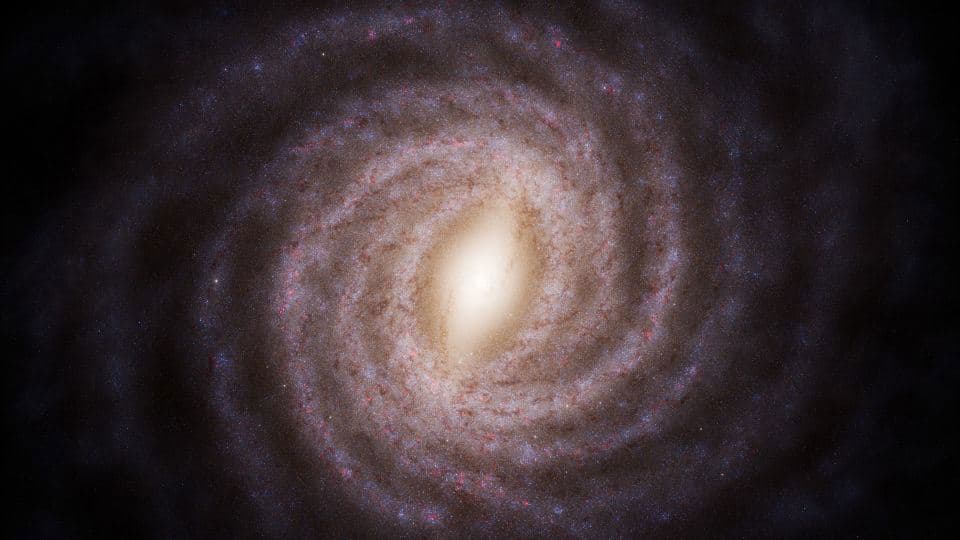
Astronomers have concluded that the Milky Way galaxy has consumed another galaxy, with new evidence brought to light about the remnants of this cosmic event. The absorbed galaxy, known as Gaia-Enceladus, was approximately a quarter the size of the Milky Way at the time of its absorption, adding substantial insight into the Milky Way's historical growth patterns.
This groundbreaking discovery stemmed from data collected by the Gaia satellite, which has been mapping the positions and movements of over a billion stars with unprecedented accuracy. The satellite revealed a vast stellar stream of around 30,000 stars that share similar orbits, providing compelling evidence of their common origin in the now-extinct galaxy.
The stellar stream is characterized by elongated orbits that are inclined to the plane of the Milky Way's disk and move in a direction that is contrary to other stars, suggesting they are remnants of past merger events. Remarkably, this structure surrounds the Sun, allowing astronomers to observe these stars stretching across the sky.
What makes this discovery significant is that the stars from Gaia-Enceladus exhibit distinct chemical properties, showing lower iron content than the typical stars found in the Milky Way. Additionally, the stars within this stream appear to be roughly 10 to 13 billion years old, indicating they originated well before the Milky Way's evolution into its current form.
The process by which the Milky Way consumes smaller galaxies involves gravitational interactions, where the larger galaxy's gravity stretches and ultimately disassembles the smaller galaxy over time. As Gaia-Enceladus spiraled into the Milky Way's gravitational pull, its stars were torn apart, creating the observable stellar stream that scientists can study today.
These findings not only enrich our understanding of the Milky Way's dynamic history but also foster interest in the broader implications of galactic mergers in the universe, offering insights into how galaxies evolve and grow over billions of years. Scientists are eager to continue exploring these cosmic connections to uncover further secrets of our galaxy's past.
Published by Banx Network. This article is part of the Banx decentralized media programme, powered by the BXE token on the XRP Ledger.