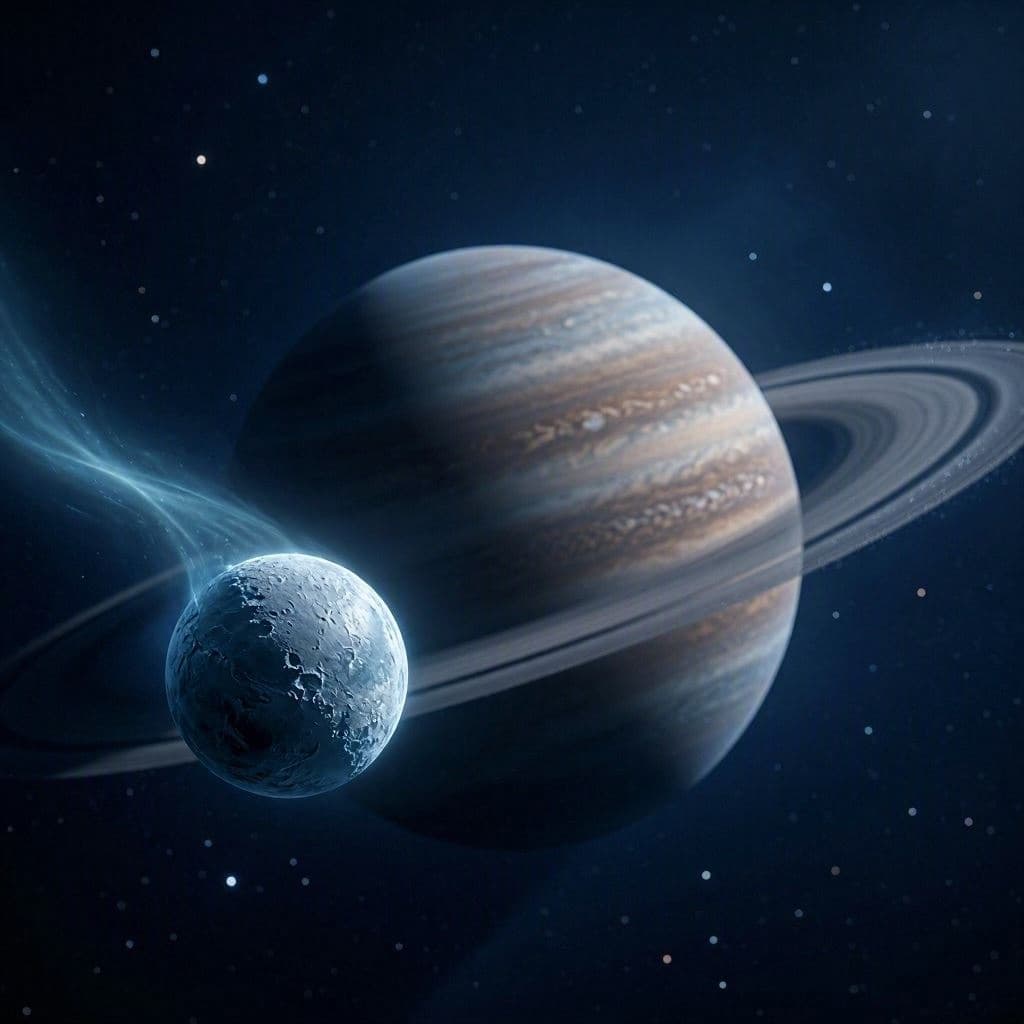
In the vast, silent theater of the solar system, size is not always a measure of influence. Enceladus, a modest moon of Saturn, spans merely 504 kilometers, a distance roughly equivalent to half the length of Great Britain. Yet, this small icy world casts a shadow far beyond its physical dimensions. A groundbreaking study published in 2026 has revealed that Enceladus generates an electromagnetic wake so profound that it stretches for at least 504,000 kilometers through Saturn’s magnetosphere, a distance greater than the separation between the Earth and its Moon.
This discovery challenges our understanding of how small celestial bodies interact with their planetary environments. The moon is not merely a passive satellite orbiting in the void; it is an active participant in the complex dance of magnetic fields and plasma. As Enceladus moves through Saturn’s magnetosphere, it interacts with charged particles, creating a disturbance known as an Alfvén wave. These waves are ripples in the magnetic field, carrying energy and momentum across vast distances, much like the wake of a boat cutting through calm water.
The scale of this wake is staggering. To visualize it, one must imagine a thread extending from the tiny moon, reaching out into the darkness for hundreds of thousands of kilometers. This trail is not visible to the naked eye, but it is detectable through sensitive instruments that monitor electromagnetic fluctuations. The study utilized data from spacecraft missions to map this invisible structure, revealing the extent of Enceladus’s influence on its host planet’s magnetic environment.
Enceladus is already famous for its subsurface ocean and the geysers that eject water vapor and ice particles into space. These plumes provide the material that fuels the electromagnetic interaction. As the ejected material becomes ionized, it loads the magnetic field lines, generating the Alfvén waves that propagate downstream. This process links the moon’s geological activity directly to the broader dynamics of Saturn’s magnetosphere.
The implications of this finding extend beyond Saturn. It suggests that other small moons with active surfaces or subsurface oceans may also create significant electromagnetic signatures. This insight could aid in the detection of similar worlds around other planets, both within our solar system and in exoplanetary systems. By looking for these magnetic wakes, astronomers might identify hidden oceans beneath icy crusts without needing to land on the surface.
For scientists, the study underscores the interconnectedness of planetary systems. A small moon can have a outsized impact on its environment, shaping the behavior of plasma and magnetic fields on a grand scale. It reminds us that in space, even the smallest objects can leave lasting marks, influencing the cosmic landscape in ways that are only now being fully understood.
As future missions plan to explore the outer planets, understanding these interactions will be crucial. The ability to trace such wakes provides a new tool for probing the interiors of distant moons. It transforms the magnetosphere into a diagnostic medium, allowing researchers to peer beneath the ice and uncover the secrets held within.
The 2026 study of Enceladus’s electromagnetic wake highlights the surprising power of small celestial bodies. By tracing its influence across hundreds of thousands of kilometers, scientists have gained new insights into the dynamic relationship between moons and their planets, expanding our knowledge of the solar system’s hidden connections.
AI Image Disclaimer: The visual representations accompanying this article are generated by artificial intelligence to illustrate the scientific concepts described.
Sources: Nature Astronomy NASA Jet Propulsion Laboratory Science Daily
Published by Banx Network. This article is part of the Banx decentralized media programme, powered by the BXE token on the XRP Ledger.