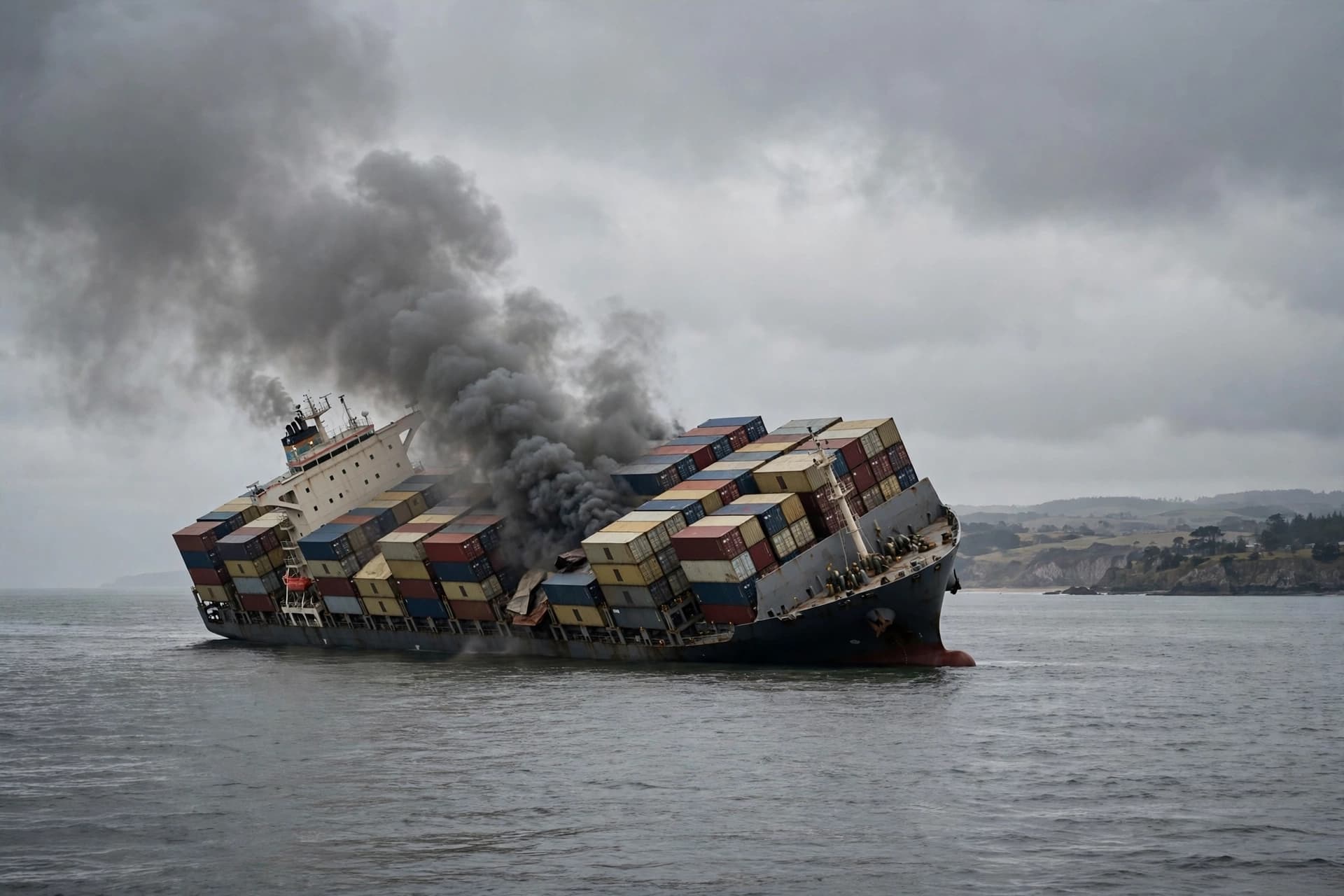
There is a particular vulnerability that comes with moving goods across open water, a trust that the sea will remain a corridor rather than a battleground. On Wednesday, that trust was broken once more in the western Black Sea. A Liberian-flagged container ship managed by a Greek company was struck by three naval drones as it passed through Bulgaria's exclusive economic zone, outside its territorial waters, en route from Haifa in Israel to Constanța in Romania. By Thursday morning, the vessel had sunk.
The ship was the Contship Jet, carrying 421 containers. The crew—fourteen Filipinos and four Ukrainians—was rescued and transferred safely to the port of Varna by a Bulgarian naval vessel. No injuries were reported among the eighteen seafarers. Video footage verified by Reuters showed a sea drone driving alongside the vessel before turning toward its hull, followed by an explosion that caused the ship to list before it eventually went down.
What makes this attack particularly concerning is what the ship was carrying. The cargo included lithium-ion batteries, corrosive liquids, acids, and industrial components. Bulgarian authorities are inspecting the coastline for possible contamination, though initial assessments on Thursday found no visible traces of pollution. The environmental risk, however, remains a live concern, one that will not be fully resolved until the inspections are complete.
The attack is not an isolated incident. At least six ships have been struck by drones off Bulgaria this month, and roughly two dozen seafarers are feared dead, according to government statements. Bulgaria's Prime Minister, Rumen Radev, has said some of the attacks appear to benefit Russia. Moscow has denied involvement in recent attacks and did not immediately comment on Wednesday's incident.
Responsibility for the Contship Jet attack remains unclear. Ambrey, a maritime risk management firm, analyzed footage reportedly filmed by a crew member and assessed that the drone was likely a variant of, or derived from, the Russian Murena-300S design. A former senior Ukrainian navy officer said the drone visible in the video did not resemble any Ukrainian naval drone model he was aware of. The ambiguity is itself a feature of this conflict, where attribution is contested and deniability is a strategic asset.
Bulgarian naval commander Kiril Mihaylov told national television that authorities had been alerted to a possible drone attack by a French patrol aircraft, but were unable to prevent it. The distance to the attack site exceeded the navy's capacity to respond in time, he said, and the attack occurred in international waters. The gap between warning and response is measured in minutes, and in this case, the minutes were not enough.
Bulgaria, a member of the EU and NATO, has sought assistance to bolster security off its Black Sea coast. The coastal states of Bulgaria, Romania, and Turkey plan to hold regular consultations on how to respond to the strikes. For the crews who sail these waters, the risk is no longer abstract. The sea that carries their livelihood has become a place where the line between commerce and conflict has blurred, and the consequences of that blurring are measured in sunken ships and lost lives.
Image note: The visuals accompanying this article were generated by artificial intelligence and do not depict the actual vessel or the individuals involved.
Sources: Reuters, Bulgarian government statements, Contships Management, Ambrey Analytics, eKathimerini, Gulf Today, Yonhap
Published by Banx Network. This article is part of the Banx decentralized media programme, powered by the BXE token on the XRP Ledger.