
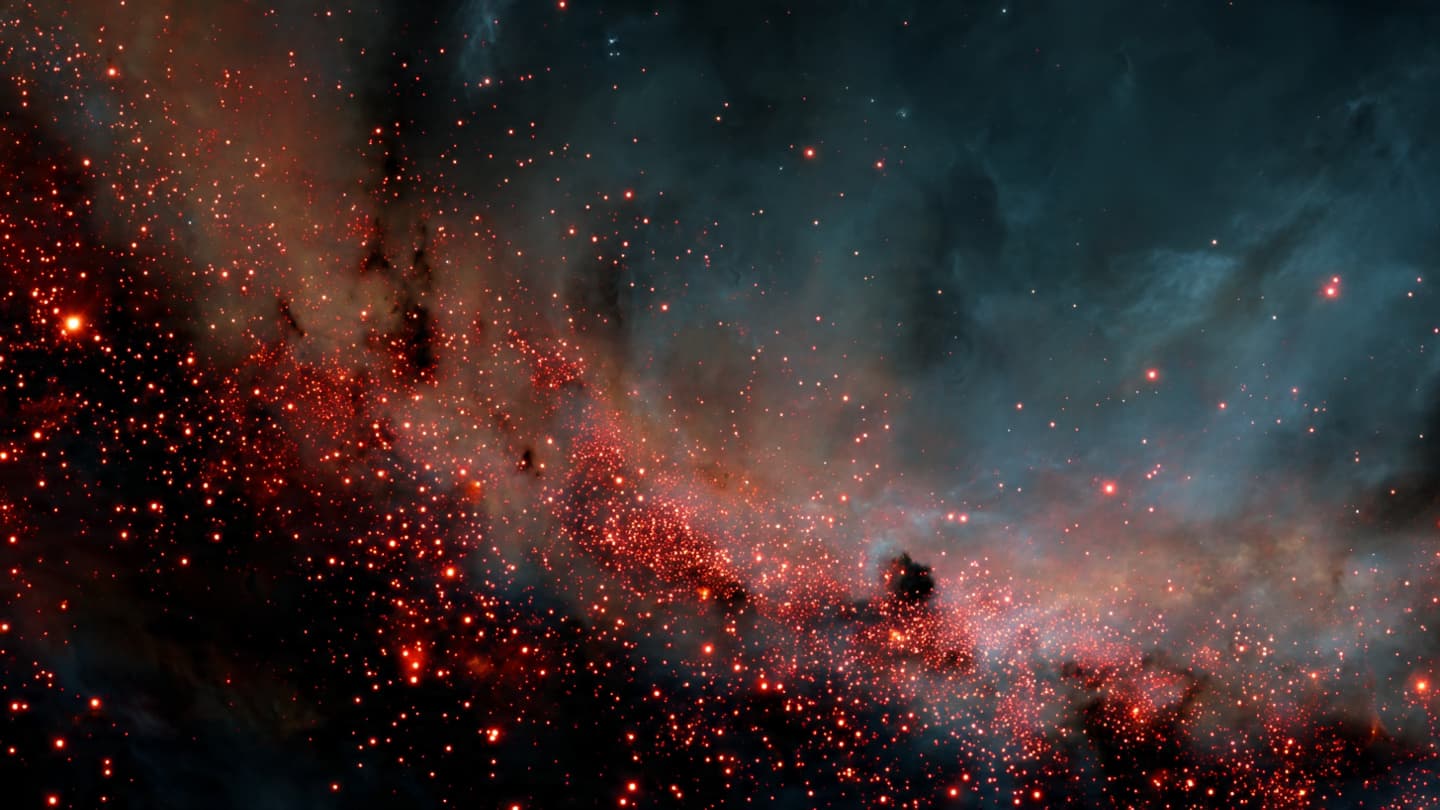
In the vast darkness of the universe, even the smallest points of light can feel like whispers from an ancient story. Each observation becomes a way of listening to time itself, stretched across billions of years.
Astronomers using the have focused on a distant black hole system that may help explain the nature of mysterious cosmic features often referred to as “little red dots.” These compact, faint objects have puzzled researchers since their detection in deep space surveys.
The telescope’s advanced infrared capabilities allow it to capture light that has traveled for billions of years, revealing structures that were previously beyond the reach of earlier instruments. In this case, observations of a black hole environment may provide clues about how early galaxies formed and evolved.
Scientists believe that these “little red dots” could represent early galactic cores or highly active black hole regions, though interpretations remain under study. The new data helps refine models of how energy and matter behaved in the early universe.
The observations also connect to broader questions about cosmic evolution—how matter clustered, how light escaped dense regions, and how black holes influenced surrounding space during formative cosmic eras.
By focusing on these distant structures, researchers aim to build a clearer timeline of the universe’s development, linking small-scale observations to large-scale cosmic history.
While no single observation provides definitive answers, each layer of data adds depth to ongoing scientific interpretation, slowly reducing uncertainty around these distant phenomena.
The latest findings from the James Webb observations contribute to an evolving scientific effort to understand early cosmic structures, offering new perspectives on long-standing astronomical questions.
AI Image Disclaimer: Illustrative visuals in this article are AI-generated to represent scientific concepts and are not direct telescope imagery.
Sources: NASA, ESA, Nature Astronomy, Science Magazine
Published by Banx Network. This article is part of the Banx decentralized media programme, powered by the BXE token on the XRP Ledger.



