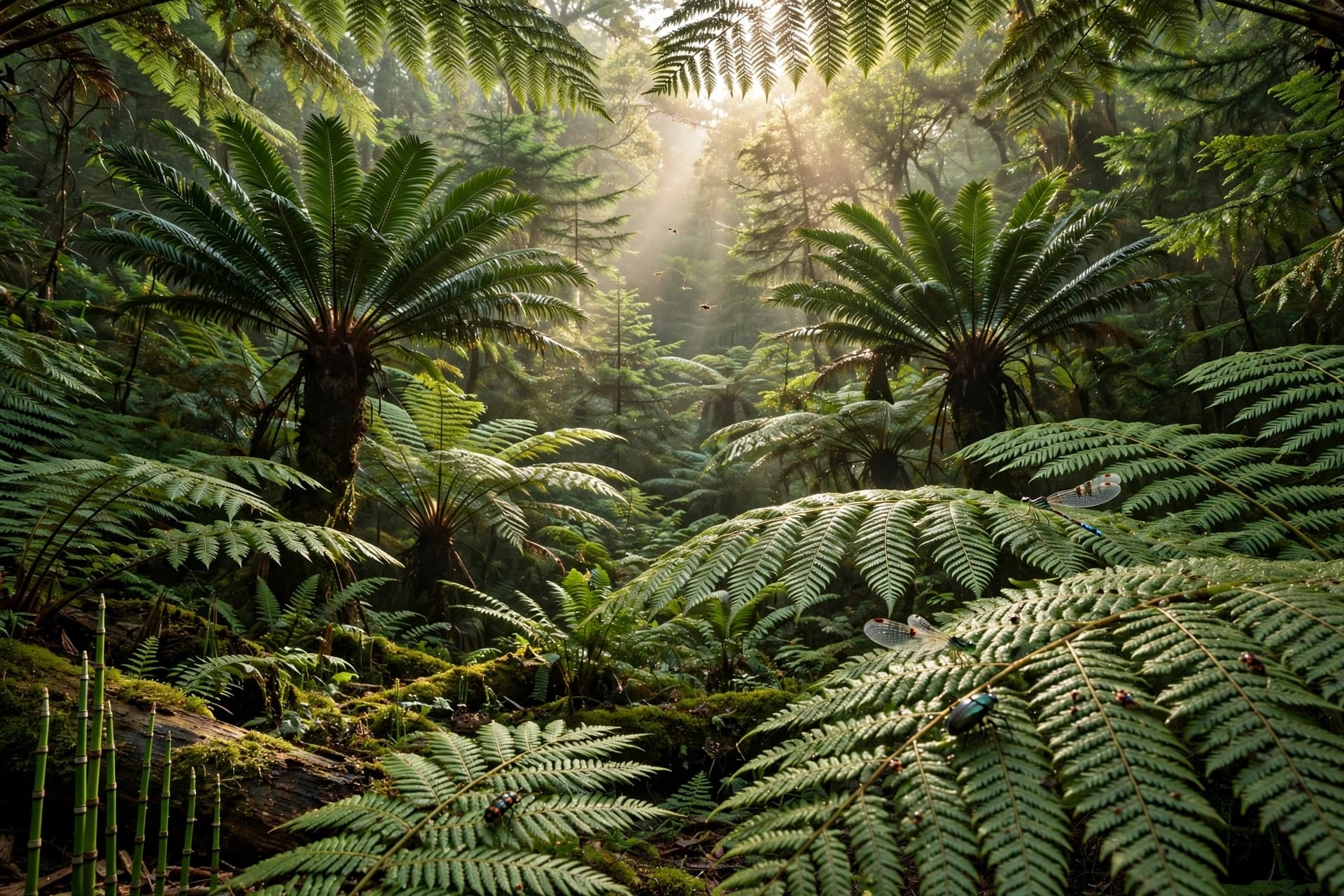
There is a particular silence that surrounds the deep past—a silence we have filled with our own imaginings, with the roars and rumbles of Hollywood, with the thunder of footsteps we have never heard. But the forests of the Jurassic were not silent. They were, according to a new study, alive with sound: the trills and chirps of insects, some of them pitched so high that human ears could never have detected them, filling the ancient canopy with a soundtrack we are only now learning to reconstruct .
The challenge of recovering that soundscape is fundamental. Soft tissues—vocal cords, lungs, the delicate structures that produce sound in most animals—do not fossilize. This is why filmmakers have historically relied on speculation, drawing on the cries of modern animals or, in the case of Jurassic Park, slowing down a dog's bark to create a dinosaur's roar . But insects offer a different path. Their sound-producing organs are embedded in their tough outer skeletons, and those structures can survive for millions of years .
The study, published in Proceedings of the National Academy of Sciences, focused on twenty fossilized insects representing nine species, all found in the same geological formation in Inner Mongolia and dating to roughly 165 million years ago . These insects—ancestors of modern crickets and katydids—produced sound through stridulation, rubbing a serrated vein on one wing against a scraper on the other. The spacing of the microscopic teeth on that vein determines the pitch of the sound, much like the ridges on a comb determine the tone when you run your fingernail across it .
To translate those fossils into sound, the researchers combined biomechanical models tested on living insects with laser measurements of wing vibration and machine learning algorithms to process the repetition rates . The results painted a picture of a soundscape far richer than expected. Most of the Jurassic insects produced low-frequency calls, around five kilohertz, similar to modern crickets. But one species, a katydid relative called Sigmaboilus peregrinus, emitted frequencies between twenty and twenty-two kilohertz—crossing into the ultrasonic range, beyond the limit of human hearing .
That finding is significant because it pushes back the known history of ultrasonic communication. Bats, long considered the earliest animals to use ultrasound for echolocation, did not appear until tens of millions of years later. If Sigmaboilus peregrinus was indeed communicating at those frequencies, it suggests that the pressures driving ultrasonic signaling—perhaps the need to evade predators with less acute hearing—were already at work in the Jurassic .
The sounds themselves, as reconstructed, are unlike the buzzing and rasping of many modern insects. Many were pure tones, narrow bands of frequency that would have sounded like sharp electronic beeps or high-pitched whistles . These clean, concentrated signals would have been difficult for predators to locate precisely, a useful defense in a dark forest filled with creatures hunting by sound .
What remains missing from this reconstruction, of course, are the dinosaurs themselves. No vocal cords have ever been fossilized, and the sounds they made can only be inferred from bone structures and comparisons with living relatives . The Jurassic soundscape was vastly more complex than a chorus of insects. But for the first time, we have a fragment of it that is grounded in data rather than imagination—a faint, high-pitched echo of a world that has been silent for 165 million years, and now, however incompletely, is silent no longer.
AI Image Disclaimer: The images accompanying this article were generated by artificial intelligence and are for illustrative purposes only.
Sources: Proceedings of the National Academy of Sciences, Futura-Sciences, The Times of India, Superinteressante, Radio-Canada
Published by Banx Network. This article is part of the Banx decentralized media programme, powered by the BXE token on the XRP Ledger.