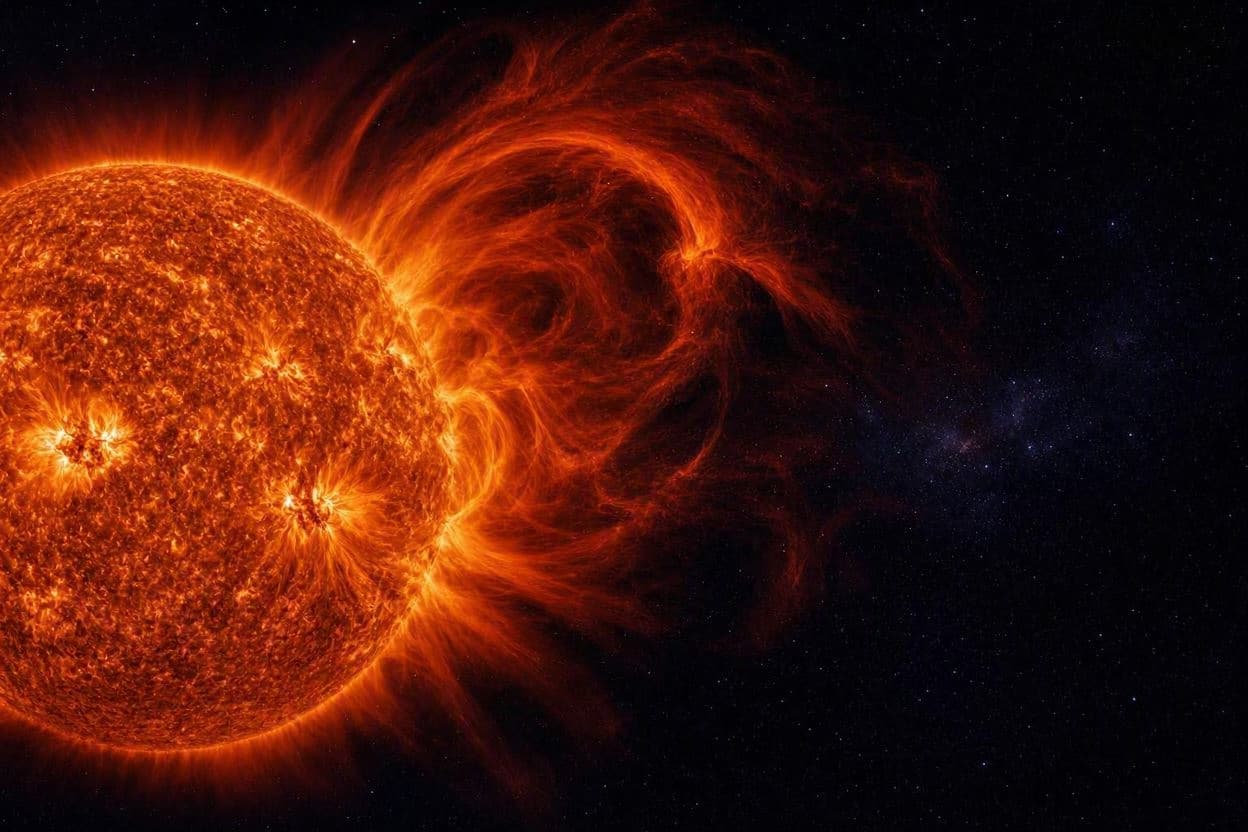
The sun, our nearest star, is a source of life and energy, yet it also possesses a volatile temper. Solar storms, massive eruptions of plasma and magnetic field from the sun’s corona, can travel across space and interact with Earth’s magnetosphere. While these celestial events create beautiful auroras, they also pose a significant threat to modern infrastructure, particularly the electrical grid. A new economic model has been developed to quantify the financial risks associated with these space weather events, highlighting the vulnerability of our technology-dependent society. It is a reminder that our economic stability is intertwined with cosmic forces beyond our control.
Solar storms can induce geomagnetic currents in long-distance power lines, potentially causing transformers to overheat and fail. The most famous example occurred in 1989, when a solar storm caused a nine-hour blackout in Quebec, Canada. While rare, extreme events like the Carrington Event of 1859 could have catastrophic effects today, given our reliance on electricity. The new model seeks to estimate the potential economic losses from such disruptions, considering factors like repair costs, lost productivity, and supply chain interruptions.
The model integrates data on solar activity, grid topology, and economic output to simulate various scenarios. It accounts for the varying resilience of different regions and the interconnectedness of the national grid. By assigning monetary values to potential outages, researchers can provide policymakers and utility companies with a clearer picture of the stakes involved. This quantification helps justify investments in protective measures, such as grid hardening and advanced monitoring systems.
One of the key findings is that the economic impact extends far beyond the immediate area of the outage. In a highly connected economy, a failure in one region can ripple through others, affecting industries ranging from finance to healthcare. The model highlights these cascading effects, showing that the total cost could reach billions of dollars for a severe event. This broader perspective emphasizes the need for coordinated national strategies rather than isolated local responses.
Utility companies are increasingly using these models to prioritize upgrades and maintenance. Identifying critical nodes in the grid that are most susceptible to geomagnetic interference allows for targeted improvements. This proactive approach is more cost-effective than reacting to a disaster after it occurs. It represents a shift from passive vulnerability to active risk management, aligning infrastructure planning with scientific understanding.
The study also underscores the importance of space weather forecasting. Agencies like NOAA provide alerts that allow grid operators to take preventive actions, such as reducing load or isolating vulnerable components. Accurate forecasts can significantly mitigate damage, turning a potential catastrophe into a manageable incident. Investing in better prediction technologies is thus an economic imperative as well as a scientific one.
Public awareness of solar storm risks remains low, despite the potential severity. Educating stakeholders and the general public about these threats can foster support for necessary infrastructure investments. It also encourages individual preparedness, such as having backup power sources for essential devices. A well-informed society is better equipped to handle disruptions, reducing panic and facilitating recovery.
As our dependence on technology grows, so does our exposure to space weather risks. Satellites, communication networks, and navigation systems are all vulnerable to solar activity. The economic model for the power grid is just one piece of a larger puzzle, highlighting the need for comprehensive resilience strategies across all sectors. It calls for a holistic approach to security that includes the cosmic environment.
The new economic model for solar storm risks highlights the financial vulnerability of the US power grid. It urges proactive investment in protection and forecasting. Let us prepare for the sun’s unpredictable influence.
AI Image Disclaimer: The visuals accompanying this piece are AI-generated interpretations intended for illustrative purposes only.
Sources: Space Weather Journal Reuters
Published by Banx Network. This article is part of the Banx decentralized media programme, powered by the BXE token on the XRP Ledger.