

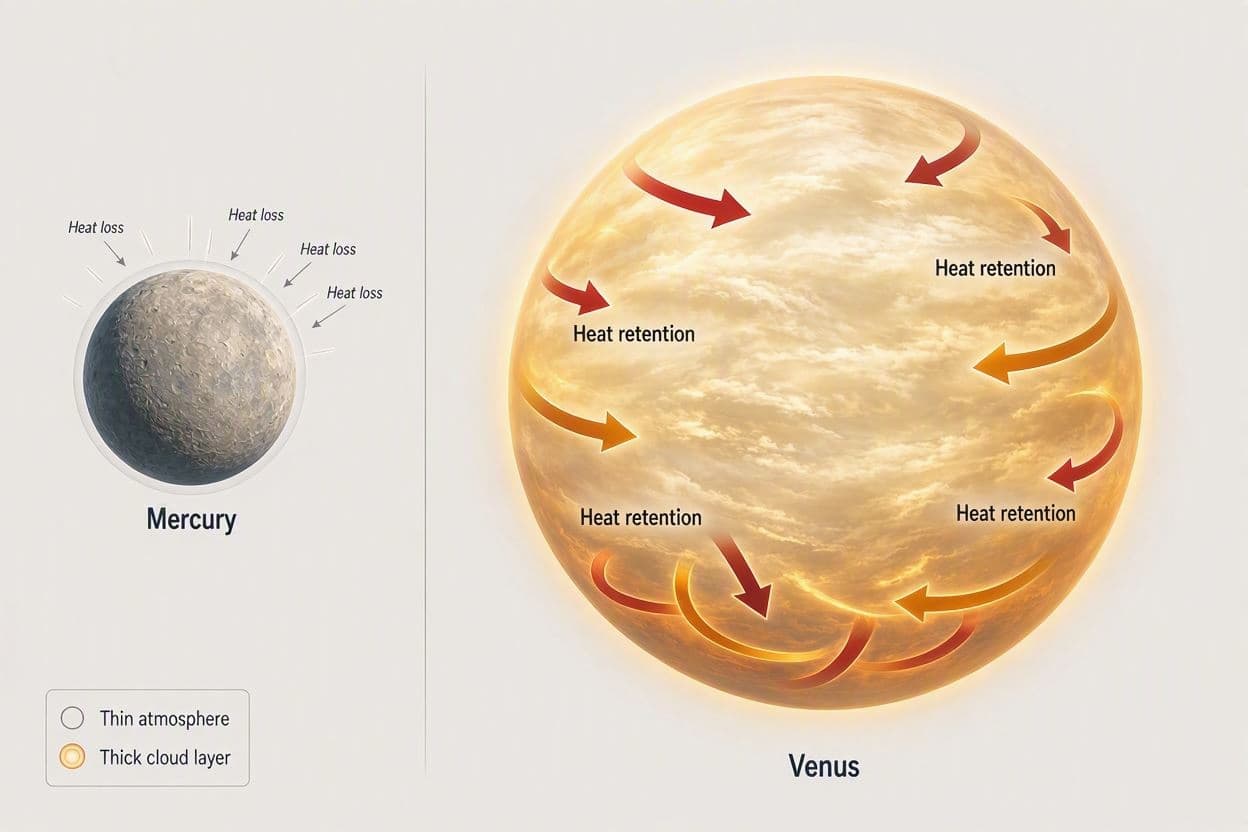
In the grand architecture of our solar system, proximity to the sun might intuitively suggest a hierarchy of heat, with the closest planet bearing the brunt of stellar radiation. Yet, nature often defies simple expectations. Mercury, the swift messenger orbiting nearest to our star, is not the hottest world in our celestial neighborhood. That title belongs to Venus, a planet shrouded in thick, toxic clouds that trap heat with terrifying efficiency, creating a furnace far more intense than the scorched surface of its inner neighbor.
The reason for this thermal inversion lies in the atmosphere, or rather, the lack thereof on Mercury compared to the suffocating blanket surrounding Venus. Mercury has only a tenuous exosphere, unable to retain any significant amount of heat. As a result, while its dayside can reach scorching temperatures of up to 800 degrees Fahrenheit, its nightside plummets to hundreds of degrees below zero. It is a world of extremes, swinging wildly between fire and ice as it rotates slowly under the sun’s gaze.
Venus, by contrast, is wrapped in a dense atmosphere composed primarily of carbon dioxide, with clouds of sulfuric acid. This composition creates a runaway greenhouse effect, a phenomenon where heat from the sun enters the atmosphere but cannot escape. The carbon dioxide acts like a heavy woolen blanket, trapping infrared radiation and causing surface temperatures to soar to an average of 900 degrees Fahrenheit. This heat is consistent across the entire planet, day and night, making Venus the true inferno of the solar system.
The geological history of Venus likely played a crucial role in this transformation. Scientists believe that billions of years ago, Venus may have had oceans similar to Earth’s. However, as the sun grew brighter, these oceans evaporated, releasing water vapor into the atmosphere. Water vapor is a potent greenhouse gas, which further heated the planet, causing more evaporation in a vicious cycle. Eventually, the water was lost to space, leaving behind a dry, CO2-rich atmosphere that continues to bake the surface today.
This stark difference highlights the delicate balance that makes Earth habitable. Our planet sits in the "Goldilocks zone," where temperatures allow for liquid water, and our atmosphere is thick enough to sustain life but not so thick as to crush it. Venus serves as a cautionary tale of what happens when that balance is tipped too far in one direction, offering a glimpse into a possible future for planets that lose their atmospheric equilibrium.
Studying Venus helps scientists understand climate dynamics not just in our solar system but in others as well. Exoplanets discovered around distant stars often exhibit similar characteristics, and understanding the mechanisms of greenhouse effects on Venus provides valuable data for modeling these alien worlds. It reminds us that planetary conditions are complex interactions of distance, atmosphere, and geological history.
As we continue to explore our cosmic neighbors, Venus remains a fascinating subject of study. Missions planned by various space agencies aim to penetrate its cloudy veil and uncover more secrets about its past and present. In doing so, we gain a deeper appreciation for the unique conditions that allow life to flourish on Earth, while marveling at the diverse and sometimes hostile environments that exist elsewhere in the universe.
AI Image Disclaimer: The visual representations in this article are AI-generated illustrations designed to depict the atmospheric differences between Mercury and Venus.
Sources: The Conversation, NASA, Sky & Telescope
Published by Banx Network. This article is part of the Banx decentralized media programme, powered by the BXE token on the XRP Ledger.



