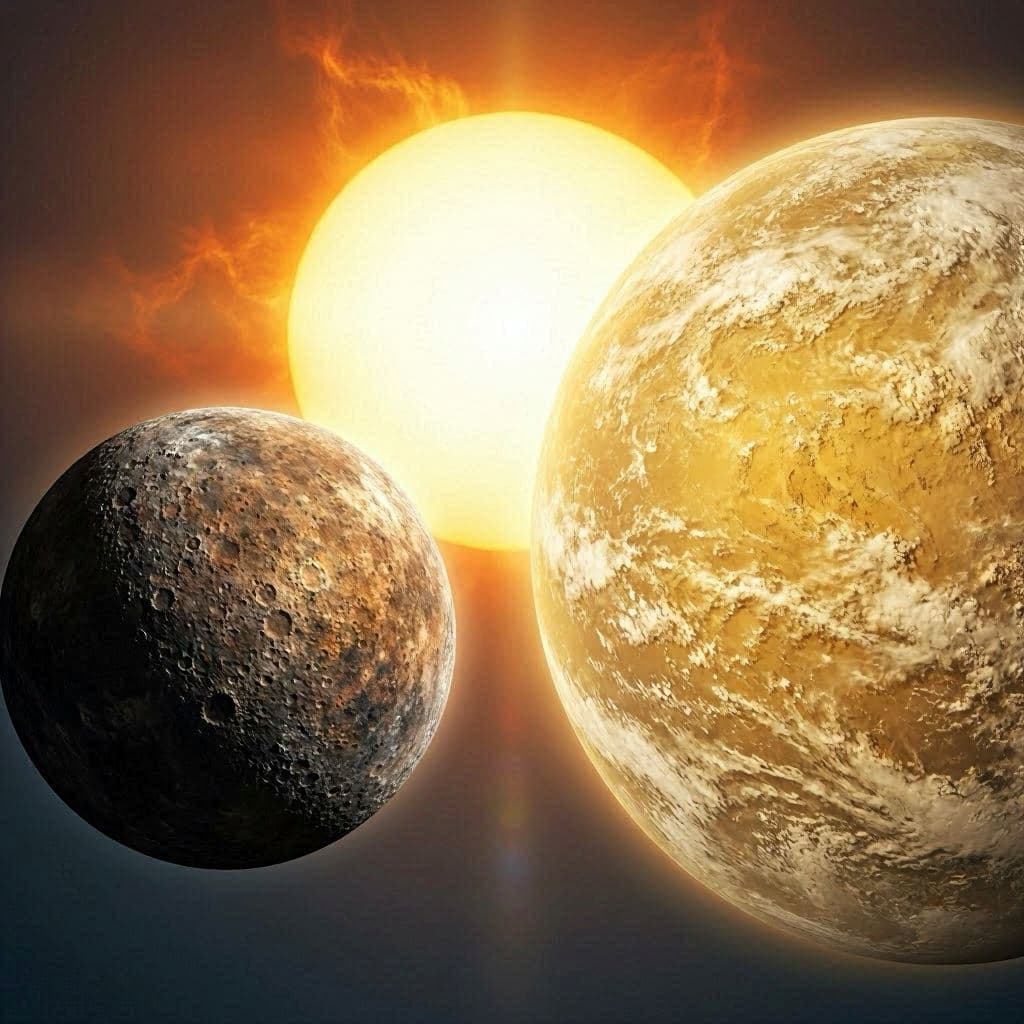
In the grand theater of the solar system, proximity to the star does not always guarantee the hottest seat. Mercury, the closest planet to the Sun, might seem the obvious candidate for the title of hottest world. Yet, it is Venus, the second planet from the Sun, that holds this distinction, with surface temperatures soaring high enough to melt lead. This counterintuitive reality invites us to reflect on the powerful influence of atmosphere and the delicate balance that makes a planet habitable or hostile. It is a lesson in the complexity of planetary science, where distance is only one factor in a much larger equation.
Body: Mercury, lacking a substantial atmosphere, experiences extreme temperature fluctuations. During the day, it bakes under the direct rays of the Sun, but at night, the heat escapes rapidly into space, causing temperatures to plummet. Without a blanket of gases to trap warmth, Mercury cannot retain the energy it receives. It is a world of extremes, where the sunlit side is scorching and the dark side is freezing. This lack of thermal regulation keeps its average temperature lower than that of its neighbor.
Venus, on the other hand, is shrouded in a thick, toxic atmosphere composed mainly of carbon dioxide. This dense layer creates a runaway greenhouse effect, trapping heat with incredible efficiency. Solar radiation penetrates the clouds and warms the surface, but the heat cannot escape. The result is a planetary oven, with surface temperatures averaging around 462 degrees Celsius (864 degrees Fahrenheit). This uniform heat persists day and night, making Venus the hottest planet in the solar system.
The comparison between these two worlds highlights the critical role of atmospheric composition. While Mercury is a barren rock exposed to the vacuum of space, Venus is a pressure cooker sealed by its own air. This distinction is crucial for understanding climate dynamics, not just on other planets but on Earth as well. It serves as a stark reminder of how greenhouse gases can transform a planet’s environment.
Scientists study Venus to better understand the limits of planetary habitability. By analyzing its atmosphere and surface conditions, they gain insights into the processes that can lead to such extreme outcomes. This knowledge helps refine models of climate change and planetary evolution. It underscores the importance of maintaining a balanced atmosphere for life to thrive.
The exploration of Venus has been challenging due to its harsh conditions. Spacecraft sent to study the planet must withstand immense pressure and heat. Despite these difficulties, missions have provided valuable data, revealing a world that is both beautiful and terrifying. Its thick clouds reflect sunlight, making it the brightest object in the night sky after the Moon, a deceptive allure that hides its infernal surface.
For astronomers, Venus remains a subject of fascination and mystery. Recent discoveries of potential phosphine in its atmosphere have sparked debates about the possibility of microbial life in its upper clouds. While the surface is uninhabitable, the upper atmosphere may offer a different story. This ongoing research keeps the scientific community engaged and curious.
The contrast between Mercury and Venus teaches us that context matters. In the solar system, as in life, being closest to the source of energy does not always mean being the most affected by it. Other factors, such as insulation and composition, play decisive roles. It is a nuanced perspective that enriches our understanding of the cosmos.
Closing: In the end, Venus’s status as the hottest planet is a testament to the power of atmosphere. It reminds us that the universe is full of surprises and that simple assumptions often fail to capture the full picture. As we continue to explore our celestial neighbors, the hope is that we will gain a deeper appreciation for the delicate balances that shape our world.
AI Image Disclaimer: Visuals accompanying this text are AI-generated conceptualizations intended to depict the themes of planetary science and atmospheric effects.
Sources: NASA Planetary Fact Sheet Scientific American European Space Agency (ESA)
Published by Banx Network. This article is part of the Banx decentralized media programme, powered by the BXE token on the XRP Ledger.