Key Highlights
- Bridge Development:A new conduit connects trillions in Traditional Finance liquidity to DeFi.
- Market Impact:This connection could revolutionize both TradFi and DeFi landscapes.
- Future Prospects:The bridge opens doors for new revenue streams and financial opportunities.
The worlds of Traditional Finance (TradFi) and Decentralized Finance (DeFi) have long operated in isolation, each with its own set of rules and vast reserves of capital. TradFi, characterized by established institutions like the New York Stock Exchange and NASDAQ, represents a colossal pool of wealth, while DeFi has emerged as a nimble and innovative alternative, offering open access to financial services. The potential for a connection between these two realms has been largely theoretical—until now.
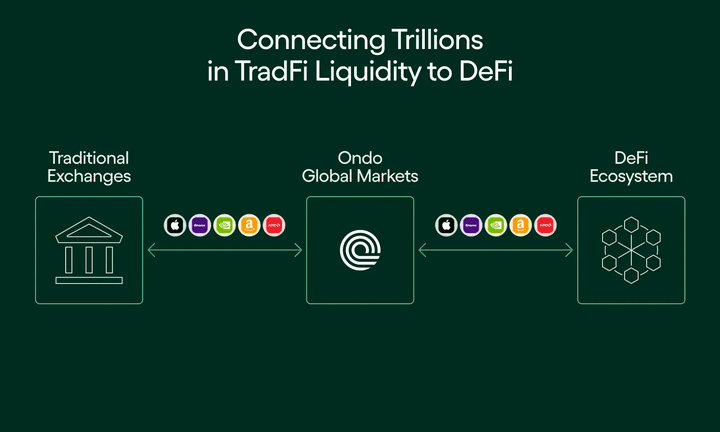
The bridge being constructed aims to connect the trillions of dollars in TradFi liquidity directly to the burgeoning DeFi ecosystem. This development is not just a technical innovation; it has profound implications for the future of finance.
Traditional financial markets are home to an almost unfathomable amount of wealth, encompassing tens of trillions of dollars in stocks, bonds, and other securities. However, for the average DeFi user or protocol, accessing this ocean of capital has been nearly impossible due to stringent regulations and legacy infrastructure. For instance, using Tesla stock as collateral on a DeFi lending platform has been unfeasible—until the advent of this new bridge.
On the flip side, DeFi has proven to be a transformative force in finance, enabling transparent and automated services ranging from lending to complex derivatives. Yet, despite its revolutionary potential, DeFi has struggled with liquidity constraints, operating on a fraction of the capital available in TradFi. To achieve greater scale and stability, DeFi must tap into the vast resources of traditional markets.
The bridge, spearheaded by Ondo Global Markets, serves as a compliant gateway that facilitates this connection. Rather than replacing either system, it acts as a translator, converting real-world assets (RWAs) from traditional exchanges—such as government bonds and blue-chip stocks—into a format that can be securely utilized within the DeFi ecosystem.
The implications of this fusion are monumental. For TradFi, the dormant assets can now earn yield in the dynamic DeFi landscape, creating new revenue streams for institutional investors. For DeFi, the influx of high-quality collateral will enable larger loans and more robust protocols, strengthening the foundation of the entire digital economy. Ultimately, this bridge signifies the dawn of a new era in finance, where value can flow freely to its most efficient use, breaking down barriers between traditional and decentralized systems.
As this bridge continues to develop, the potential for a multi-trillion dollar liquidity flood becomes increasingly tangible. The dam is breaking, and the trillions are on their way.
Published by Banx Network. This article is part of the Banx decentralized media programme, powered by the BXE token on the XRP Ledger.