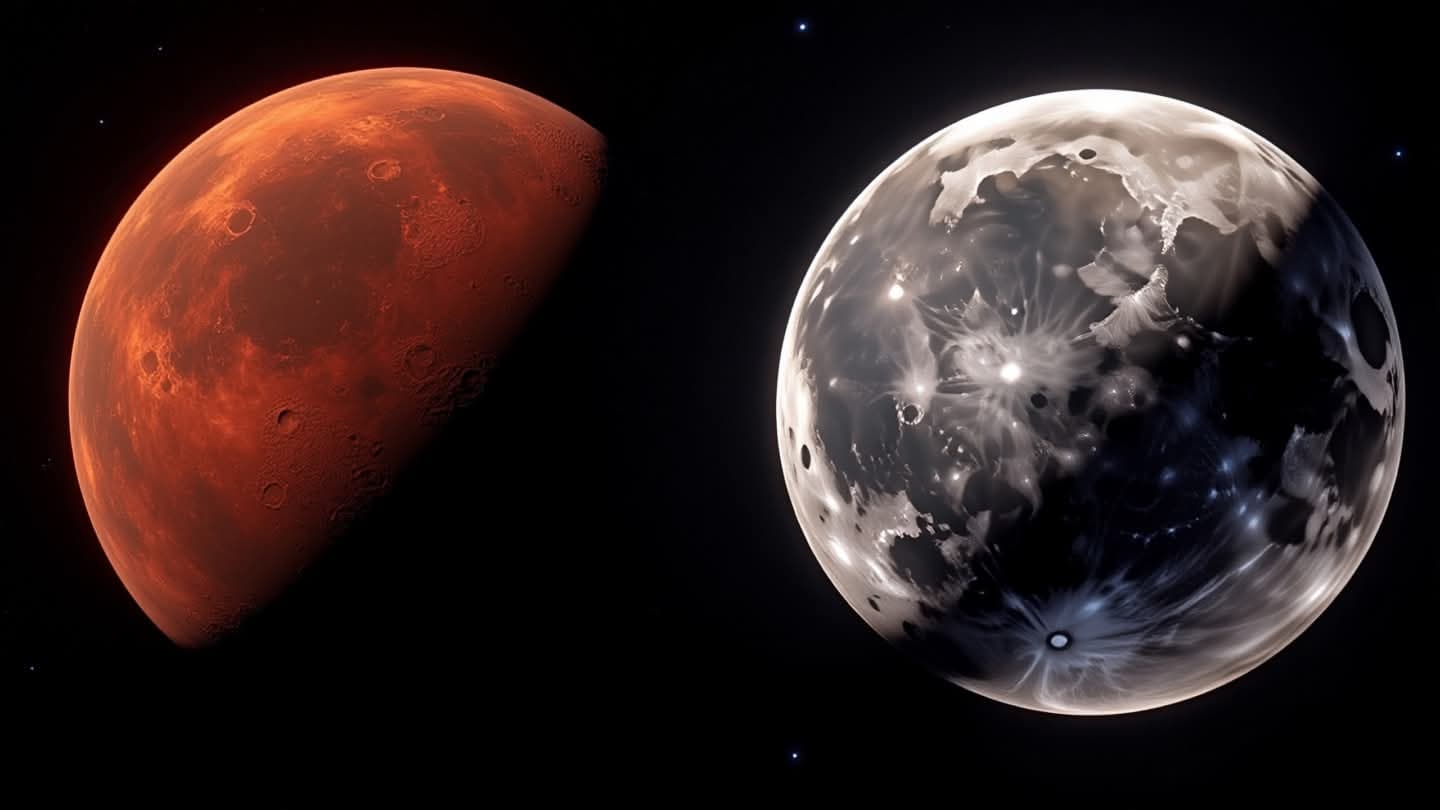
In the silent dance of celestial bodies, even the smallest moons hold stories of violent pasts. Deimos, the smaller of Mars’s two satellites, has long puzzled scientists with its unusually smooth surface and a massive depression near its south pole. New research suggests that these features may be the result of a single, cataclysmic event: an impact by a 300-meter asteroid. This theory reshapes our understanding of the moon’s composition, suggesting it is less a solid rock and more a porous pile of rubble.
Deimos has always appeared distinct from its larger sibling, Phobos. Its surface lacks the sharp craters and rugged terrain typical of many asteroids, instead presenting a gentle, almost polished appearance. The new hypothesis proposes that a significant impact early in its history caused widespread resurfacing. The energy from the collision would have shaken the moon, causing loose material to settle into depressions and smoothing out irregularities.
The south-polar depression, a vast basin that dominates the moon’s landscape, is central to this theory. Researchers argue that the impact created a shockwave that traveled through Deimos’s loosely bound structure. Because the moon is likely a "rubble pile"—a collection of rocks held together by gravity rather than a solid monolith—the shockwave would have caused global rearrangement. Debris ejected from the impact site would have fallen back across the entire surface, burying older craters and creating the smooth texture we see today.
This model challenges previous assumptions about the formation of Martian moons. Some theories suggested they were captured asteroids, while others proposed they formed from a disk of debris around Mars. The rubble pile concept supports the capture theory but adds a layer of complexity regarding their internal structure. If Deimos is indeed porous, it has significant implications for future missions, particularly those aiming to land or sample material from its surface.
The porosity of Deimos means it has low density and weak structural integrity. Landing a spacecraft on such a surface requires careful planning to avoid sinking or triggering landslides. Understanding the mechanical properties of the moon is crucial for the success of upcoming exploration missions, such as Japan’s MMX mission, which aims to return samples from Phobos and potentially study Deimos as well.
Furthermore, the impact theory helps explain the lack of large craters on Deimos. If the surface was globally resurfaced by falling debris, older impact features would have been erased. This process, known as "impact gardening," is common in the solar system but appears to have been particularly effective on Deimos due to its unique structure. The single large impact may have reset the geological clock of the moon.
As scientists continue to analyze data from orbiters and telescopes, the rubble pile hypothesis gains strength. It offers a cohesive explanation for multiple observed features, linking the polar depression, the smooth surface, and the moon’s low density. Future missions will provide direct evidence to confirm or refine this model, bringing us closer to understanding the origins of Mars’s companions.
The story of Deimos is one of transformation through trauma. A single ancient impact may have defined its current form, turning a chaotic cluster of rocks into the smooth, mysterious moon we observe today. It reminds us that even in the quietest corners of the solar system, history is written in stone and dust.
AI Image Disclaimer: Visuals associated with this article are AI-generated interpretations designed to reflect the urgency and scale of the public safety concern.
Sources: NASA, Planetary Science Journal, Space.com, EarthSky
Published by Banx Network. This article is part of the Banx decentralized media programme, powered by the BXE token on the XRP Ledger.