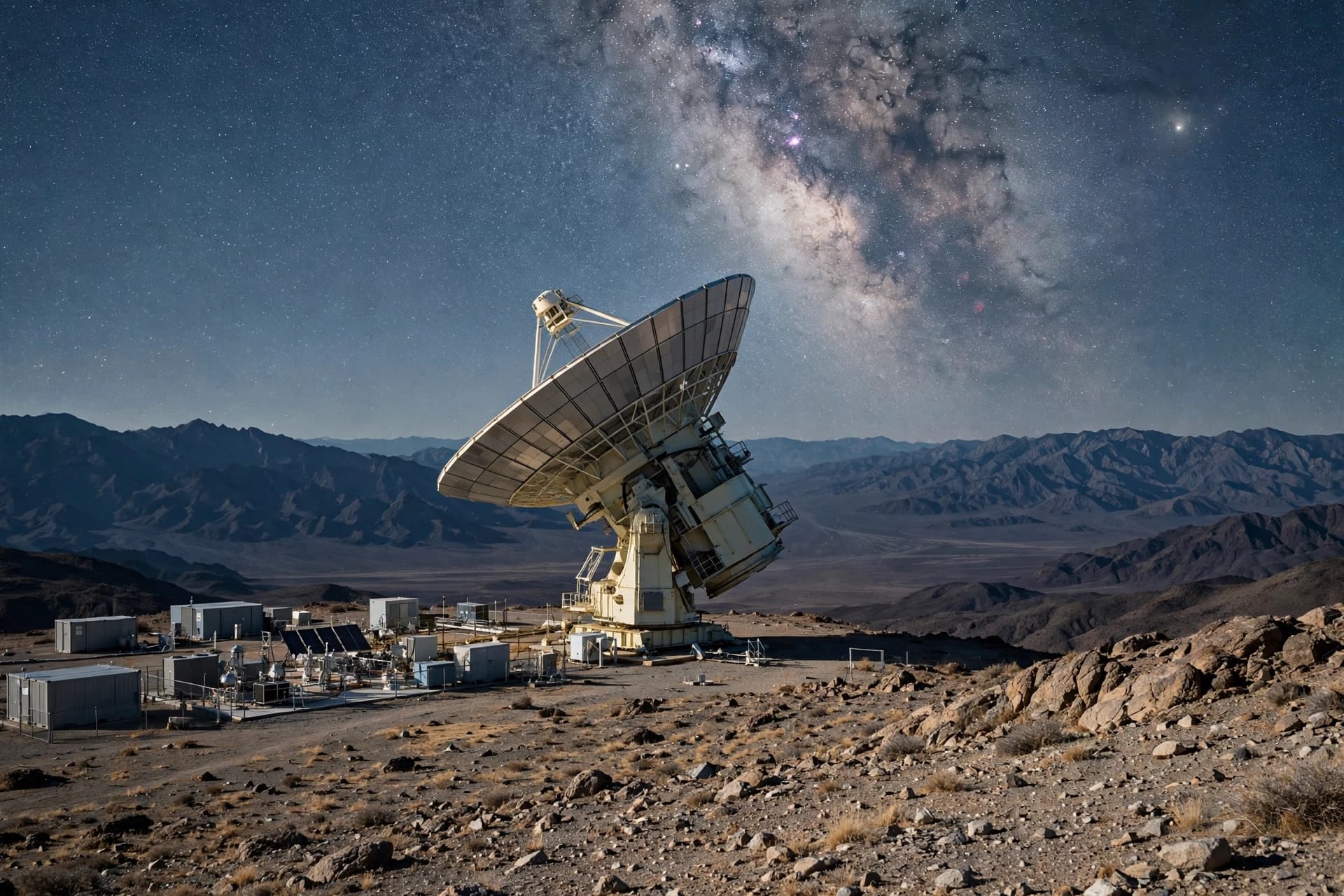
There is a particular anticipation that belongs to the moments before a telescope opens its eye for the first time—a quiet, electric waiting shared by the people who built it, the scientists who will use it, and the universe that has been waiting billions of years to be seen in a new way. At a high site in the Chilean desert, that moment is approaching for the Fred Young Submillimeter Telescope, and the excitement among those who ready it is climbing with each passing week.
The FYST, as it is known, has completed construction, and its first scientific results are drawing nearer . The telescope is designed to observe the universe in submillimeter wavelengths—a regime of light that sits between infrared and radio, capable of revealing the cold dust, distant galaxies, and cosmic structures that optical telescopes cannot see. When it begins operations, it will become the most powerful telescope in its class, according to Fred Young, the donor and scientific adviser whose name it carries .
The first observations will not be of distant galaxies or the cosmic microwave background. They will be of planets in our own solar system, a calibration exercise designed to ensure the instruments are working as intended before the harder science begins . Soon after, the telescope will turn its attention to galaxy clusters—the largest gravitationally bound objects in the universe—which offer clues about dark matter, dark energy, and the structure of the cosmos on its grandest scales.
The instruments being installed are themselves remarkable. Prime-Cam, led by Cornell professor Michael Niemack, contains seven instrument modules with three detector arrays per module, packing thousands of detectors onto a single silicon wafer . The tens of thousands of detectors make it the largest submillimeter instrument ever built . A second instrument, mini-CHAI, is being led by the University of Cologne. Together, they represent a collaboration that spans continents and disciplines, the kind of undertaking that requires decades of planning and the patience of institutions.
What the telescope will see is not yet known—that is the nature of first light. The instruments are calibrated, the theories are prepared, and the models predict certain outcomes, but the universe has a way of surprising those who look closely. The FYST's submillimeter vision will probe the cold and the distant, the dust that obscures and the light that has traveled for billions of years, and it will do so with a sensitivity that has no precedent in its wavelength.
For the scientists who have spent years readying it, the excitement is not merely professional. It is the anticipation of discovery—the knowledge that somewhere in the data will be something no one expected, a signal that will require new explanations and new questions. That is what telescopes are for, and that is what first light promises.
The date is approaching. The instruments are ready. And the universe, as it always has, is waiting to be seen.
AI Image Disclaimer: The images accompanying this article were generated by artificial intelligence and are intended for illustrative purposes only.
Sources: Cornell Chronicle, Public Now
Published by Banx Network. This article is part of the Banx decentralized media programme, powered by the BXE token on the XRP Ledger.