From the vantage point of space, Earth appears as a vibrant blue marble, a world defined by its oceans. This aquatic veneer covers roughly 71 percent of the planet’s surface, creating an illusion of abundance and depth. Yet, this visual dominance is deceptive. Beneath the shimmering waves lies a truth that reshapes our understanding of our home: water, for all its life-sustaining power, constitutes a mere fraction of Earth’s total mass, a thin skin over a dense, rocky core.
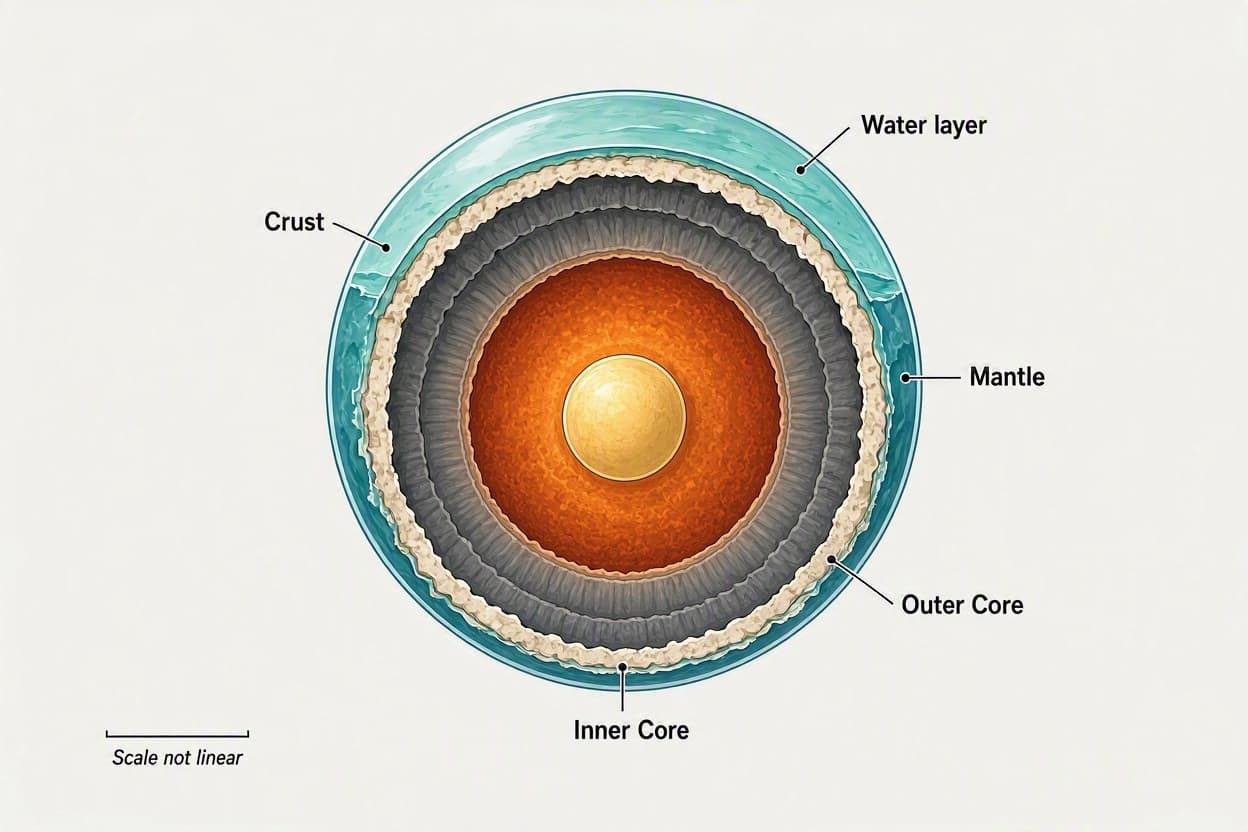
The hydrosphere, encompassing all liquid water, ice, and vapor, accounts for only about 0.02 percent of Earth’s total mass. This statistic is startling when contrasted with the visual prominence of the oceans. It serves as a humbling reminder that what we see is not always what defines the substance of our world. The vast majority of the planet’s weight is concentrated in the mantle and core, composed of silicate rocks and heavy metals like iron and nickel.
This disparity highlights the unique position of water in the planetary structure. It is not a foundational building block of Earth’s bulk but rather a superficial layer, essential for life yet negligible in terms of gravitational heft. If Earth were an apple, the hydrosphere would be thinner than the skin. This perspective shifts the narrative from one of water-dominated geography to one of geological density and internal heat.
The rock and metal beneath the surface are not passive elements. They drive the tectonic plates that shape continents, fuel volcanic activity, and generate the magnetic field that protects the atmosphere. Without this dense, dynamic interior, the thin layer of water on the surface would likely have boiled away or frozen solid long ago. The interplay between the deep earth and the surface water is a delicate balance that has allowed life to flourish.
Understanding this ratio also informs our search for habitable worlds beyond our solar system. Astronomers often look for "water worlds," but this data suggests that a planet’s potential for life may depend more on its geological activity than on the sheer volume of its oceans. A planet needs a robust interior to sustain an atmosphere and regulate temperature, making the rock beneath just as critical as the water above.
For environmentalists and geologists alike, this fact underscores the fragility of our surface resources. While water feels infinite in our daily experience, it is a finite and thin layer resting on a massive, unyielding foundation. Protecting this layer requires recognizing its relative scarcity in the grand scheme of planetary physics, even as it dominates our visual landscape.
The contrast between surface appearance and internal reality invites a deeper appreciation for Earth’s complexity. It is a planet of contradictions: mostly dry by mass, yet wet by sight; solid at heart, yet fluid on the surface. This duality is what makes Earth not just a rock in space, but a living, breathing entity.
The realization that water makes up only 0.02 percent of Earth’s mass challenges our perceptions of abundance. It reminds us that the vitality of our planet relies on the hidden strength of its rocky interior, supporting the fragile blue layer that sustains us all.
AI Image Disclaimer: Please note that any accompanying illustrations for this piece are AI-generated representations intended to evoke the mood of the described events.
Sources: NASA Earth Observatory, USGS, National Geographic, Scientific American
Published by Banx Network. This article is part of the Banx decentralized media programme, powered by the BXE token on the XRP Ledger.