In the vast darkness of space, black holes are often imagined as static voids, silent and unchanging. Yet, they are dynamic entities, capable of producing brilliant flares of energy when they consume nearby matter. These cosmic outbursts, however, are not eternal; they fade, leaving astronomers to wonder why. Recent research suggests that the answer may lie in the rotation of the stars being consumed. This insight offers a glimpse into the intricate dance of gravity and spin that governs some of the most powerful events in the universe.
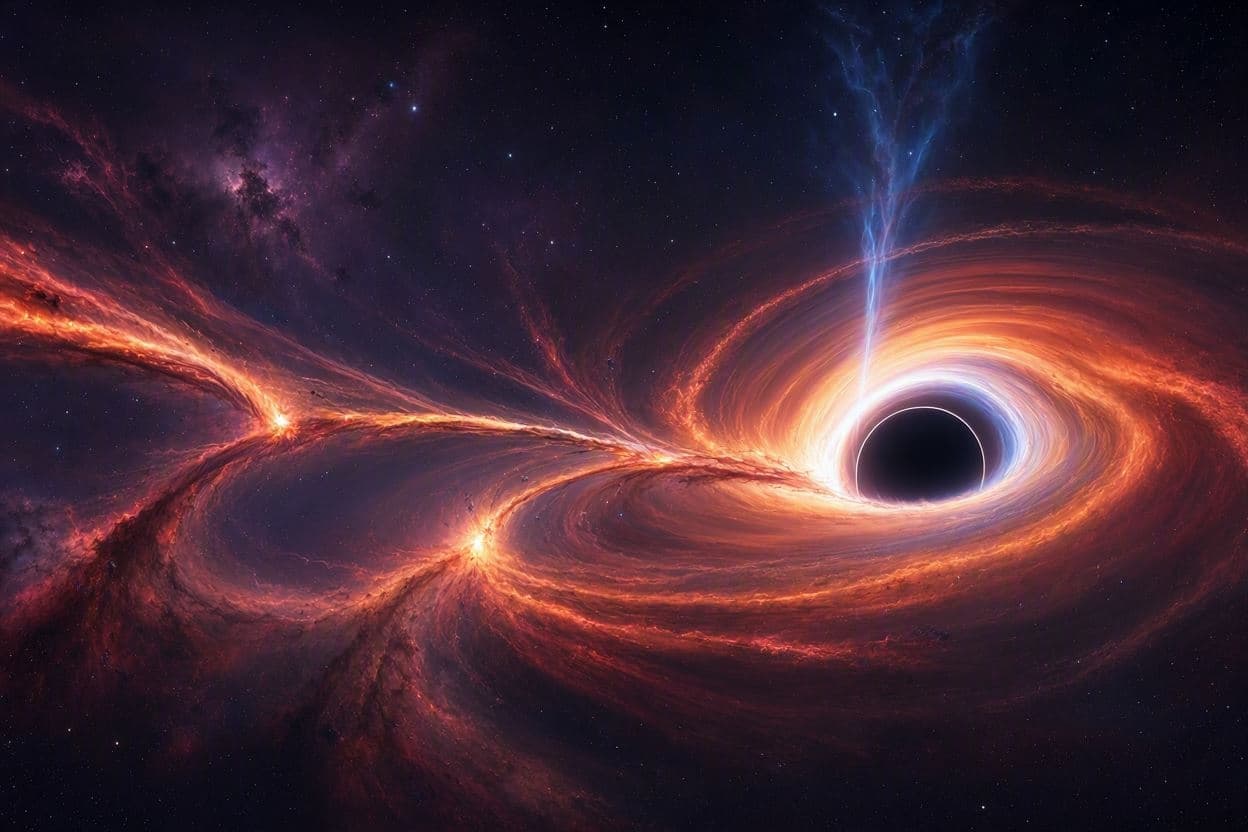
When a star ventures too close to a black hole, it is torn apart by tidal forces in an event known as a tidal disruption event (TDE). The debris forms an accretion disk, heating up and emitting intense radiation. For years, scientists observed that these flares would brighten rapidly and then decline, but the mechanism behind the decline was not fully understood. The new hypothesis proposes that the spin of the star plays a crucial role in how quickly the material is consumed and dispersed.
If a star is spinning rapidly, its structure is more diffuse, allowing the black hole to strip away material more efficiently. This rapid consumption can lead to a quicker peak and a faster decline in brightness. Conversely, a slowly spinning star might hold together longer, resulting in a more prolonged and steady flare. This distinction helps explain the variability seen in different TDE observations, providing a unified framework for understanding these phenomena.
The role of stellar spin adds a layer of complexity to our models of black hole feeding. It suggests that the history of the star—its formation, age, and rotational speed—leaves an imprint on the final moments of its life. This connection between the progenitor star and the resulting flare allows astronomers to work backward, inferring properties of stars that are otherwise impossible to observe directly.
Observational data from telescopes like the Zwicky Transient Facility has supported this theory, showing correlations between flare decay rates and theoretical models of stellar spin. While more data is needed to confirm the hypothesis definitively, the initial findings are promising. They demonstrate how detailed observations can refine our understanding of extreme astrophysical processes.
Understanding these flares is not just an academic exercise; it helps us map the population of black holes in the universe. By analyzing the light curves of TDEs, scientists can estimate the mass and spin of the black holes themselves. This information is vital for testing general relativity and understanding the growth of supermassive black holes over cosmic time.
The elegance of this explanation lies in its simplicity. A fundamental property of a star—its spin—determines the fate of its debris and the appearance of its death throes. It reminds us that even in the most violent and chaotic events in the cosmos, there are underlying orders and rules that govern behavior.
As technology improves, we will be able to observe these events with greater precision, potentially uncovering further nuances in the relationship between stellar spin and black hole flares. Each observation brings us closer to a complete picture of how matter behaves under extreme gravity, expanding the boundaries of human knowledge.
The hypothesis that stellar spin influences the decay of black hole flares offers a compelling explanation for observed variations in tidal disruption events. As research continues, this insight enhances our understanding of black hole dynamics and the lifecycle of stars. It highlights the intricate connections that define the cosmos.
AI Image Disclaimer: The images associated with this article are AI-generated visualizations intended to depict the interaction between a star and a black hole, using dramatic and scientifically inspired imagery.
Sources: Astrophysical Journal NASA Goddard Space Flight Center Space.com
Published by Banx Network. This article is part of the Banx decentralized media programme, powered by the BXE token on the XRP Ledger.