Key Highlights
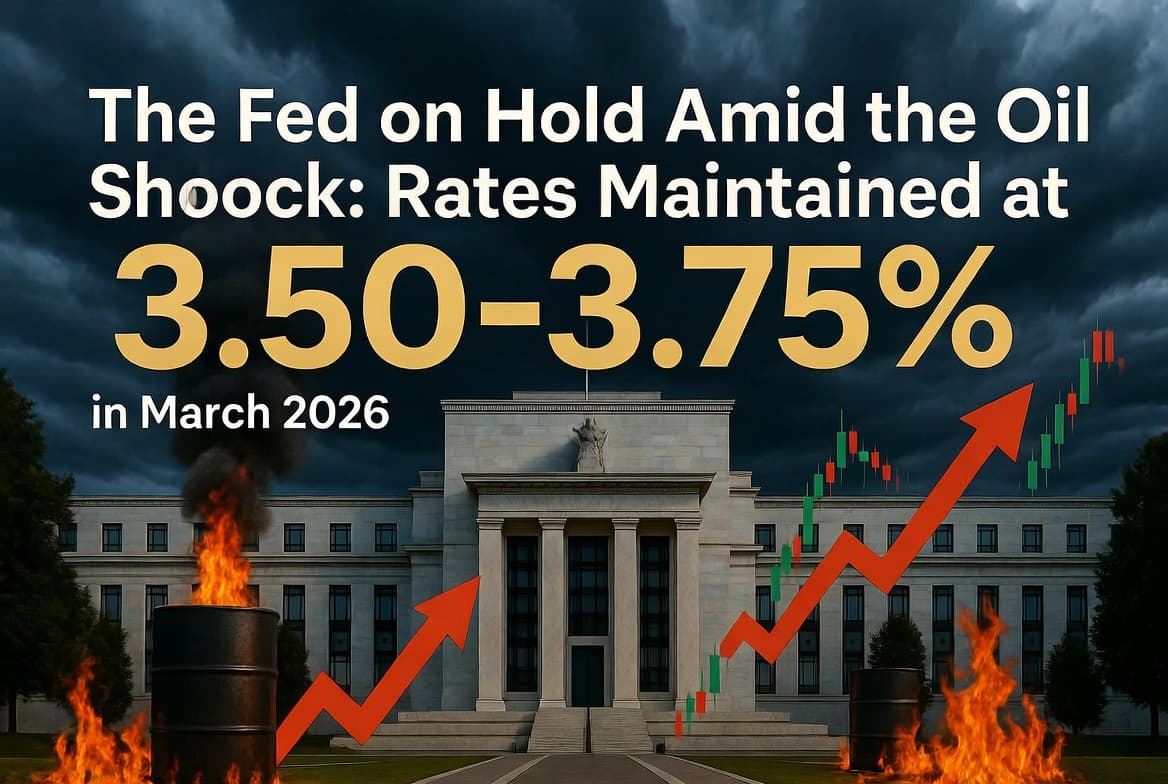
- Decision:The Federal Reserve maintains interest rates at 3.50–3.75%.
- Voting:11 out of 12 members supported the decision, with one dissent.
- Economic Outlook:Inflation projections revised upward due to rising oil prices.
The Federal Reserve has decided to maintain its current interest rates at 3.50–3.75% during its March 2026 meeting, reflecting a cautious approach amid rising oil prices and geopolitical tensions. Out of the 12 voting members, 11 supported this decision, with only Governor Stephen Miran advocating for a 0.25 percentage point cut. Jerome Powell, serving as chair pro tempore, emphasized the elevated uncertainty stemming from the ongoing U.S./Israel–Iran conflict, stating, “We do not yet know whether the effects of the energy shock will be transitory or more lasting. It is therefore too early to adjust our policy.”
In conjunction with the decision, the Federal Reserve released its Summary of Economic Projections (SEP), which indicates a significant adjustment in its outlook for inflation. The Fed now anticipates only one 0.25% rate cut for the remainder of 2026, a shift from previous expectations of two or three cuts. This change reflects a growing concern about inflationary pressures, particularly due to the rising costs of energy.
The ongoing conflict in the Middle East has led to a surge in energy prices, with Brent crude oil frequently trading above $100–$112 per barrel. In the U.S., diesel prices are nearing $5.40 per gallon in some regions, while the national average gasoline price hovers around $4.85 per gallon. Powell acknowledged that these developments could lead to a temporary rise in inflation above 3% in the coming months, but the Fed is not yet treating the situation as a structural issue.
The labor market is another area of concern for the Federal Reserve. Following a surprising loss of 92,000 jobs in February 2026, job creation has remained weak. Although the unemployment rate stands at 4.4%, which is generally consistent with full employment, Fed economists have noted a clear slowdown in job growth. Powell reiterated that the central bank will only consider cutting rates if there is a “significant and sustained” weakening in the labor market.
The implications of the Fed's decision are significant for various stakeholders. For borrowers, 30-year mortgage rates remain high, ranging from 6.8% to 7.1%, and a rate cut is not anticipated before autumn at the earliest. Businesses are facing elevated borrowing costs, which could slow investment, particularly in sectors reliant on transportation, such as logistics, agriculture, and construction. On Wall Street, stock markets experienced a rebound following optimistic comments from President Donald Trump regarding discussions with Iran, although futures are slightly lower amid ongoing tensions.
In summary, the Federal Reserve is navigating a complex landscape of rising oil prices and economic uncertainty. The central bank aims to avoid reigniting inflation with premature cuts while also preventing the economy from tipping into recession due to overly tight policies. The future trajectory of interest rates will depend heavily on two critical factors: the evolution of the Middle East conflict and oil prices, as well as upcoming monthly inflation and employment data, with the next Consumer Price Index report due on April 10. Powell encapsulated the Fed's approach succinctly: “We remain data-dependent. We will adjust our policy based on the facts, not on hopes.”
Published by Banx Network. This article is part of the Banx decentralized media programme, powered by the BXE token on the XRP Ledger.