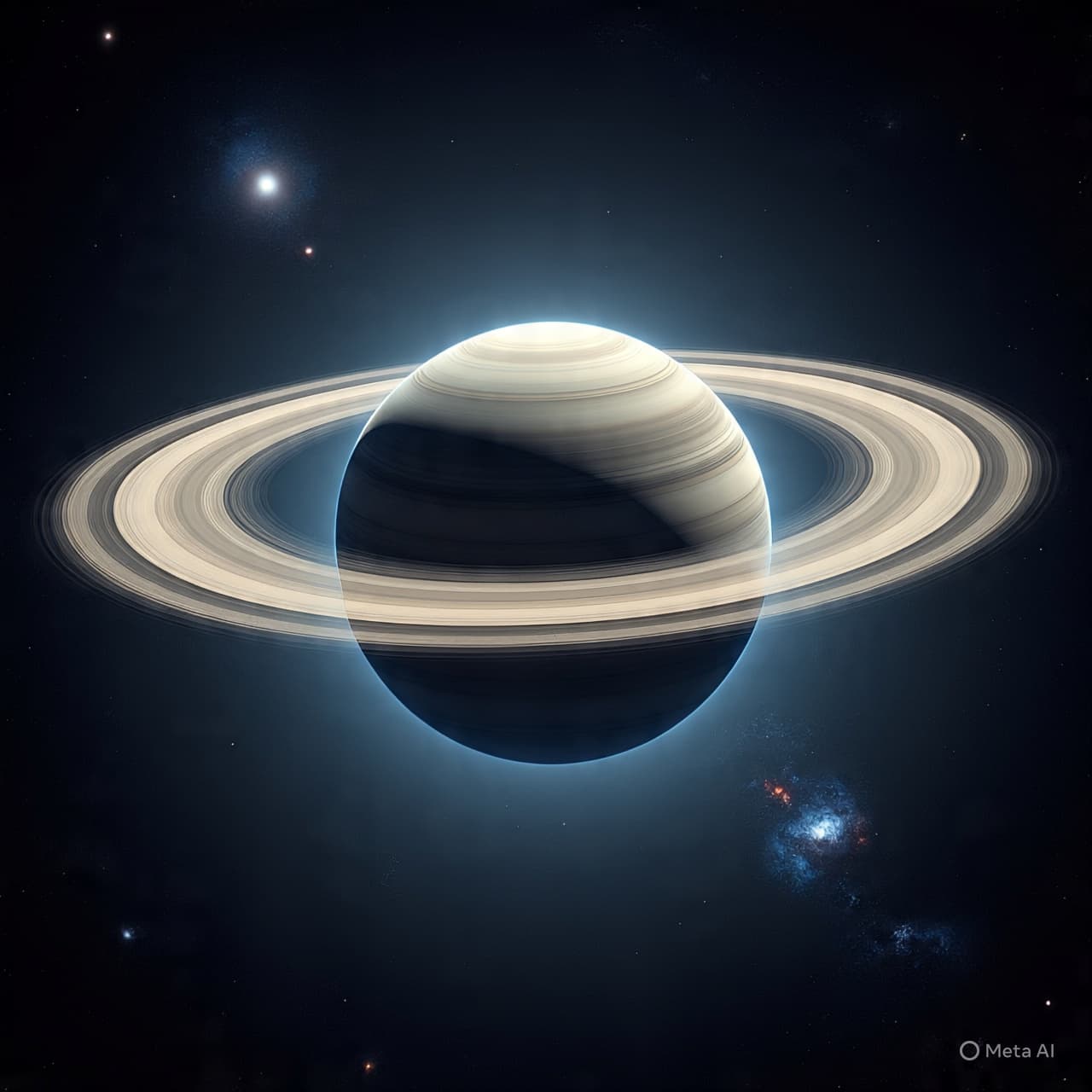
There is a tender melancholy in watching something grand begin to thin, as if time itself were brushing gently against its edges. Saturn’s rings — once the symbol of cosmic elegance, a perfect halo suspended in the dark — appear to be slowly fading, shedding particles as quietly as snow melting under soft sunlight. To the casual gaze through a telescope, they still shine. But to scientists studying the planet’s environment, the rings tell a different story: one of steady disappearance.
The process is known as *ring rain*, a phenomenon where particles from the rings fall into Saturn’s upper atmosphere. Gravity, sunlight, and the delicate tug of Saturn’s magnetic field all conspire to pull the icy grains downward. These particles evaporate, breaking apart before they ever reach the clouds, their remnants dissolving into the planet’s ionosphere. Over time, this rain has measurable effects — draining mass from the rings at a pace faster than once assumed.
Recent studies highlight that Saturn’s rings, composed mostly of ice with traces of rocky material, are not ancient relics but transient formations. They may have been born from the breakup of a moon or a massive icy body only a few hundred million years ago — recent, by cosmic standards. And like many things that come too late in a planet’s history, their stay may be shorter than their beauty suggests.
The fading effect is not a dramatic vanishing act. Saturn will not lose its rings in a human lifetime, nor even in the span of early civilization. But the clock is ticking: projections suggest the rings could be gone in tens of millions of years, a blink in planetary time but a forever in ours. In the skies of some far-future Earth, if anyone is still watching, Saturn may appear bare — another gas giant without its luminous crown.
For now, though, the rings remain breathtaking: broad arcs of ice and light, casting shadows on the cloud tops and reminding us that even in the coldest corners of the Solar System, transience is part of the design. Their slow dissolution carries no tragedy, only a quiet acknowledgment that beauty in the universe is rarely permanent.
In the gentle erosion of Saturn’s rings, we see a cosmic truth reflected back at us — that even the grandest structures drift toward change, and that impermanence is woven into the fabric of time itself.
Published by Banx Network. This article is part of the Banx decentralized media programme, powered by the BXE token on the XRP Ledger.