The universe is often imagined as a vast, expanding stage where celestial actors perform their roles against a backdrop of stretching space. For decades, scientists have viewed black holes as isolated entities, growing only by devouring nearby stars and gas. However, a new study suggests a more intimate connection between these gravitational giants and the cosmos itself. It proposes that supermassive black holes may be growing in tandem with the expansion of the universe, coupled to the fabric of spacetime in ways previously unimagined. This finding invites us to reflect on the deep, hidden symmetries of nature and the possibility that the smallest scales of gravity are woven into the largest scales of cosmology.
The research focuses on supermassive black holes located at the centers of ancient, dead elliptical galaxies. These galaxies have long since stopped forming stars, meaning their central black holes should not be gaining mass through traditional accretion. Yet, observations reveal that these black holes are significantly more massive than expected. The study posits that their growth is not due to feeding, but rather to a phenomenon known as "cosmological coupling," where the black hole’s mass increases as the universe expands.
This hypothesis challenges standard models of general relativity, which typically treat black holes as independent of the cosmic expansion. If confirmed, it suggests that black holes contain vacuum energy, contributing to the acceleration of the universe’s expansion. This could provide a natural explanation for dark energy, the mysterious force driving the cosmos apart, without requiring new physics beyond what we already know. It bridges the gap between the quantum vacuum and cosmic dynamics.
The implications for our understanding of gravity are profound. If black holes are coupled to the expansion, they act as sources of repulsive gravity on large scales. This would mean that the very objects known for their intense attraction also play a role in pushing the universe apart. Such a duality reshapes our conceptual map of the cosmos, suggesting that attraction and repulsion are two sides of the same gravitational coin.
Critics urge caution, noting that alternative explanations, such as underestimated star formation or mergers, could account for the observed masses. The data, while compelling, relies on complex modeling and assumptions about galaxy evolution. Further observations with next-generation telescopes will be crucial to verify whether this coupling is a universal law or a specific feature of certain black hole populations.
Despite the debate, the study opens new avenues for theoretical exploration. It encourages physicists to reconsider the boundary conditions of black holes in an expanding universe. By integrating cosmology and black hole physics, researchers may uncover deeper principles that govern the structure of reality. This interdisciplinary approach is essential for solving some of the most persistent mysteries in science.
For the public, the idea that black holes grow with the universe is both humbling and awe-inspiring. It suggests that even the most extreme objects in the cosmos are part of a dynamic, interconnected whole. They are not static monuments but evolving entities, changing as the universe changes around them. This perspective fosters a sense of unity, reminding us that everything in the cosmos is in flux.
As we look to the future, missions like the James Webb Space Telescope and upcoming radio arrays will provide more precise data. These tools will allow us to test the predictions of cosmological coupling with greater accuracy. Until then, the question remains open, inviting us to wonder about the hidden connections that bind the universe together.
The study suggesting black holes grow with the universe offers a novel perspective on cosmology and dark energy. It highlights the dynamic nature of spacetime and gravity. Let us await further verification with open minds.
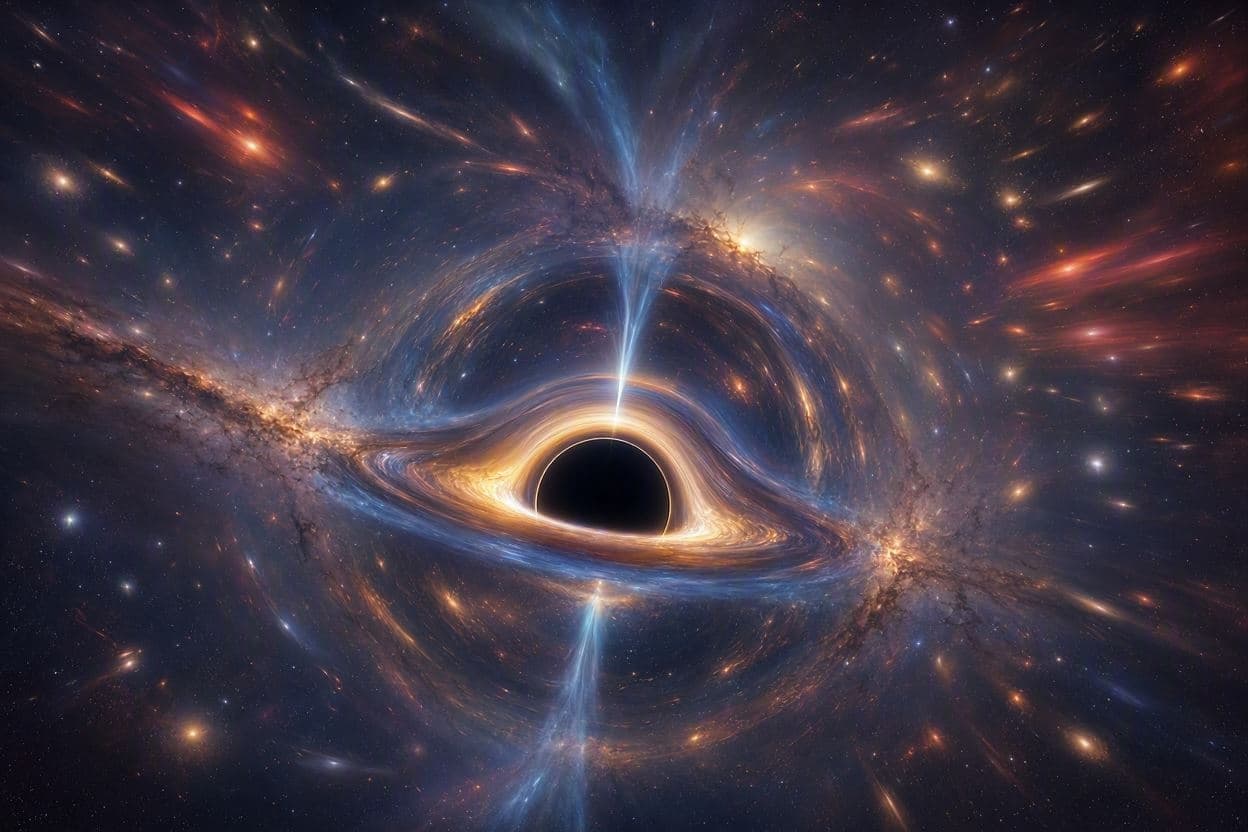
AI Image Disclaimer: Please note that any visual representations in this article are AI-generated illustrations created for conceptual clarity.
Sources: The Astrophysical Journal University of Hawaii Press Release ScienceAlert
Published by Banx Network. This article is part of the Banx decentralized media programme, powered by the BXE token on the XRP Ledger.