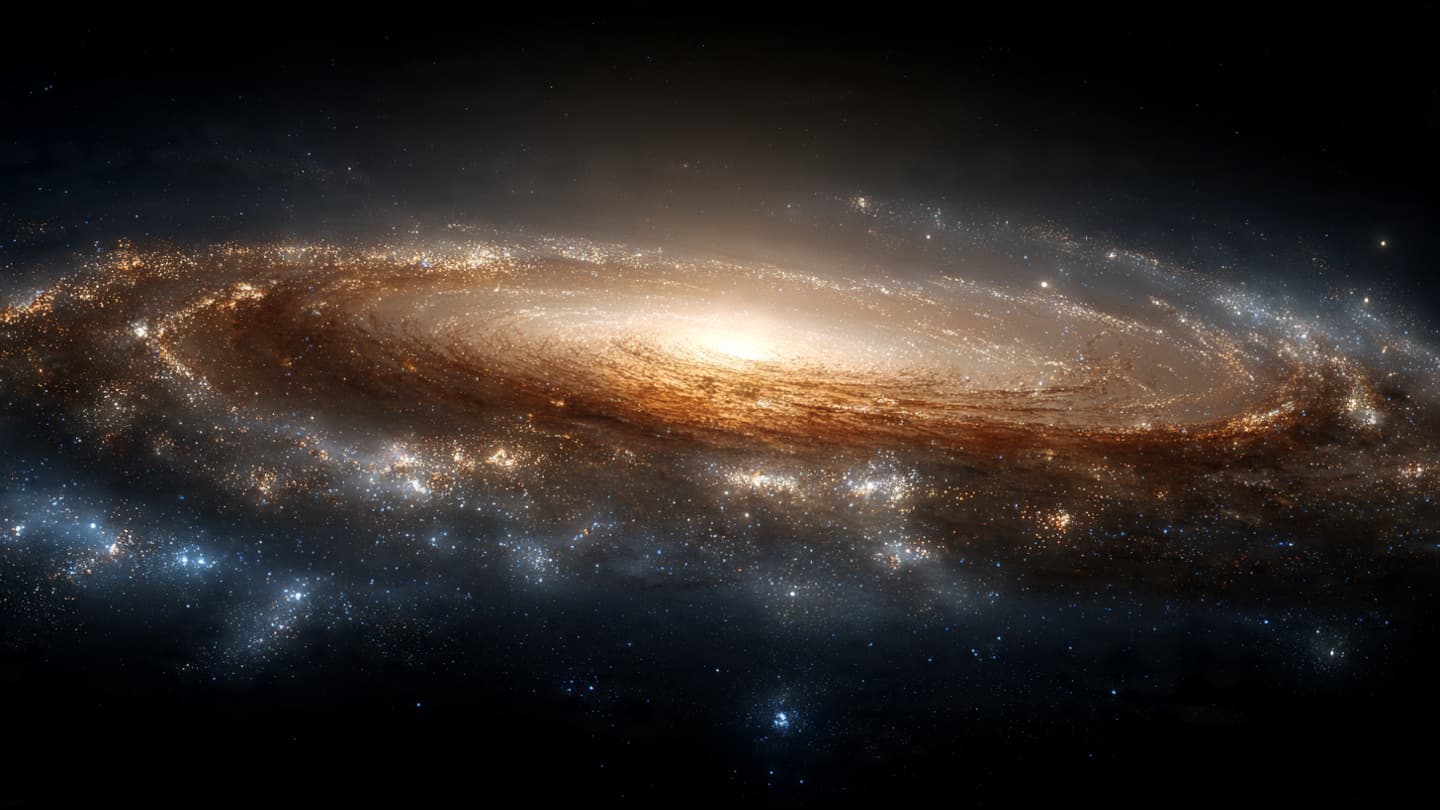
The early universe is often imagined as a place of simplicity gradually evolving into complexity. Yet deep-space observations continue to reveal structures forming earlier, and in more organized ways, than many theoretical models once predicted.
Astronomers using the James Webb Space Telescope (JWST) have identified a barred spiral structure in a galaxy from the early universe, a finding that challenges previous expectations about how quickly such formations could emerge.
Barred spiral galaxies feature a central elongated structure of stars and gas that influences the motion of material within the galaxy, often playing a key role in star formation and galactic evolution.
Conventional models suggested that such well-defined structures would take billions of years to form after the Big Bang, once galaxies had undergone multiple stages of gravitational settling and interaction.
However, JWST’s ability to observe infrared light from extremely distant galaxies allows scientists to see much earlier stages of cosmic history with unprecedented clarity.
The detection of a stellar bar in such an early epoch suggests that galactic organization may have developed faster than previously thought, prompting scientists to revisit aspects of galaxy formation theory.
Researchers are now comparing the observation with simulations to determine whether early gravitational instabilities or rapid gas dynamics could explain the unexpected structure.
While further confirmation and additional examples are needed, the finding adds to a growing list of early-universe structures that appear more mature than traditional models predicted.
In this way, the universe continues to reveal that its earliest chapters may have been more structured and dynamic than once imagined, offering new questions for the next generation of cosmic exploration.
AI Image Disclaimer: The images in this article are AI-generated scientific illustrations representing early galaxy formation and are not direct telescope captures.
Sources (Verification Check):
NASA JWST mission releases Nature Astronomy Astrophysical Journal European Space Agency Space Telescope Science Institute
Published by Banx Network. This article is part of the Banx decentralized media programme, powered by the BXE token on the XRP Ledger.