
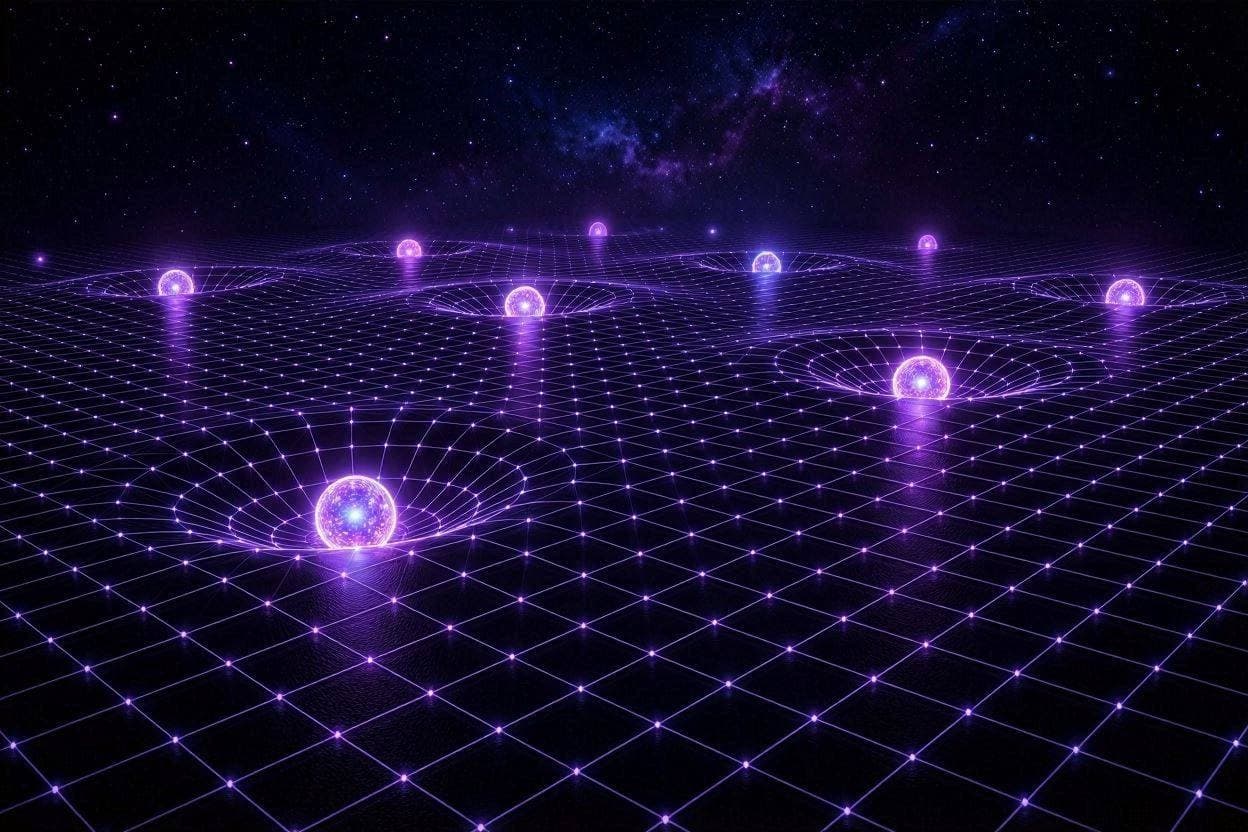
The fabric of the universe, woven from the threads of space and time, has long been the subject of intense scrutiny by physicists seeking to understand its fundamental nature. A new theoretical framework proposed by a group of physicists offers a fresh perspective on how energy interacts with this fabric, suggesting that what we perceive as vacuum may be far more dynamic than previously thought.
This new theory posits that energy fluctuations in the vacuum of space-time are not random noise but structured patterns that could influence gravitational fields in subtle ways. By refining the mathematical models used to describe quantum field theory, the researchers aim to bridge the gap between general relativity and quantum mechanics, two pillars of physics that have yet to be fully unified. Their work suggests that energy density variations might play a role in the curvature of space-time.
The implications of this theory are profound, potentially offering explanations for dark energy, the mysterious force driving the accelerated expansion of the universe. If vacuum energy is indeed structured, it could provide a mechanism for this expansion without invoking unknown particles or forces. This would simplify our understanding of cosmology and align better with observational data from distant supernovae and cosmic microwave background radiation.
Experimental verification remains a significant challenge, as the effects predicted by the theory are extremely small and difficult to detect with current technology. However, the proposal outlines potential avenues for testing, such as precision measurements of gravitational waves or atomic interferometry experiments. These future tests could validate or refute the theory, pushing the boundaries of our technological capabilities.
The scientific community has responded with cautious optimism, recognizing the elegance of the mathematical formulation while awaiting empirical evidence. Peer review processes are currently underway, with experts examining the consistency of the theory with existing physical laws. This rigorous scrutiny is essential to ensure that the new model stands on solid ground.
For students and enthusiasts of physics, this development serves as a reminder that our understanding of the universe is always evolving. Each new theory, whether proven or disproven, adds depth to our knowledge and inspires further inquiry. It highlights the creative and collaborative nature of scientific progress, where ideas are constantly tested and refined.
Theoretical physics often operates at the edge of human comprehension, dealing with concepts that defy everyday intuition. Yet, it is this very abstraction that allows us to probe the deepest mysteries of reality. The new theory on space-time energy is a testament to the enduring human quest to make sense of the cosmos.
As research continues, the hope is that this theoretical breakthrough will lead to tangible insights into the nature of reality. Whether it becomes a cornerstone of future physics or a stepping stone to other discoveries, it enriches the ongoing dialogue about the fundamental structure of our universe.
AI Image Disclaimer: Please note that the images included in this article are AI-generated visualizations created to complement the narrative and are not actual representations of space-time structures.
Sources: Physical Review Letters ScienceDaily Phys.org New Scientist
Published by Banx Network. This article is part of the Banx decentralized media programme, powered by the BXE token on the XRP Ledger.



