There is a paradox in the exploration of Mars: the same dust that gives the planet its rusty glow is also one of its quietest dangers. Future astronauts will carry it on their suits, track it into their habitats, and breathe it in if the right protections are not in place. For decades, engineers have known that Martian dust is a problem. What they have not known, until now, is just how small the smallest particles truly are.
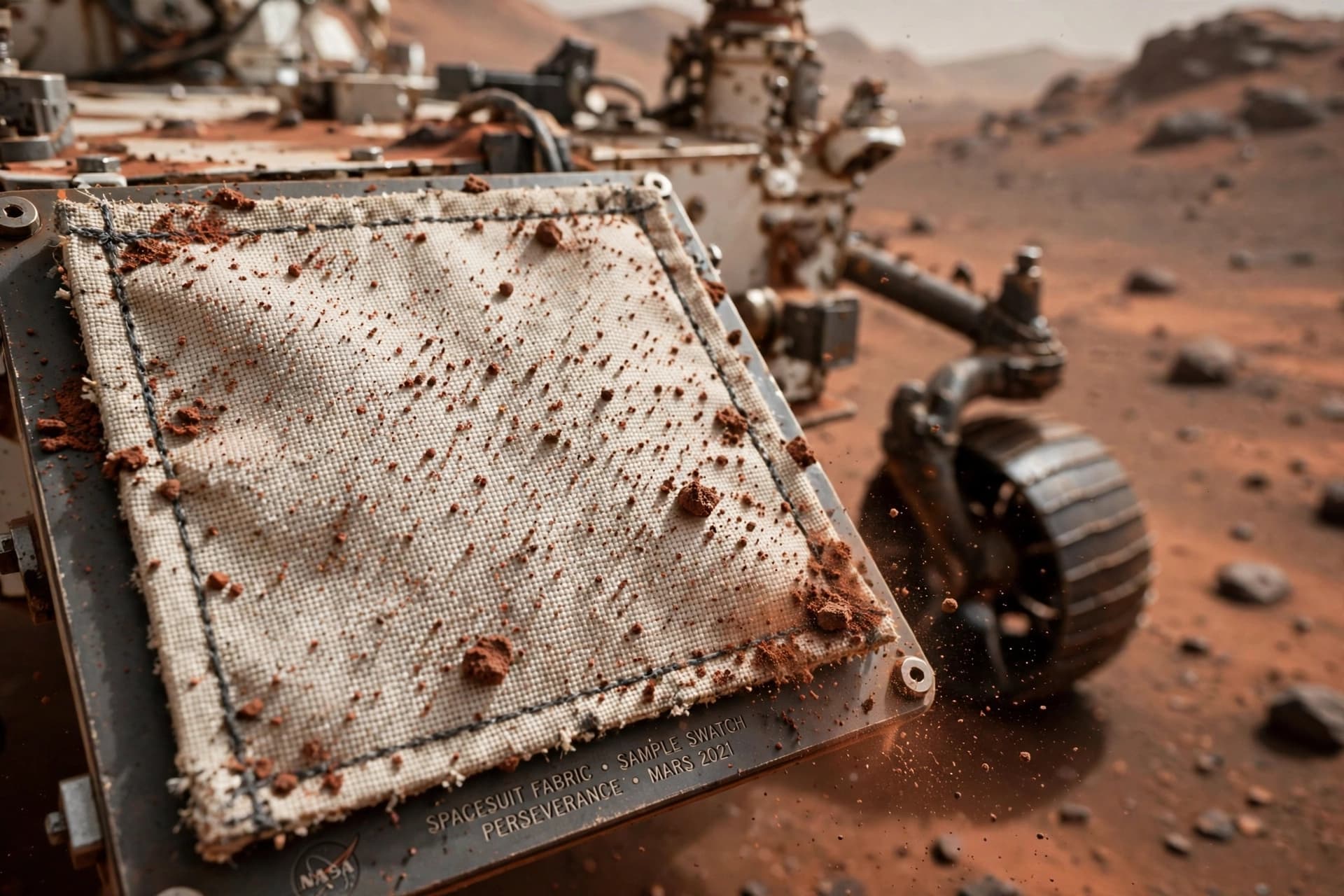
NASA's Perseverance rover has spent over 1,600 Martian days measuring the fine and ultrafine dust that clings to samples of spacesuit material carried aboard the rover. The findings, published in the Proceedings of the National Academy of Sciences, reveal particles small enough to penetrate the lungs and enter the bloodstream—sizes that previous instruments could not resolve . Earlier measurements on Mars captured dust down to about three micrometers across. Perseverance's PIXL instrument detected two categories of even smaller particles: fine particles below 2.5 micrometers, and ultrafine particles around 100 nanometers, roughly 700 times thinner than a human hair .
The study used calibration targets containing Teflon and Vectran, materials common in spacesuit outer layers, to see what would stick. On some surfaces, particle sizes ranged down to 100 to 300 nanometers. Static electricity appears to determine which sizes adhere to which materials, with the finest particles remaining attached through years of driving and drilling . The dust itself is enriched in sulfur, chlorine, iron, and phosphorus, with silica content higher than lunar dust—a composition that matters for long-term health .
The implications are practical. Some materials hold less dust than others, a finding that could guide future spacesuit coatings and habitat design. Suitports, which allow astronauts to enter a suit attached to the outside of a habitat, and dual-chamber airlocks could reduce how much dust reaches living quarters . "The existence of Mars dust at these ultrafine sizes has been predicted for a long time, and PIXL gave us the chance to measure it directly on Mars," said Scott VanBommel, the paper's lead author .
What the rover has provided is not a solution but a measurement—the kind of data that turns an abstract concern into an engineering problem. Mars will not be made dust-free. But the dust can be understood, and understanding is the first step toward protection.
The images in this article are AI-generated and are not actual photographs from Mars.
Sources: NASA Jet Propulsion Laboratory, PNAS, Les Numériques, Nauka.ua
Published by Banx Network. This article is part of the Banx decentralized media programme, powered by the BXE token on the XRP Ledger.