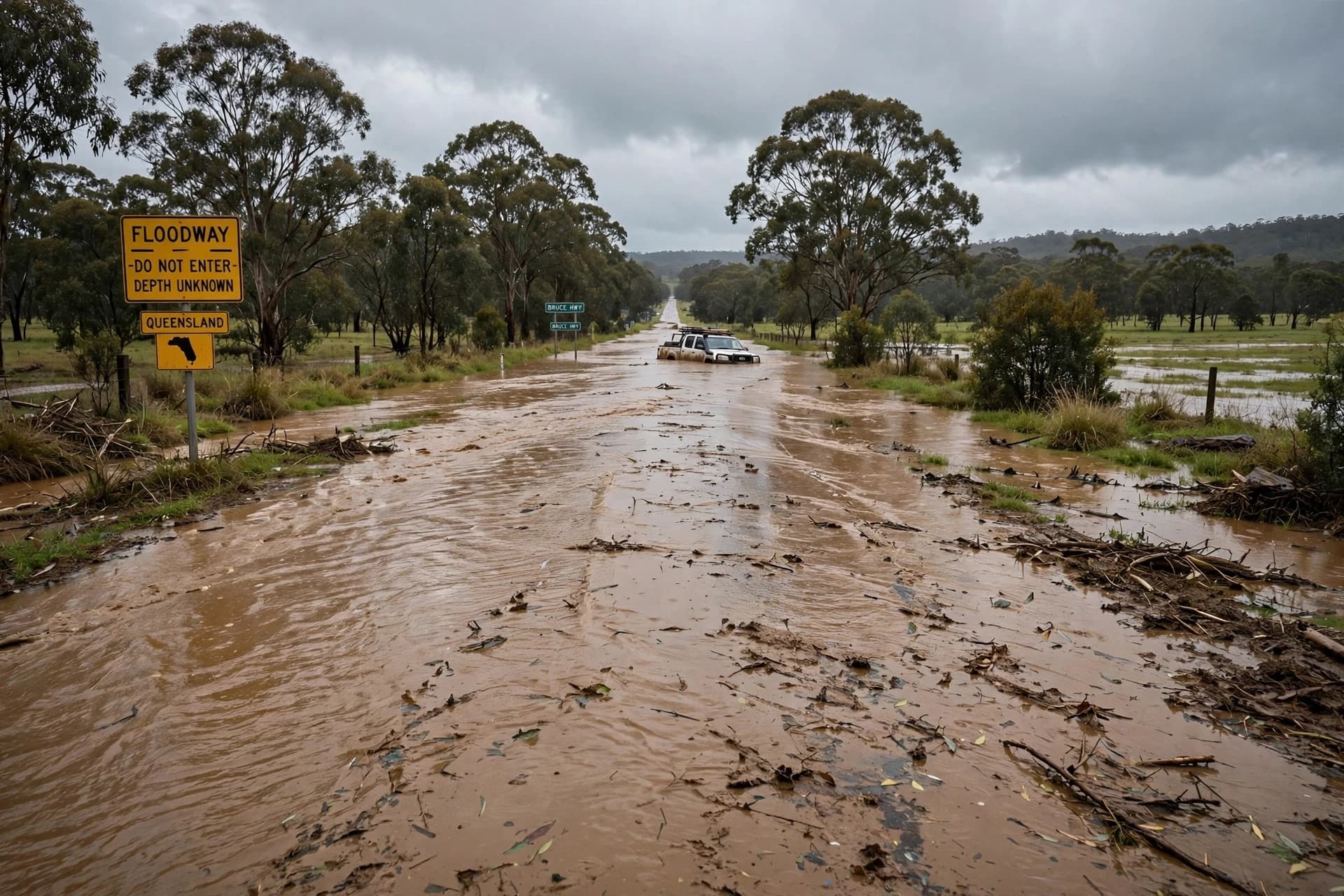
There is a moment in every flood when the water stops being scenery and becomes something else entirely—a force with its own intentions, its own patience, its own appetite. For a television crew standing on the edge of a submerged road in Queensland, that moment arrived when a utility vehicle drove past them and vanished into the brown water, and the distance between reporting and rescuing collapsed in an instant.
Will Murray, a reporter for the Australian Broadcasting Corporation, was covering the record rainfall at Morayfield, north of Brisbane, on Thursday when the vehicle entered the flooded section of Buchanan Road at speed and stalled . Within seconds, the car began to sink, the current pushing it deeper. Murray called emergency services, but when the driver disappeared from view, he handed his phone to his camera operator and jumped into the water .
A bystander, Daniel Hainey, who had been nearby with his family, joined the rescue. The two men swam to the vehicle, which was already partially submerged. They tried the doors without success. They climbed onto the rear of the car, hoping to break the back window, but the glass held . Murray then moved to the passenger-side rear door, braced his feet against the body of the vehicle, and pulled. The door gave way, aided by the pressure of the water rushing in .
The driver emerged into their arms. The three men embraced in the floodwater, a brief island of relief in a landscape that had become hostile. Emergency services arrived about ten minutes later . The driver told Murray he had not seen any warning signs and had not expected the water to be so deep . The reporter's response was simple and direct: "Please, do not drive into flooded roads" .
The rescue was captured on camera by Liz Pickering, the ABC camera operator who continued filming as her colleague swam toward the sinking car. "They saved that man's life, without a doubt," she said afterward . The footage spread quickly across social media and international news outlets, a rare moment of human agency interrupting the usual helplessness of disaster coverage.
What makes this story resonate is not only the courage it displays but the ordinariness from which it emerged. Murray was not equipped for rescue. He was not trained for it. He was a reporter doing his job on a rainy Thursday, and then he was a person responding to another person in danger. The distinction between those roles, it turns out, is thinner than we often imagine.
Visuals in this article were created using AI and are for illustrative purposes only.
Sources: T13, Athens Voice, SCC10, RaiNews, ABC
Published by Banx Network. This article is part of the Banx decentralized media programme, powered by the BXE token on the XRP Ledger.