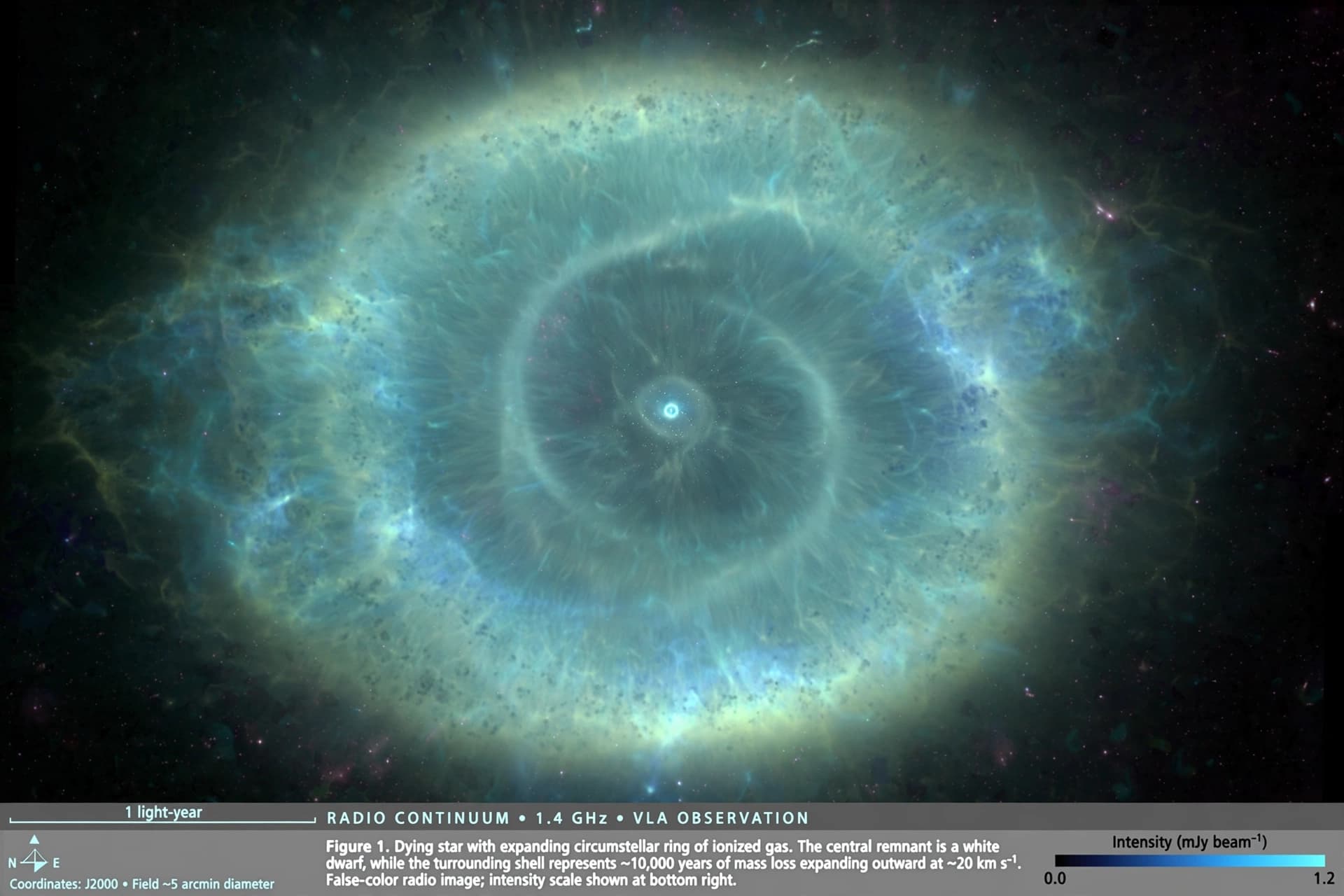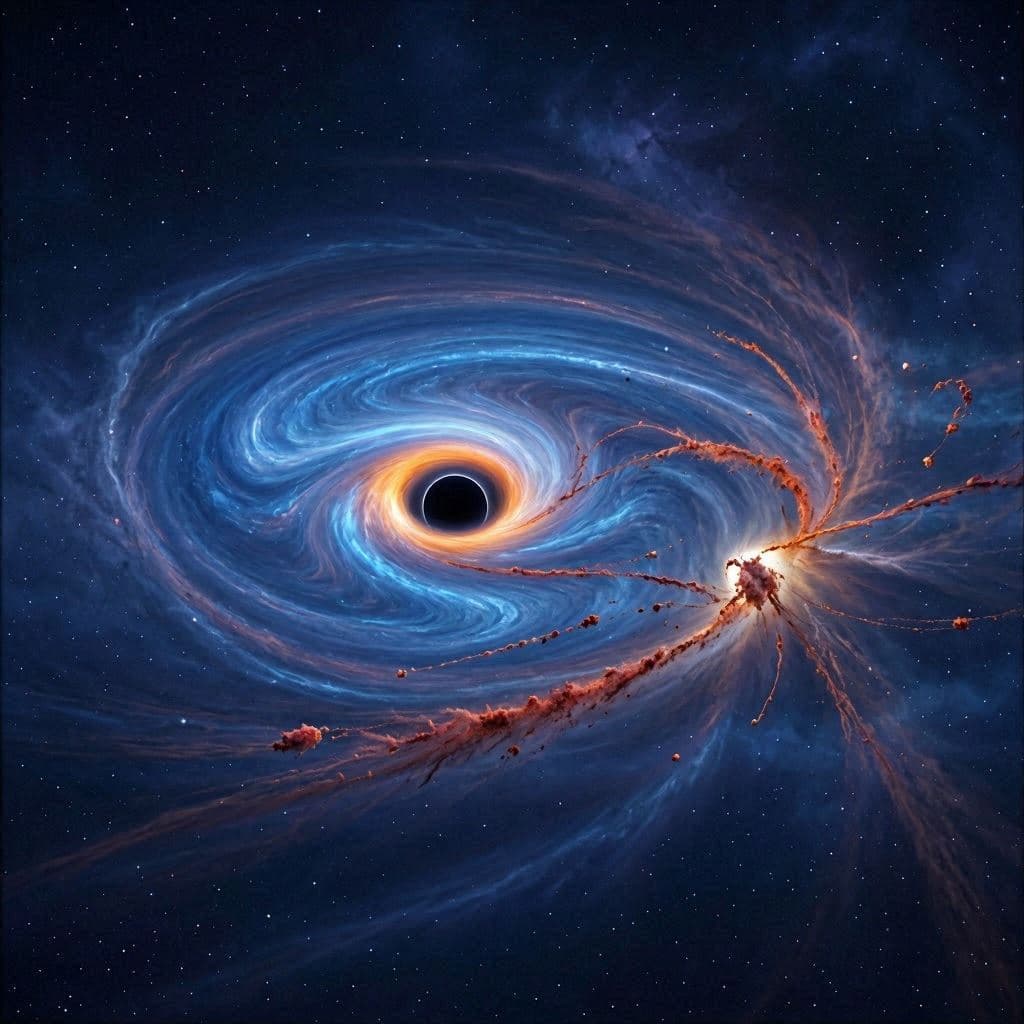
The universe often reveals itself through moments of extraordinary violence that illuminate hidden mysteries. For countless years, a massive black hole may drift silently through the darkness, invisible even to powerful telescopes. Yet when an unfortunate star wanders too close, the encounter briefly transforms that unseen traveler into one of the brightest objects in its galaxy, allowing astronomers to witness an event that would otherwise remain concealed.
NASA's Neil Gehrels Swift Observatory recently captured such a phenomenon when it detected a tidal disruption event known as AT2024tvd. In this rare occurrence, a supermassive black hole shredded a passing star through immense gravitational forces, producing a brilliant flare of radiation visible across hundreds of millions of light-years. Unlike nearly every previously observed event of this kind, the black hole was not located at the center of its host galaxy.
Astronomers determined that the black hole was positioned approximately 2,600 light-years from the galaxy's nucleus, making it what researchers describe as a "wandering" supermassive black hole. Most supermassive black holes occupy the centers of galaxies, where they influence the motion of surrounding stars. Finding one displaced so far from the galactic core provides compelling evidence that these enormous objects can survive outside their traditional locations.
The event occurred when the doomed star ventured within the black hole's tidal radius. The intense difference in gravitational pull between the star's near and far sides stretched and ultimately tore it apart in a process known as a tidal disruption event. As stellar debris spiraled inward, it formed a rapidly rotating accretion disk that heated to extreme temperatures, emitting ultraviolet, optical, and X-ray radiation detected by multiple observatories.
Researchers believe the wandering black hole may have reached its unusual location through the merger of galaxies. During such interactions, gravitational forces can displace central black holes or leave behind stripped galactic remnants containing little visible matter. In this case, astronomers found no detectable dwarf galaxy or star cluster surrounding the object, strengthening the interpretation that it is a truly wandering supermassive black hole rather than one residing within a hidden companion galaxy.
The discovery demonstrates the value of monitoring transient astronomical events across the sky. Because wandering black holes emit little or no light when inactive, they are exceptionally difficult to detect directly. Tidal disruption events act as temporary cosmic beacons, revealing their presence for weeks or months before gradually fading from view. Scientists hope similar observations will uncover additional wandering black holes that have remained hidden until now.
The findings also improve astronomers' understanding of galaxy evolution. If galaxy mergers routinely leave behind displaced supermassive black holes, these objects may represent an overlooked population scattered throughout the universe. Future observations by NASA missions and ground-based observatories could determine how common such wandering giants truly are and how they influence their galactic environments over billions of years.
The observation serves as a reminder that even the darkest regions of the cosmos can briefly reveal their secrets. A single star's destruction has provided scientists with a rare opportunity to study an elusive supermassive black hole, expanding humanity's understanding of how galaxies evolve and how some of their most powerful inhabitants continue their quiet journeys through space.
AI Image Disclaimer: The accompanying illustrations are AI-generated visual interpretations based on verified scientific findings and are intended to represent the astronomical phenomenon rather than actual telescope imagery.
Sources (Verified):
NASA Science NASA Goddard Space Flight Center Space.com University of Maryland Astrophysical Journal Letters
Published by Banx Network. This article is part of the Banx decentralized media programme, powered by the BXE token on the XRP Ledger.