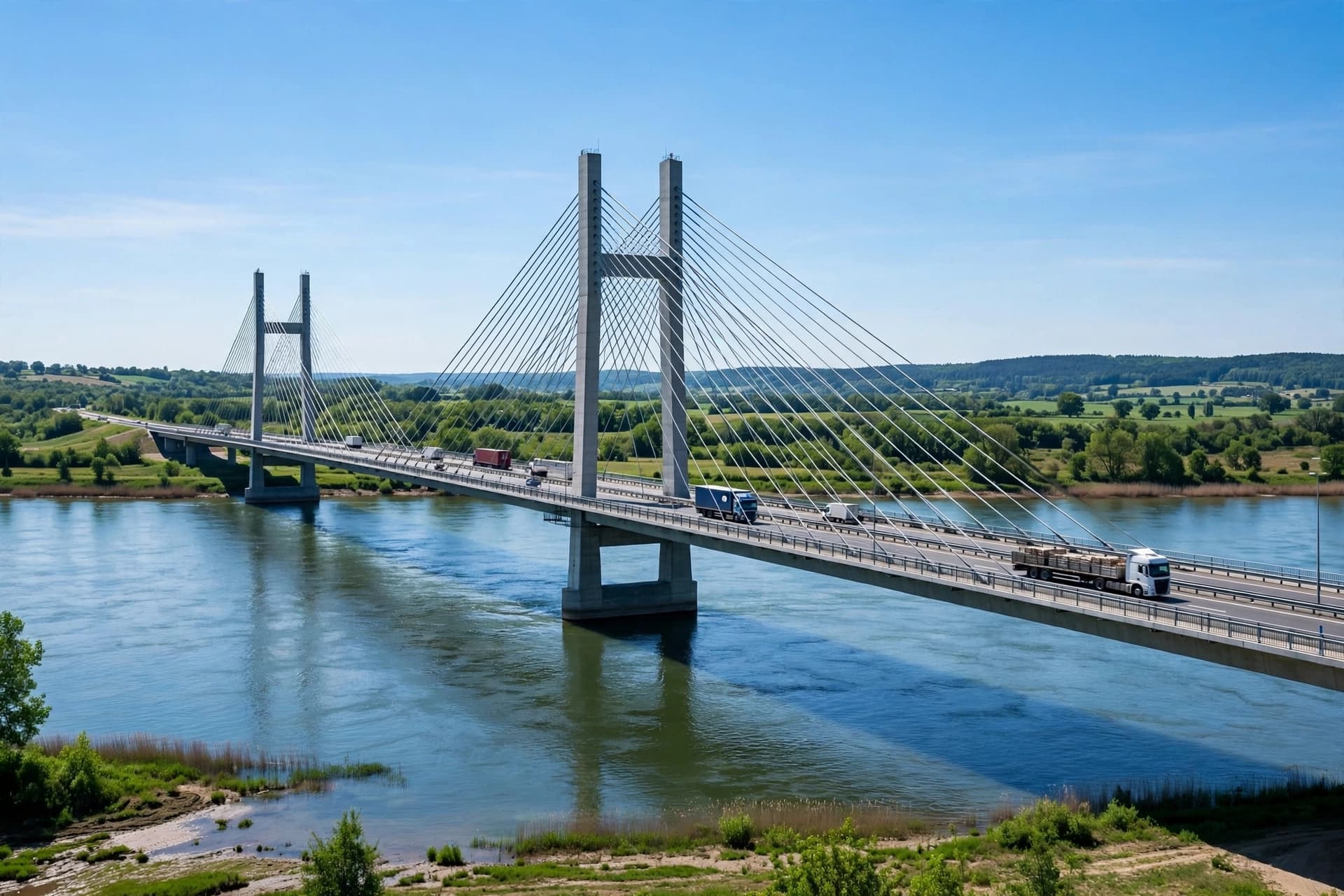
For twelve years, the New Yalu River Bridge stood complete but empty, a cable-stayed span waiting for the roads and customs facilities on one side to catch up. On Thursday, trucks bearing North Korean and Chinese flags finally crossed in both directions, and a bridge that had become a symbol of stalled ambition became a symbol of something else: connection, however cautious.
The 3,026-meter bridge links Dandong in China's Liaoning Province to Sinuiju in North Korea's North Pyongan Province. It features a four-lane deck designed for two-way traffic and a water navigation clearance for vessels up to 3,000 tonnes. Chinese Premier Li Qiang, in a video speech at the opening ceremony, called it "a new landmark symbolizing the traditional friendship between China and the DPRK".
The bridge is intended as an alternative and eventual replacement for the Sino-Korean Friendship Bridge, the older combined road-rail structure that has long served as the primary crossing. That bridge could only accommodate trucks weighing no more than 20 tonnes for one-way traffic. The new span is expected to boost bilateral trade and people-to-people exchanges, according to Chinese foreign ministry spokesperson Mao Ning.
China is North Korea's largest trading partner and a vital source of diplomatic and economic support. Dandong boasts China's largest border trade port with the North. The opening comes after years of pandemic-era border closures. North Korea sealed its borders during COVID-19, and train journeys between the two countries only restarted in March after a six-year halt. The North has not yet resumed issuing tourism visas to Chinese citizens.
The timing is notable. The bridge opens just over a month after North Korea and Russia opened their first road bridge, with Pyongyang praising it as a sign of tightening relations. For a country that has often balanced its relationships with its two large neighbors, the new bridge with China serves as a reminder that economic ties remain a quiet counterweight to isolation.
Construction of the bridge was completed in 2014, but its opening was delayed due to the lack of connecting roads and customs facilities on the North Korean side, according to South Korean news agency Yonhap. The twelve-year gap between completion and opening reflects the complex realities of cross-border infrastructure—where engineering meets diplomacy, and where a bridge is only as functional as the roads that lead to it.
The opening ceremony was held jointly by both sides. For the people of Dandong, the bridge represents more than a trade route. It is a visible link to a neighbor that has been, for most of recent memory, just out of reach. For now, the trucks are moving, and the bridge is no longer a symbol of waiting.
AI Image Disclaimer: Visual content accompanying this article is generated by artificial intelligence for illustrative purposes only.
Sources: Xinhua, People's Daily Online, China.org.cn, AFP via BSS News, Bangladesh Sangbad Sangstha
Published by Banx Network. This article is part of the Banx decentralized media programme, powered by the BXE token on the XRP Ledger.