The Brain as an Interface
The human brain is constantly producing electrical and chemical activity.
Every movement, sensation and attempted action involves patterns of neural activity.
When someone reaches for a cup, for example, their brain generates signals associated with planning and executing that movement.
A brain-computer interface attempts to capture some of those signals and translate them into commands.
The basic concept is surprisingly simple:
Brain activity → computer interpretation → digital or physical action
Instead of moving a mouse, a person could potentially imagine moving a cursor.
Instead of typing a sentence, neural signals could potentially be translated directly into text.
Instead of moving a robotic arm manually, a user could potentially control it through neural activity.
The technology required to make this work, however, is extraordinarily complex.
What Exactly Is a Brain-Computer Interface?
A brain-computer interface, or BCI, is a system that creates a direct communication pathway between brain activity and an external device.
BCIs generally involve three stages.
First, neural activity is recorded.
Second, software interprets those signals.
Third, the system converts the interpretation into an action.
The recording method can vary significantly.
Some systems use electrodes implanted inside the brain.
Others use electrodes positioned on or near the surface of the brain.
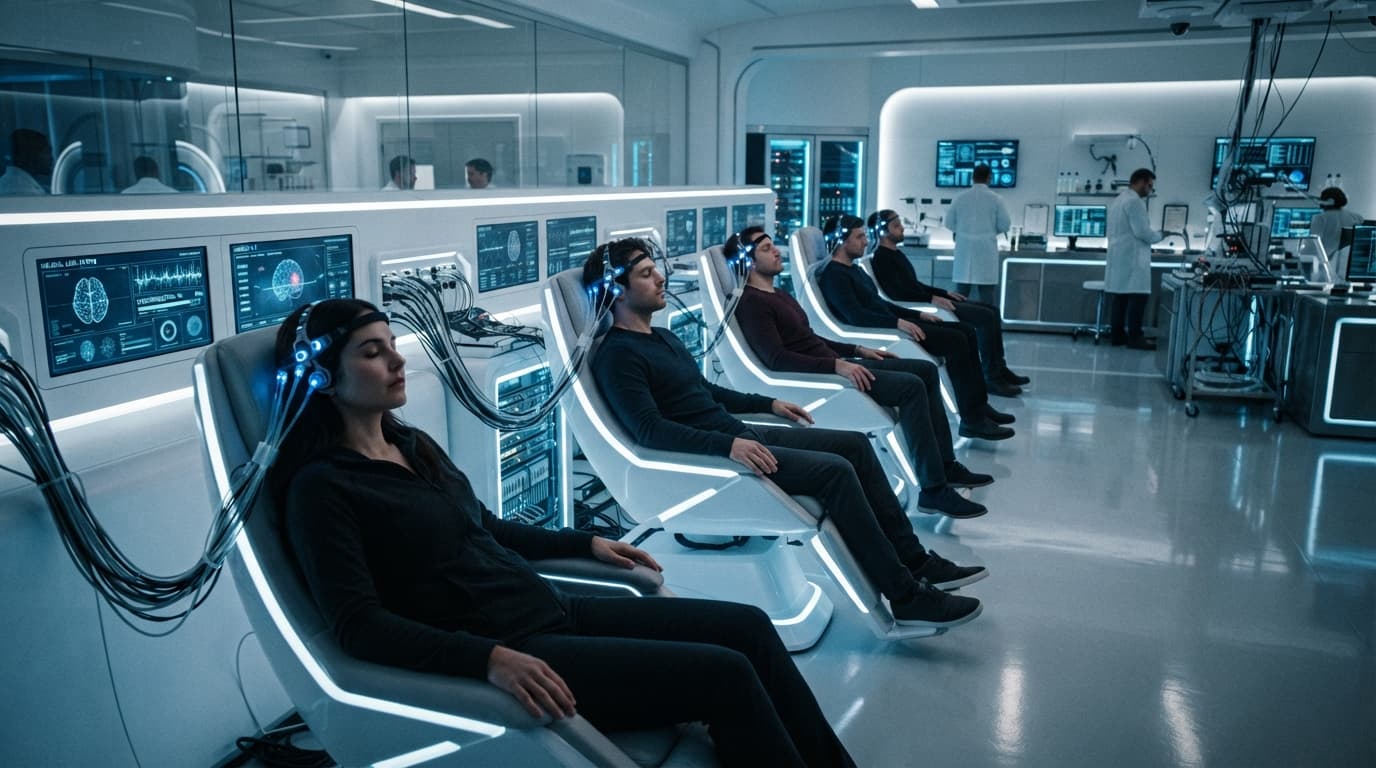
There are also non-invasive systems that measure brain activity through sensors placed on the scalp.
Each approach involves different compromises involving signal quality, safety, invasiveness and practicality.
Why Medical Applications Come First
The most immediate applications for BCIs are medical.
Millions of people worldwide live with conditions that can severely restrict movement or communication.
Stroke, spinal-cord injury and neurodegenerative diseases can leave people unable to move their limbs or communicate normally despite retaining significant cognitive ability.
A BCI could potentially provide another pathway.
Rather than sending commands through damaged nerves and muscles, the system can attempt to interpret signals generated by the brain itself.
That makes BCIs particularly interesting as a form of assistive technology.
The goal isn't initially to enhance a healthy person.
It is to restore capabilities that disease or injury has taken away.
From Brain Signals to Speech
One of the most impressive areas of recent research is speech.
In 2026, researchers reported a BCI system that allowed a man with paralysis and severe dysarthria to use an implanted interface for speech and computer control independently at home.
Over nearly two years, he used the system for more than 3,800 hours, communicating more than 183,000 sentences. In a prompted-word test, the speech decoder achieved more than 99% word accuracy using a vocabulary of 125,000 words.
This represents an important shift.
Earlier BCI demonstrations often took place in highly controlled laboratories with researchers present.
Long-term independent operation in someone's home addresses a different problem:
Can this technology actually become part of someone's daily life?
The 2026 study suggests that increasingly sophisticated BCI systems are beginning to address that challenge.
Giving a Voice Back
Another research direction is even more ambitious.
Instead of translating brain activity into text, researchers are attempting to recreate speech directly.
A 2025 study published in Nature demonstrated an implanted brain-to-voice neuroprosthesis capable of synthesising speech from neural activity in a participant with ALS and severe dysarthria. The system could also reproduce aspects of vocal expression, including changes in intonation.
That distinction matters.
Text is useful.
But human communication isn't simply words.
We communicate through tone, rhythm, pauses and emotion.
A future BCI capable of reproducing those characteristics could provide a much more natural communication experience.
The Brain Could Control More Than Speech
Speech is only one possible application.
BCIs can also decode signals associated with movement.
Researchers have demonstrated systems capable of allowing people with paralysis to control computer cursors, robotic limbs and other devices.
In 2025, researchers reported a high-performance BCI that allowed a person with paralysis to control individual finger groups and interact with a quadcopter game.
These experiments demonstrate an important principle.
The brain does not necessarily need the original muscles and nerves to remain functional for certain intended movements to be detected.
If the relevant neural signals can be recorded and interpreted, they may potentially be converted into commands for an external machine.
Connecting the Brain to Robots
This creates an obvious connection between BCIs and robotics.
Imagine someone who cannot move their arms controlling a robotic arm using their own neural signals.
The robot effectively becomes an extension of the person's physical capabilities.
The potential applications include:
Robotic prosthetic limbs Wheelchairs Exoskeletons Robotic arms Computer interfaces Assistive household technology
The technology is still developing, but the underlying concept is powerful.
Instead of restoring the damaged biological pathway, engineers can potentially create a new technological pathway.
Brain → computer → machine.
Artificial Intelligence Could Make BCIs More Powerful
Artificial intelligence is becoming an increasingly important part of the BCI ecosystem.
Raw neural signals are extremely complicated.
The brain does not produce a clean digital command saying:
"Move the cursor left."
Instead, sensors capture patterns of neural activity that must be interpreted.
Machine-learning models can analyse those patterns and identify relationships between neural activity and intended actions.
This creates an important convergence between two frontier technologies:
Artificial intelligence + neuroscience.
Researchers have already demonstrated AI-assisted BCI systems.
A 2025 study in Nature Machine Intelligence showed that AI "copilots" could improve BCI performance in cursor-control and robotic-arm tasks. In one experiment involving a participant with paralysis, the AI-assisted system enabled robotic-arm pick-and-place behaviour that the participant could not achieve without the AI copilot.
This points toward an interesting future.
The human may not need to control every individual movement.
Instead, the human could communicate an intention while AI handles some of the lower-level execution.
Human Intention Could Become the New Interface
Consider how people interact with computers today.
You move a mouse.
You click a button.
You type.
You swipe.
These actions are intermediary steps.
The ultimate goal is usually something else.
You want to open an application.
You want to write a message.
You want to move an object.
A sufficiently capable BCI could potentially remove some of those intermediary actions.
The user could provide the intention.
AI could interpret it.
The computer could execute it.
That could represent a fundamental change in human-computer interaction.
The Non-Invasive Alternative
Not every BCI requires brain surgery.
Researchers are also developing non-invasive systems.
Electroencephalography, or EEG, uses sensors placed on the scalp to measure electrical activity associated with brain function.
The major advantage is obvious:
No surgical implantation.
But there is a trade-off.
The skull and other tissues distort and weaken the signals before they reach sensors on the scalp.
As a result, non-invasive systems generally provide less detailed information than electrodes placed directly on or near the brain.
This creates two broad directions for the industry.
Implanted BCIs: potentially higher-quality neural signals, but greater medical complexity.
Non-invasive BCIs: easier to deploy and potentially more accessible, but generally with weaker or noisier signals.
Both approaches could have important roles.
The Race to Build Implantable BCIs
Several companies and research groups are working toward implantable BCI systems.
Neuralink has attracted considerable attention through its development of an implantable interface intended to allow people with paralysis to control digital devices using neural activity.
But Neuralink is only one part of a much larger research ecosystem.
Synchron has developed a different approach involving an implant designed to record neural signals without requiring the same type of open-brain surgery associated with some intracortical systems.
Paradromics has also entered clinical development, with research focused on restoring communication for people with severe motor impairments. Nature reported in 2025 that the U.S. FDA had approved a first long-term clinical trial of Paradromics' BCI.
The competitive landscape is therefore expanding.
Different companies are pursuing different technical approaches to the same fundamental problem:
How can neural information be captured safely and reliably enough to become useful?
China Has Also Entered a New Phase
The BCI industry is becoming increasingly international.
In March 2026, Nature reported that China had approved a brain implant for people with severe paralysis that enables control of a soft robotic hand.
The publication described the approval as the world's first BCI device of its kind to become available outside a clinical trial.
This illustrates another important development.
BCIs are gradually moving from purely experimental research toward regulated medical applications.
The transition will be slow and highly controlled, but it represents a significant step for the field.
The Challenge of Brain Surgery
Despite the promise, implantable BCIs face substantial challenges.
Brain surgery carries risks.
Implanted electronics must remain functional for long periods.
Electrodes can degrade.
Neural signals can change over time.
And the system must operate reliably while interacting with one of the most complex biological organs in existence.
This is why BCI development is not simply an engineering problem.
It is simultaneously a problem in:
Neuroscience Medicine Materials science Electrical engineering Artificial intelligence Software development Robotics
The eventual winning systems may therefore depend on advances across many disciplines.
The Data Problem
There is another issue that could become increasingly important:
Who owns your neural data?
A BCI could potentially generate highly sensitive information about a person's brain activity.
Today, companies already collect information about what people search for, what they purchase and what they watch.
Neural interfaces could potentially create an entirely new category of personal information.
That raises difficult questions.
Could neural data be sold?
Could it be used for advertising?
Could employers request access?
Could insurers want it?
Could governments regulate it?
These questions remain largely ahead of the technology.
But they will become increasingly important as BCIs move from laboratories into everyday life.
The Future of Communication
One of the most transformative possibilities is communication.
Imagine being able to communicate without physically speaking or typing.
The system could interpret intended speech from neural activity and convert it into text or synthetic speech.
For people who have lost the ability to speak, that could be transformative.
But the longer-term implications extend further.
If neural decoding becomes highly reliable, communication itself could eventually become faster and more direct.
The keyboard could become less important.
Voice assistants could potentially become more responsive.
Digital devices could become increasingly aware of user intention.
The boundary between thinking about an action and performing it could become thinner.
Could BCIs Enhance Healthy People?
This is where the subject becomes much more speculative.
The medical applications of BCIs are increasingly supported by research.
Enhancement is a different question.
A future BCI might theoretically allow a healthy person to interact with computers more directly.
For example, someone could potentially control software without a keyboard.
Or interact with a virtual environment using neural signals.
Or control robotic systems from a distance.
But these applications require substantial technological advances.
A system capable of helping a paralysed person move a cursor is not automatically capable of reading someone's thoughts.
That distinction is crucial.
BCIs do not currently provide a general-purpose mind-reading technology.
They decode specific neural patterns associated with trained tasks.
The 2030s Could Be Important
If current research continues progressing, the 2030s could become an important decade for BCI development.
The technology could potentially move through several stages.
Stage One: Restore communication.
Stage Two: Restore movement and physical control.
Stage Three: Improve long-term reliability and independence.
Stage Four: Connect BCIs with increasingly capable AI and robotics.
Stage Five: Explore applications beyond medical rehabilitation.
There is no guarantee that every stage will occur.
But the direction of research is becoming increasingly clear.
BCIs are moving toward systems that can operate for longer periods, decode more complex behaviours and work with AI to translate neural signals into useful actions.
The Economic Opportunity
If BCIs become reliable, the economic implications could extend well beyond medical devices.
A new neurotechnology industry could emerge around:
Neural implants Sensors AI decoding software Medical robotics Neuroprosthetics Assistive technology Brain-controlled computers Neural data infrastructure
Healthcare would likely remain the initial market.
But successful medical technology could eventually provide the foundation for broader applications.
This is similar to how other technologies have evolved.
A technology initially developed for a specialised purpose can eventually find uses far beyond its original market.
The Long-Term Vision
The most ambitious vision is not simply controlling a computer with your brain.
It is creating a new interface between humans and machines.
Imagine sitting at a computer without a keyboard.
Imagine controlling a robotic limb as naturally as a biological one.
Imagine communicating through synthetic speech without physically speaking.
Imagine operating machines remotely through neural signals.
And eventually, imagine AI systems interpreting your intentions while handling the technical complexity in the background.
That would represent a fundamentally different relationship between humans and technology.
But it remains a long-term possibility, not today's reality.
The Brain-Computer Interface Revolution
The significance of BCIs lies in what they represent.
For decades, technology has adapted itself around human physical interfaces.
We built keyboards.
We built touchscreens.
We built microphones.
We built cameras.
BCIs attempt to reverse the relationship.
Instead of requiring humans to translate their intentions into physical commands, technology could increasingly attempt to understand the neural signals underlying those intentions.
The technology is still young.
Surgery remains a major barrier.
Neural signals are difficult to interpret.
Long-term reliability must be demonstrated.
Regulation and privacy questions remain unresolved.
And many of the more futuristic applications are still speculative.
Yet the progress is becoming difficult to ignore.
In 2026, researchers have demonstrated long-term independent BCI use at home, highly accurate brain-to-text communication and increasingly sophisticated systems capable of decoding multiple forms of human expression.
The ultimate goal may not be to create machines that read every thought.
It may be something more practical:
making technology respond more naturally to human intention.
If that becomes possible at scale, the computer mouse, keyboard and touchscreen may eventually become only the earliest chapters in the history of human-computer interaction.
References
1. Nature Medicine — Long-term independent use of an intracortical BCI for speech and cursor control Research published in 2026 demonstrating more than 3,800 hours of independent home use by a person with paralysis. Nature Medicine — BCI Speech and Cursor Control
2. Nature Neuroscience — Simultaneous speech and gesture decoding 2026 research demonstrating simultaneous decoding of speech and gestures using a single cortical implant. Nature Neuroscience — Speech and Gesture BCI
3. Nature — Brain-to-voice neuroprosthesis Research demonstrating instantaneous voice synthesis from neural activity in a person with ALS. Nature — Voice-Synthesis Neuroprosthesis
4. Nature Machine Intelligence — AI copilots for BCIs Research examining how AI can improve BCI performance and assist with cursor and robotic-arm control. Nature Machine Intelligence — AI-BCI Copilots
5. Nature Medicine — High-performance BCI for finger control Research demonstrating finger-level BCI control and interaction with a quadcopter game in a person with paralysis. Nature Medicine — Finger-Decoding BCI
6. Nature — China's brain-implant approval Report on China's 2026 approval of a BCI device for people with severe paralysis. Nature — China Brain-Computer Interface Approval
7. Nature — Paradromics enters BCI clinical trials Report on FDA approval of Paradromics' first long-term BCI clinical trial. Nature — Paradromics BCI Trial
Published by Banx Network. This article is part of the Banx decentralized media programme, powered by the BXE token on the XRP Ledger.