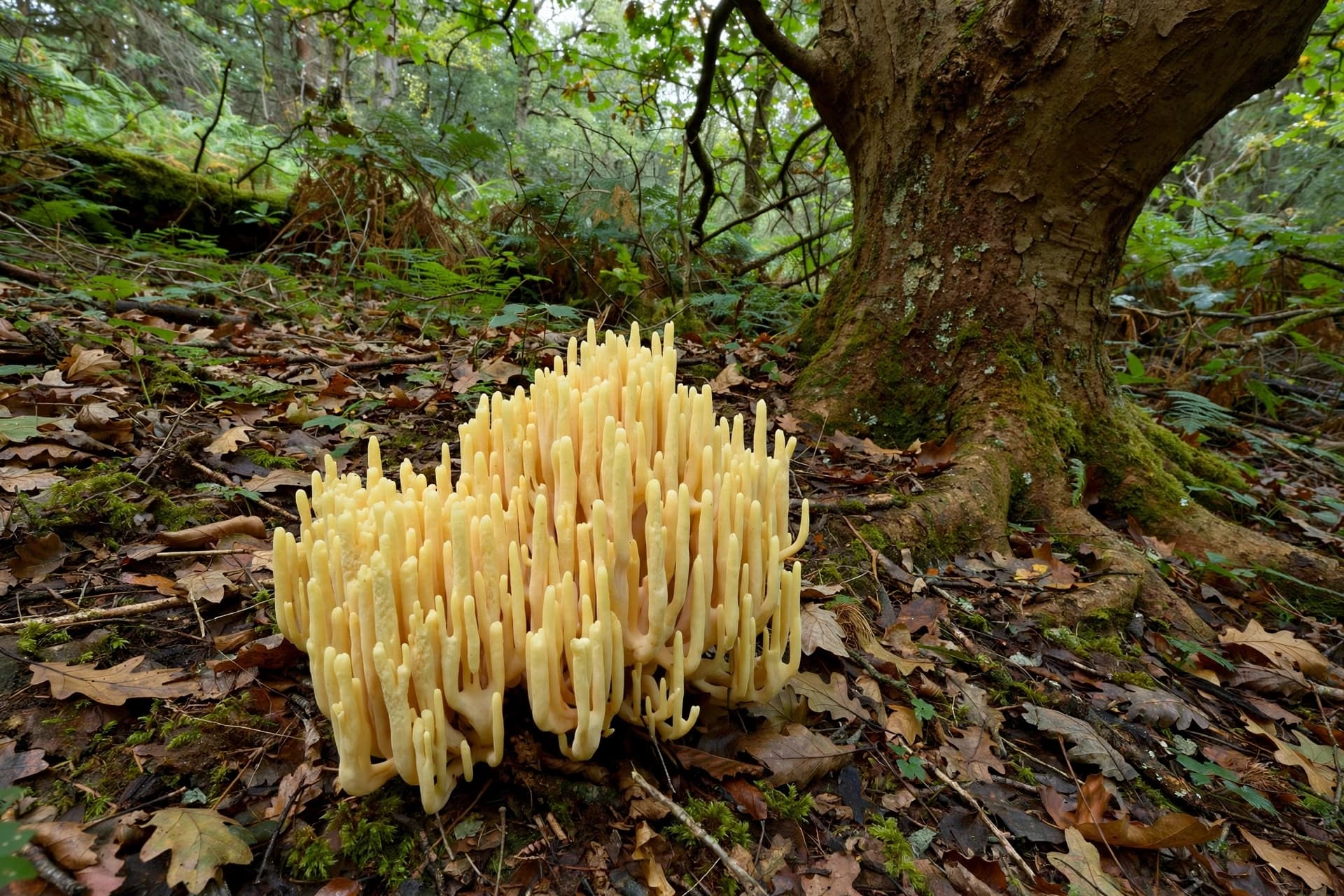
There is a peculiar humility in the way science discovers its giants. Not with trumpets, but with a curious photograph sent by a local farmer, a cluster of pale fingers rising from the forest floor around a dead tree, noticed but not understood. In the forests of southwestern China's Yunnan province, something had been growing for millennia that no one had thought to name—a fungus so large, so distinct, and so ancient that it now bears a name borrowed from the most famous king of the dinosaurs .
Scientists have identified Dianjunus rex, or D. rex, a fungus whose upright fruiting bodies can reach 20 inches in height and weigh nearly five pounds. It is the largest known member of the Ascomycota phylum, the vast fungal group that includes morels, truffles, and yeasts . Before this discovery, the largest known ascomycete was a bulbous fungus found in Kenya; D. rex dwarfs its relatives with a presence that is difficult to ignore in the dense, humid forests where it grows .
What makes the discovery more than a curiosity of size is its evolutionary timing. Genetic analysis indicates that the family to which D. rex belongs, Dianjunaceae, diverged from its closest relatives approximately 65 million years ago—roughly one million years after the asteroid impact that ended the Cretaceous period and wiped out the non-avian dinosaurs . The researchers suggest that the mass extinction, which left vast quantities of dead plant material in its wake, may have created an ecological opportunity for wood-decomposing fungi to thrive and diversify .
The fungus was found during surveys conducted in 2024 and 2025 in Yunnan, growing at the base of Chinese cork oak trees, on decaying roots or stumps. Local farmers had seen it before; some had even tasted it and reported no ill effects, though researchers have not tested it for toxins . No one had recognized it as something unknown to science. It took a photograph, sent to researchers, to begin the process of formal identification.
Why D. rex grows so large remains an open question. Its fruiting bodies, called stromata, rise well above the forest floor, which may allow spores to disperse more widely in dense vegetation. But such a large structure requires substantial energy, and most fungi in its phylum remain microscopic or only a few inches tall . The genome of D. rex contains fewer carbohydrate-active enzymes than its relatives, a genetic feature that may help explain its unusual growth strategy—perhaps it spends less energy breaking down plant matter and more on building its towering form .
The discovery is a reminder of how much remains unknown in the fungal world. Fungi are essential to the carbon cycle and to the health of forests, yet they are often overlooked in biodiversity surveys. Kabir Peay, a biologist at Stanford University who was not involved in the research, noted that the finding points to "all of the really exotic forms of fungal life on this planet that haven't had a chance to be described by science" .
D. rex now sits in the scientific record, a king among fungi, named for its size and its ancient lineage. In the forests of Yunnan, it continues to rise from the roots of oak trees, releasing spores into the air, as it has for millions of years—unnoticed until now.
---
AI Image Disclaimer: The visuals in this article are AI-generated illustrations and do not depict the actual fungus or its habitat.
Sources: CNN, ScienceAlert, Gizmodo, The Times of India
Published by Banx Network. This article is part of the Banx decentralized media programme, powered by the BXE token on the XRP Ledger.