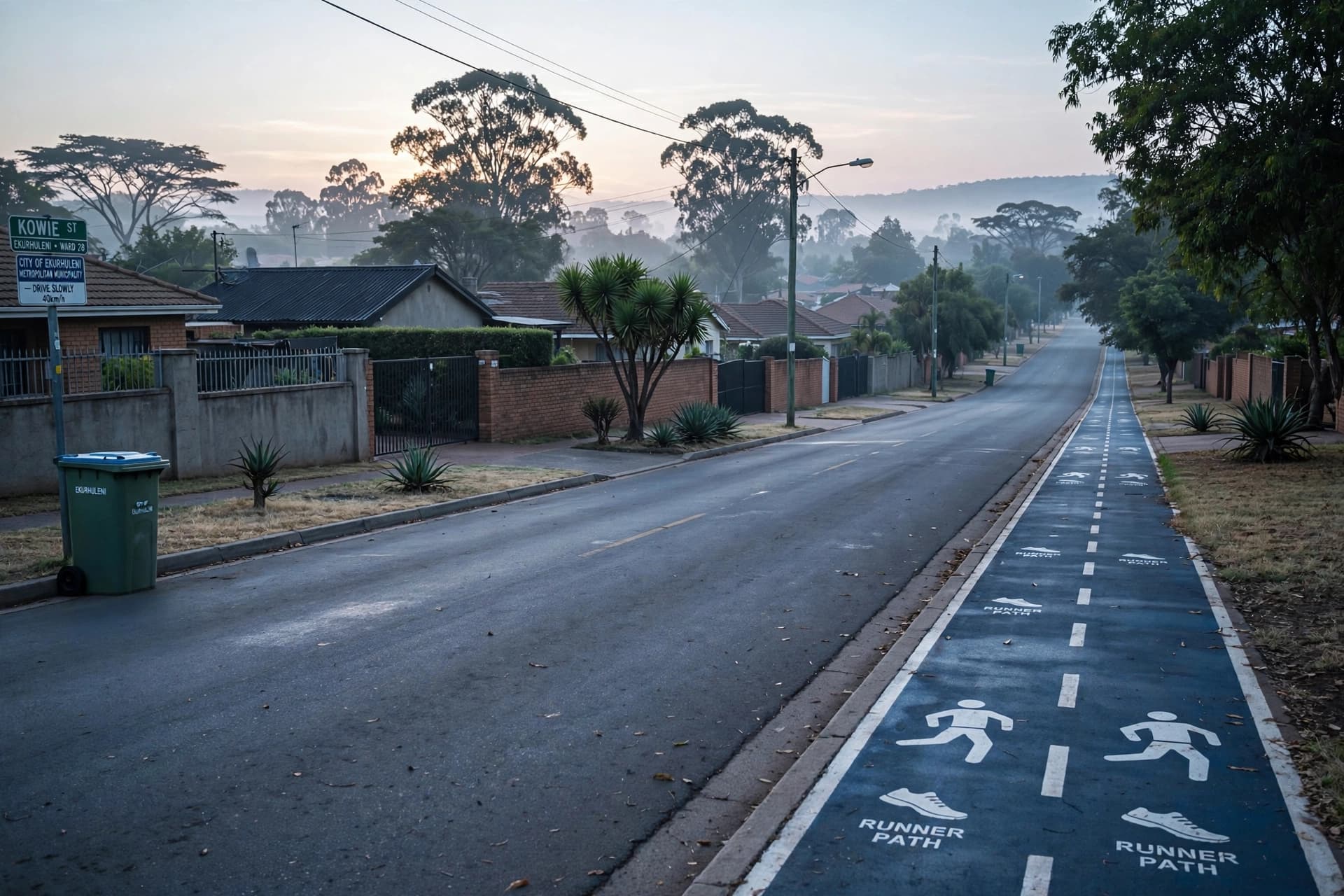
There is a particular kind of fear that settles into a community when the danger is not random—when the pattern becomes visible, when the bodies are found in the same area, when the question shifts from "what happened" to "who is next." In Ekurhuleni, east of Johannesburg, that fear has taken root, and it has a name: the twelve women found dead since July.
The latest discovery came on Saturday morning, when the body of a woman was found at a cemetery in Tembisa, northeast of Johannesburg's city center. She had been at a bar with a friend the night before. The friend identified her by the clothes she had been wearing. "I don't know what I'm going to say to her children," the friend told South African broadcaster SABC, wiping away tears. "This is painful".
That body brought the total to twelve. Eight of the victims were found in Kempton Park, a neighborhood near Africa's busiest airport. Others were found in Tembisa, Olifantsfontein, Springs, and Boksburg. Most were in their twenties and thirties. Almost all were found partially or fully naked, with signs of severe violence before death. Some showed evidence of sexual assault.
Gauteng police commissioner Tommy Mthombeni said it was too early to determine whether the deaths were connected. But he acknowledged that the victims shared "similar characteristics" pointing to a "common method of killing." "At this point, we cannot rule out a serial killer, but we cannot confirm one either," he said.
The victims have names. Busisiwe Mahlangu, 37, was the first, found on July 15 with her hands bound by cable ties. A suspect, believed to be her partner, was arrested but has not been linked to the other deaths. Elizabeth "Tsontso" Moselakgomo, 38, was a runner who disappeared during her daily jog near her home. Her body was found three days later. Dineo Motapane, 38, left behind a young child. Jabulile Ntimba was found wrapped in a sheet on the side of a road; two women have been charged with her premeditated murder in what police described as a possible love triangle. Three other cases have led to arrests, but police say those do not appear related to the broader pattern.
South Africa records one of the world's highest rates of gender-based violence. Between April and June of this year alone, 5,427 people were murdered. The South African Human Rights Commission reported that 569 women were killed in that same period, and 1,052 survived attempted murders. Last year, the government declared gender-based violence a national disaster.
The killings have sparked protests and solidarity marches from Kempton Park to Cape Town. Some women runners now carry knives and pepper spray. Nancy Masha, 39, told AFP she will not stop running despite the fear. "Our runner was brutally killed. I need something to protect myself, because I am a woman and I am also a runner," she said. "But I will not stop".
President Cyril Ramaphosa addressed the killings at a gathering on Thursday. "The pain and suffering that the women of South Africa are subjected to is a national shame," he said. "South African women have the right to walk in the streets of their country at any time without fear".
The investigation continues. Police are reviewing whether a single perpetrator or multiple offenders are responsible. For the women of Ekurhuleni, the question of who is next remains unanswered—and the fear, like the pattern itself, does not easily fade.
AI Image Disclaimer: The images in this article were created using artificial intelligence and are for illustrative purposes only.
Sources: BBC News, Ilta-Sanomat, Alwasat, Al Mayadeen
Published by Banx Network. This article is part of the Banx decentralized media programme, powered by the BXE token on the XRP Ledger.