The Arctic is often spoken of as a single thing—a vast white expanse, a fragile frontier, a region warming four times faster than the rest of the planet. But a new study drawing on two decades of measurements from eight monitoring stations has found that the Arctic is not one climate system at all. It is three, each responding to warming in its own way, each holding a different future.
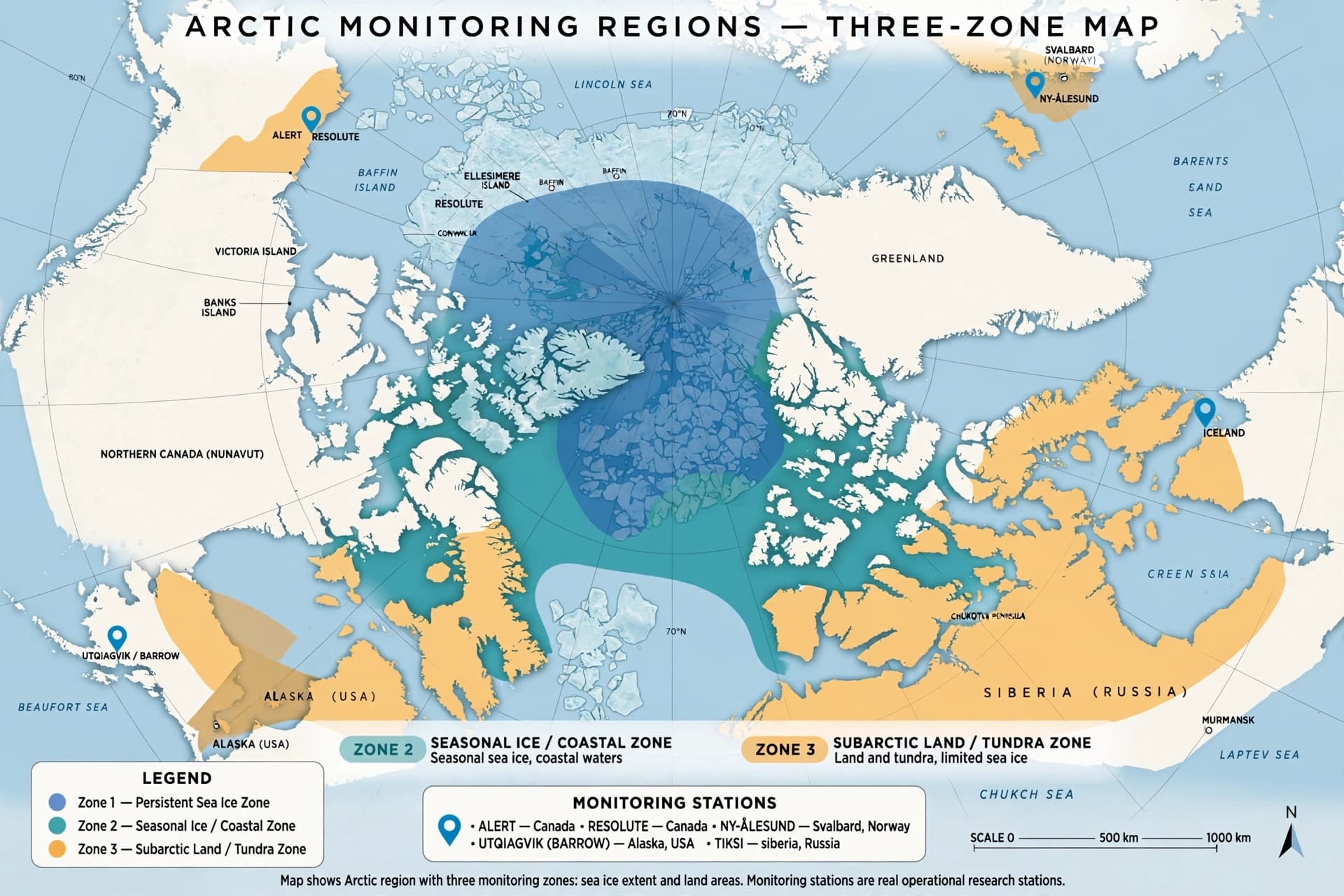
The research, led by Samuel De Xun Chua at the University of Helsinki, combined aerosol measurements collected between 2003 and 2024 with satellite data and AI-assisted mapping. The result is a division of the Arctic into three atmospheric zones with distinct behaviors, defined not by latitude or temperature alone but by how particles form and move within them .
In the High Arctic—the permanent ice, Greenland, the Canadian Archipelago—local processes dominate. Sea-ice retreat is already releasing biological and chemical precursors that nudge particle formation upward. Under an intermediate warming scenario, cloud condensation nuclei concentrations are projected to increase by 3 to 16 percent by the end of the century .
In the Maritime Arctic—the open water of the Barents and Norwegian seas—the story reverses. This zone has the highest potential for new particle formation. But more water vapor raises the condensation sink, and freshly formed particles are absorbed by existing aerosol before they can grow large enough to seed clouds. Cloud condensation nuclei concentrations are projected to fall by 15 to 31 percent .
Then there is the Continental Arctic, stretching from Lapland across Siberia into northern Canada. Here, local particle formation and cloud condensation nuclei are essentially uncorrelated. What fills the budget is transport: sulfate and organic particles carried north from European industry, Siberian wildfires, or North American agriculture. The future of this zone depends less on Arctic temperatures than on decisions made thousands of kilometers away .
The implications reach beyond regional climate. Clouds are the largest single source of uncertainty in climate projections, and the particles that seed them are a critical variable. In the Arctic, where aerosol concentrations can be so low that cloud formation is limited by scarcity, small changes in the particle budget can swing the energy balance of a region-sized stretch of ocean or ice .
What the study offers is not a prediction but a map—a recognition that the Arctic's response to warming will not be uniform because the Arctic itself is not uniform. Some zones will grow cloudier. Some will grow clearer. Some will respond to forces beyond their borders. The question, as Chua put it, is not just whether the Arctic will get cloudier, but where and how much .
The Arctic is changing. The change is not one thing. It is three.
The images in this article are AI-generated and are not photographs of the monitoring stations or researchers described.
Sources: Earth.com, University of Helsinki
Published by Banx Network. This article is part of the Banx decentralized media programme, powered by the BXE token on the XRP Ledger.