Scientific discovery is sometimes imagined as a dramatic moment—a telescope pointed toward a previously unseen corner of the universe or a spacecraft arriving at a distant world. Yet some discoveries emerge from places already familiar, hidden within archives patiently waiting for fresh eyes and new tools. In astronomy, the past often continues to reveal new stories.
Researchers recently used artificial intelligence to examine approximately 35 years of archived images collected by the Hubble Space Telescope. The effort led to the identification of more than 800 unusual objects that had not previously been documented in scientific catalogs.
The findings demonstrate the growing role of machine learning in astronomy. Rather than gathering new observations, the AI system analyzed enormous quantities of existing data, searching for patterns and anomalies that may have escaped earlier reviews.
Since its launch in 1990, the Hubble Space Telescope has generated one of the most extensive collections of astronomical imagery ever assembled. Scientists have used the observatory to study galaxies, nebulae, exoplanets, black holes, and countless other cosmic phenomena.
The challenge facing researchers is not a shortage of data but an overwhelming abundance of it. Millions of observations have accumulated over decades, creating opportunities for discoveries that traditional analysis methods may overlook. Artificial intelligence offers a way to examine these vast archives more efficiently.
Among the newly identified objects are candidates for rare astronomical phenomena requiring additional investigation. Scientists caution that discovery is only the first step. Follow-up observations and detailed analysis will be necessary to determine the exact nature of many objects.
The project highlights a broader transformation occurring across scientific disciplines. Researchers increasingly rely on AI systems to assist with pattern recognition, data sorting, and anomaly detection. These tools can help scientists focus attention on the most promising findings within enormous datasets.
Importantly, the discoveries do not diminish the value of human expertise. Astronomers remain responsible for interpreting results, validating observations, and developing scientific explanations. AI serves as a powerful assistant rather than a replacement for scientific judgment.
The results suggest that even one of humanity's most studied astronomical archives still contains hidden surprises. Decades after Hubble first opened its eye to the universe, its images continue to offer opportunities for discovery, reminding researchers that knowledge often expands not only by looking farther, but also by looking again.
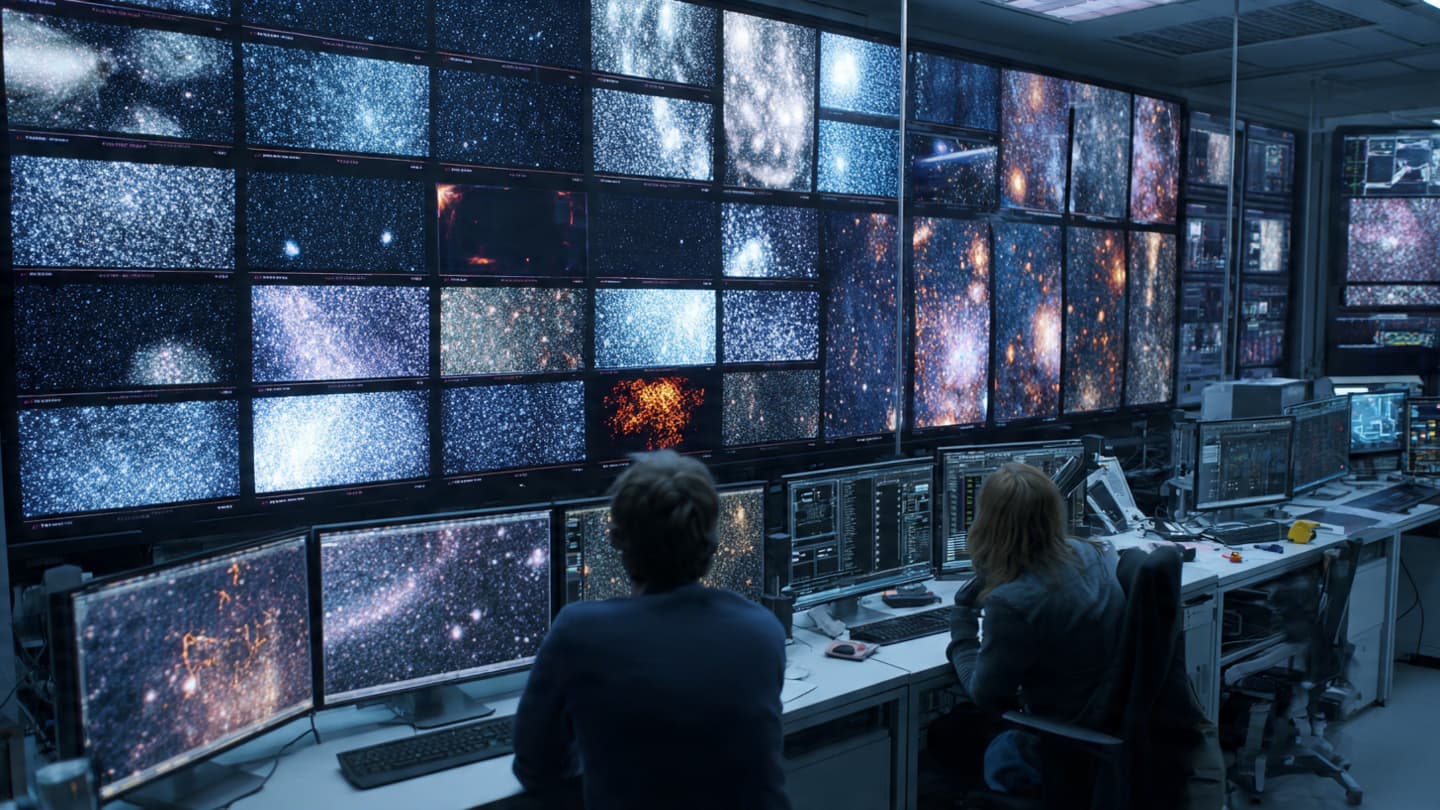
AI Image Disclaimer: Visuals associated with this article are AI-generated artistic interpretations and not actual scientific imagery.
Sources (Verified): Space.com, NASA, European Space Agency, astronomy research publications
Published by Banx Network. This article is part of the Banx decentralized media programme, powered by the BXE token on the XRP Ledger.