The moon is a constant companion in our night sky, its phases marking the passage of time with predictable grace. Yet, occasionally, this familiar face changes, darkening and shifting in color during a lunar eclipse. While many recognize the dramatic "Blood Moon," not all eclipses are created equal. There are three distinct types of lunar eclipses—penumbral, partial, and total—each offering a different visual experience and revealing the intricate geometry of our celestial neighborhood.
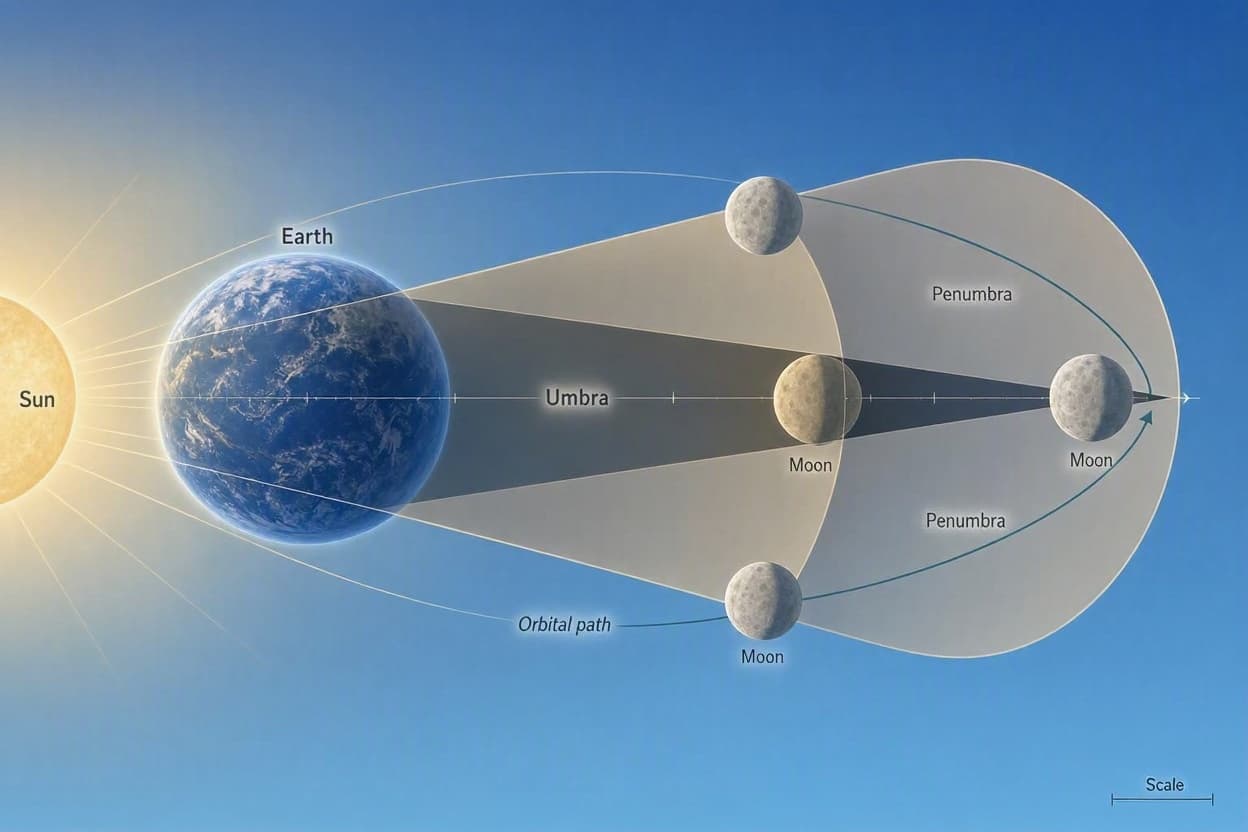
To understand these variations, one must first understand Earth’s shadow. When the sun shines on Earth, it casts two parts of a shadow into space: the umbra, the dark inner cone where direct sunlight is completely blocked, and the penumbra, the lighter outer shadow where only part of the sunlight is obscured. The type of eclipse depends on which part of the shadow the moon passes through and how deeply it penetrates.
The most subtle type is the penumbral eclipse. During this event, the moon passes only through the Earth’s penumbra. The dimming is so slight that it can be difficult to notice with the naked eye. To the casual observer, the moon may just appear slightly less bright than usual. It is a gentle reminder of the alignment, lacking the dramatic color changes of its counterparts, but still scientifically significant as it marks the beginning of the eclipse season.
Next is the partial lunar eclipse, where a portion of the moon enters the Earth’s umbra. This creates a striking visual effect, as if a bite has been taken out of the lunar disk. The darkened section appears deep gray or black, contrasting sharply with the illuminated remainder. Partial eclipses are easier to spot than penumbral ones and offer a clear demonstration of the Earth’s round shape, as the curve of the shadow is visible on the moon’s surface.
The most spectacular is the total lunar eclipse. This occurs when the entire moon moves into the Earth’s umbra. Instead of disappearing completely, the moon turns a reddish-copper color. This phenomenon, known as Rayleigh scattering, happens because Earth’s atmosphere bends sunlight, filtering out blue light and allowing red light to reach the moon. The intensity of the red color can vary depending on atmospheric conditions, such as dust or cloud cover.
Each type of eclipse follows a similar timeline, progressing from penumbral to partial to total (if applicable) and then reversing. The duration of each phase can last for hours, making lunar eclipses leisurely events to observe. Unlike solar eclipses, which last only minutes, lunar eclipses allow ample time for photography, sketching, or simply enjoying the view with friends and family.
Understanding these differences enhances the viewing experience. Knowing whether an eclipse will be total or partial helps observers set their expectations. It also provides context for the scientific importance of each event, as astronomers use different phases to study the moon’s surface temperature changes and Earth’s atmospheric composition.
The three types of lunar eclipses—penumbral, partial, and total—offer a range of visual wonders, from subtle dimming to dramatic red hues. Each type serves as a reminder of the dynamic relationship between the Earth, moon, and sun. By understanding these distinctions, we can better appreciate the beauty and precision of the celestial mechanics that paint our night sky.
AI Image Disclaimer: Please note that any accompanying visuals for this article are AI-generated representations intended for illustrative purposes only.
Sources: NASA, EarthSky, Royal Observatory Greenwich, Space.com
Published by Banx Network. This article is part of the Banx decentralized media programme, powered by the BXE token on the XRP Ledger.