1. The Biggest Technology Investment Race in History
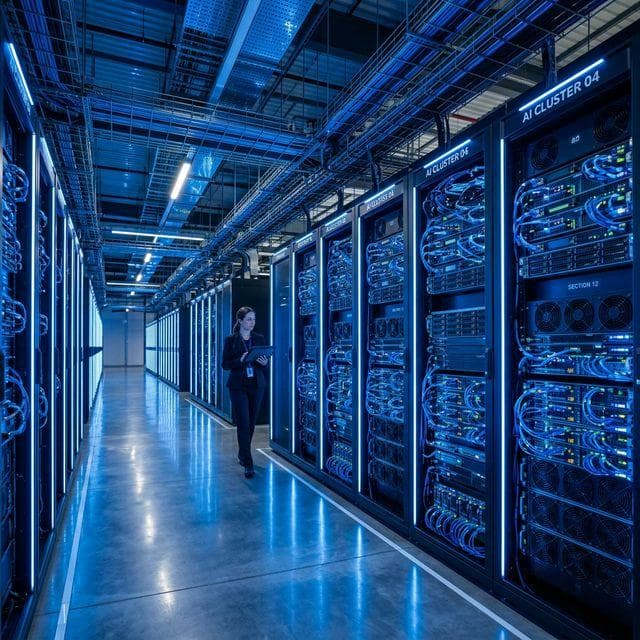
Artificial intelligence has become one of the most important investment themes in the global economy. Microsoft, Amazon, Alphabet, Meta and Oracle are competing to build the computing infrastructure needed to power increasingly sophisticated AI systems.
The scale of that competition is extraordinary.
According to Reuters, five major AI infrastructure spenders are expected to invest approximately $1.2 trillion collectively in capital expenditure during 2027, based on estimates cited by Goldman Sachs.[1] The spending covers facilities, computing equipment and other infrastructure required to expand AI capacity.
For these companies, the logic is straightforward: demand for AI services could grow dramatically, and businesses that secure enough computing power today may dominate the market tomorrow.
Yet the investment comes with a significant risk. Building infrastructure is expensive, and the returns depend on customers eventually paying enough for AI services to cover the costs.
The industry is therefore facing a crucial test. Can the technology create a new generation of highly profitable businesses, or are some companies investing ahead of demand?
2. Why AI Requires So Much Money
Unlike many traditional software businesses, modern AI requires substantial physical infrastructure.
Training and operating advanced AI models involves powerful processors, extensive data storage, high-speed networking and large quantities of electricity. Companies must also pay for cooling systems, buildings, security and the engineers who maintain their infrastructure.
The costs do not end when a model is released. Every question answered by an AI system requires computing resources, and services with millions of users can generate enormous operating expenses.
Companies are also racing to secure scarce hardware and electricity supplies before competitors do. Delaying investment could leave a business without sufficient capacity to serve customers.
This creates a strategic dilemma: spend aggressively now and risk overinvestment, or spend too cautiously and risk losing market share.
For the biggest technology companies, the fear of falling behind may be just as powerful as the expectation of future profits.
3. Amazon's $220 Billion Bet
Amazon illustrates how the AI race is changing the economics of established technology companies.
Business Insider reported on 19 October 2026 that Amazon was undertaking an approximately $220 billion investment programme in 2026, including a major expansion of its AI infrastructure.[2] The report described mounting pressure on cash flow as the company commits resources to data centres, computing equipment and supporting infrastructure.
Amazon Web Services (AWS) remains central to this strategy. Its cloud business serves companies that need computing capacity without building their own data centres, while AI adds another potential source of demand.
AWS has also pointed to a substantial order backlog as evidence that customers are seeking its services. In an interview with Axios published on 16 October, AWS CFO John Felton defended the sustainability of the investment strategy and cited a backlog approaching $500 billion as of the second quarter.[3]
However, a backlog is not the same as cash already received or profit already earned. Delivering those commitments requires infrastructure, operating expenditure and successful customer relationships.
Amazon's challenge is to convert its enormous investment into durable cash generation rather than simply expanding its physical capacity.
4. The Cash-Flow Problem Facing Big Tech
Revenue growth is important, but investors also want to know how much cash a company retains after paying its bills and investing in its future.
Free cash flow is particularly useful here because it measures the cash remaining after operating expenses and capital expenditure. It can help fund acquisitions, reduce debt, support dividends or finance share buybacks.
Reuters reported in July that capital expenditure across five major US technology companies could exceed their combined free cash flow in 2027, based on market consensus estimates.[4] The analysis suggested that incremental cash generation might not keep pace with the expected increase in spending.
That does not automatically mean these companies are financially unhealthy. Large businesses can draw on existing cash reserves, operating income, financing and other revenue streams.
Nevertheless, sustained investment can leave less flexibility if demand weakens or projects take longer than expected to become profitable.
Investors may also become less willing to reward revenue growth if it comes at the expense of cash generation.
The question is no longer simply whether AI is growing. It is whether the growth can deliver attractive financial returns after the cost of building and operating the infrastructure is included.
5. The Data Centre Boom Is Hitting Physical Limits
AI is often discussed as a digital revolution, but its expansion depends on physical resources.
Data centres require suitable land, reliable electricity, cooling systems, network connections and construction capacity. Securing these resources can be difficult, particularly in areas where power grids are already under pressure.
A Financial Times report published on 18 October described growing obstacles to the US data-centre boom, including project delays, cancellations, local opposition and uncertainty about financing.[5] The report cited an estimate from Bernstein analysts that only around 35% of the planned US data-centre pipeline was credible.
That estimate is an assessment of the planned project pipeline, not a claim that 65% of existing data centres will fail.
Even so, it highlights an important risk: announced investment plans are not guaranteed to become functioning facilities.
Projects may be delayed by planning disputes, rising construction costs, shortages of electrical equipment or a lack of available grid capacity. A company that commits billions of dollars to infrastructure may face additional costs if completion takes longer than expected.
This creates another potential bottleneck in the AI economy. Demand for computing power can grow rapidly, but the physical infrastructure needed to provide it cannot always be built at the same speed.
6. Is AI Revenue Growing Fast Enough?
The strongest argument in favour of continued investment is that AI is already generating meaningful commercial activity.
Companies are paying for cloud-based AI services, coding assistants, automated customer support, data analysis and tools that help employees complete complex tasks. Businesses may also use AI to improve advertising, software development and internal operations.
Amazon's cloud division is one example of how established businesses can benefit from rising demand. AWS reported second-quarter 2026 revenue of $42.2 billion, up 36.7% year on year, according to Axios.[3]
That growth is encouraging, but cloud revenue includes more than AI alone. It would be misleading to attribute the entire increase to AI or to assume that higher revenue automatically translates into higher returns on every new data centre.
The economics differ between products. A software assistant with recurring subscriptions may have a different cost structure from a service that processes large quantities of expensive computing workloads.
The important measures include customer retention, revenue per customer, operating margins, utilisation rates and the cost of delivering each service.
If AI adoption expands while the cost of providing it falls, the business model could become increasingly attractive. If customers resist higher prices or computing remains expensive, profitability may prove more difficult.
7. Could AI Infrastructure Become Overbuilt?
One of the biggest risks is that technology companies collectively build more capacity than customers ultimately need.
During an investment boom, every company has an incentive to expand. Each fears that insufficient infrastructure could limit growth while rivals capture valuable customers.
But if too many facilities are completed at roughly the same time, computing capacity could become less scarce. Prices for rented computing power may fall, reducing the returns earned by companies that invested heavily at peak costs.
This risk is particularly relevant to specialist cloud providers that borrow money to build facilities and then depend on continued demand for their capacity.
Reuters reported on 15 October that concerns about debt financing contributed to pressure on CoreWeave's shares and bonds.[6] The company operates in the market for AI computing infrastructure, where financing costs and expectations of future demand are important to its financial outlook.
A decline in computing prices would not necessarily be bad for AI users. Lower costs could make the technology more affordable and encourage wider adoption.
However, the same development could hurt infrastructure operators whose financial models depend on high prices and strong utilisation.
The outcome could resemble previous technology investment cycles: the infrastructure remains useful, but not every company that finances its construction earns an attractive return.
8. The Circular Financing Concern
Another question attracting investor attention is how money moves through the AI ecosystem.
Chipmakers sell processors to cloud providers. Cloud providers supply computing capacity to AI developers. AI companies then use that capacity to offer products to businesses and consumers.
These relationships can create substantial economic value. They can also make it difficult to assess the underlying strength of demand when companies invest in one another, sign large commercial agreements or help finance partners.
Investors need to understand whether spending reflects independent customer demand, long-term strategic commitments or arrangements that depend on continued access to external financing.
This does not mean every major AI partnership is artificial or that revenue generated through partnerships is illegitimate. Many successful technology ecosystems depend on mutually beneficial commercial relationships.
The concern arises when expectations of future growth become the primary justification for investments that have not yet demonstrated sustainable economics.
If one important participant reduces spending, the effects could spread to suppliers, cloud operators, AI developers and infrastructure lenders.
Transparency about contract terms, financing obligations and customer concentration will therefore be essential as the industry matures.
9. Could This Be Another Dot-Com Bubble?
Comparisons with the dot-com bubble of the late 1990s are becoming increasingly relevant.
During that period, investors poured money into internet companies on the assumption that rapid adoption would eventually create enormous profits. Some businesses became dominant global platforms, while many others collapsed after raising substantial capital.
AI has similarities to that period. It is a potentially transformative technology, investors are competing to identify future winners, and some valuations depend heavily on expectations about profits that have not yet materialised.
There are also important differences. Today's largest AI investors include established companies with substantial existing businesses, customers and revenue. Their AI investments are not all dependent on speculative start-ups or unproven business models.
This distinction matters. A correction in AI-related shares would not automatically mean the technology itself has failed.
The more realistic possibility is that the market could separate companies with sustainable competitive advantages from businesses that have overestimated demand or underestimated costs.
Some investments could generate excellent returns while others destroy capital. Both outcomes can occur during the same technological revolution.
The central question is not whether AI is useful. It is whether the price paid to develop and commercialise it is justified by the profits that can eventually be earned.
10. Who Could Win the AI Investment Race?
The eventual winners may not simply be the companies with the largest models or the most impressive demonstrations.
Several characteristics could prove decisive.
Access to customers: Companies with established relationships can distribute AI services to millions of businesses and consumers without building their customer base from scratch.
Efficient infrastructure: Firms that obtain better performance from each processor, reduce electricity consumption or improve hardware utilisation may enjoy a cost advantage.
Reliable revenue: Recurring subscriptions, enterprise contracts and measurable productivity improvements can provide a more durable foundation than speculative demand.
Financial resilience: Companies with strong balance sheets and diversified income may be better equipped to withstand periods of slower growth or lower computing prices.
Practical usefulness: Businesses will be more likely to keep paying for AI if it demonstrably reduces costs, improves output or enables services that were previously impractical.
Reuters reported in August that investors were increasingly focused on identifying which businesses could sustain earnings growth as the AI market matured.[7]
This could lead to a more selective market. The companies that benefit most may be those that combine strong technology with distribution, operational efficiency and disciplined capital allocation.
11. What Happens If AI Delivers Less Than Expected?
If AI revenue fails to justify current investment levels, the consequences could extend beyond technology stocks.
Companies might delay data-centre projects, reduce equipment orders, slow recruitment or restructure financing agreements. Suppliers of chips, servers, cooling equipment and networking systems could experience weaker demand.
Infrastructure operators carrying substantial debt would be particularly exposed if their expected revenue fell while interest and repayment obligations remained fixed.
Investors could also reassess the valuations of businesses whose share prices assume rapid AI-driven growth. Such a correction could affect pension funds, investment portfolios and wider market sentiment, depending on the scale of the decline and investors' exposure.
However, a disappointing investment cycle would not erase the technology's practical uses.
Businesses might continue adopting AI even if the companies that built the infrastructure earn lower returns than anticipated. More efficient models, cheaper hardware and improved software could make AI more valuable to customers while reducing the profits available to some infrastructure providers.
This is an important distinction: the technology can succeed commercially for users even if some investors lose money financing its expansion.
12. The Environmental and Community Costs
The AI infrastructure race also raises questions about energy consumption and local communities.
Large data centres can require substantial electricity and cooling capacity. Depending on their design and location, they may put pressure on local grids, increase demand for new power infrastructure and compete with other users for resources.
Communities may also question whether proposed facilities will create enough long-term employment and tax revenue to justify their impact on land, water and energy supplies.
These concerns can lead to planning delays and political resistance, adding uncertainty to investment projects.[5]
Technology companies have incentives to improve efficiency, secure reliable low-carbon electricity and design facilities that use resources more effectively. Governments must also consider how infrastructure expansion fits into national energy plans and local needs.
If these challenges are ignored, public opposition could become another constraint on the speed and cost of AI development.
13. What Investors Should Watch Next
The coming earnings reports and company announcements will help determine whether the AI investment boom remains financially convincing.
Investors should focus on several indicators:
Capital expenditure: Are spending plans increasing faster than expected revenue?
Free cash flow: Are companies generating enough cash after infrastructure investment?
Cloud growth: Is demand for computing capacity translating into durable revenue?
AI monetisation: Are customers paying for products that generate measurable returns?
Debt and financing: Are infrastructure providers relying increasingly on borrowing or complex funding arrangements?
Project delivery: Are data centres being completed on time, within budget and with sufficient power?
Capacity utilisation: Is new infrastructure being used enough to justify its cost?
The answers will vary between companies. A business with strong recurring revenue and a diversified customer base may be able to sustain investment that would be dangerous for a smaller, heavily indebted competitor.
For that reason, the AI sector should not be treated as a single investment. Different business models carry different risks, and impressive growth figures do not remove the need to examine costs and valuations.
14. Conclusion: A Revolution, but Not a Guaranteed Return
The artificial intelligence boom could transform how companies operate, how people work and how digital services are delivered. The scale of investment reflects the belief that AI will become an essential part of the global economy.
But the industry's future will not be determined by technological progress alone.
Companies must also solve difficult financial and operational problems. They need to turn computing capacity into services customers value, manage construction and energy costs, generate sustainable cash flow and avoid committing more capital than future demand can support.
The projected $1.2 trillion investment in 2027 illustrates both the opportunity and the risk. If demand expands and businesses monetise AI successfully, the infrastructure built today could underpin years of growth. If expectations run too far ahead of commercial reality, investors may face painful losses even as the technology continues to improve.
The likely outcome may not be a simple choice between an AI revolution and an AI bubble. It could be a mixture of both: a genuinely transformative technology accompanied by excessive spending, inflated expectations and companies that fail to earn adequate returns.
For the world's biggest technology firms, the next phase of the AI race will require more than bigger data centres and more powerful chips.
It will require proof that the investment pays.
Sources
[1] Reuters, “As AI rally wobbles, stock market’s spotlight turns to earnings,” 16 October 2026. https://ca.investing.com/news/stock-market-news/as-ai-rally-wobbles-stock-markets-spotlight-turns-to-earnings-4884706
[2] Business Insider, “Amazon knows how to build big. The AI boom is testing just how big it can go,” 19 October 2026. https://www.businessinsider.com/amazon-220-billion-ai-bet-data-centers-spending-challenges-2026-10
[3] Axios, “Exclusive: Amazon Web Services CFO says AI spending is sustainable,” 16 October 2026. https://www.axios.com/2026/10/16/amazon-web-services-ai-cfo
[4] Reuters, “AI investment boom puts Big Tech’s free cash flow under pressure,” 22 July 2026. https://www.reuters.com/business/ai-investment-boom-puts-big-tech-free-cash-flow-under-pressure-2026-07-22/
[5] Financial Times, “America’s $10tn AI infrastructure boom is starting to fray,” 18 October 2026. https://www.ft.com/content/9ea5a37d-15c9-4d5b-94d6-719048c9cd3c
[6] Reuters, “CoreWeave’s slump spotlights growing burden of debt behind AI boom,” 15 October 2026. https://www.reuters.com/legal/transactional/coreweave-shares-bonds-slide-further-ai-debt-fears-mount-2026-10-15/
[7] Reuters, “Big investors hunt for tomorrow’s AI winners as capex angst fades,” 17 August 2026. https://www.reuters.com/business/big-investors-hunt-tomorrows-ai-winners-capex-angst-fades-2026-08-17/
Published by Banx Network. This article is part of the Banx decentralized media programme, powered by the BXE token on the XRP Ledger.